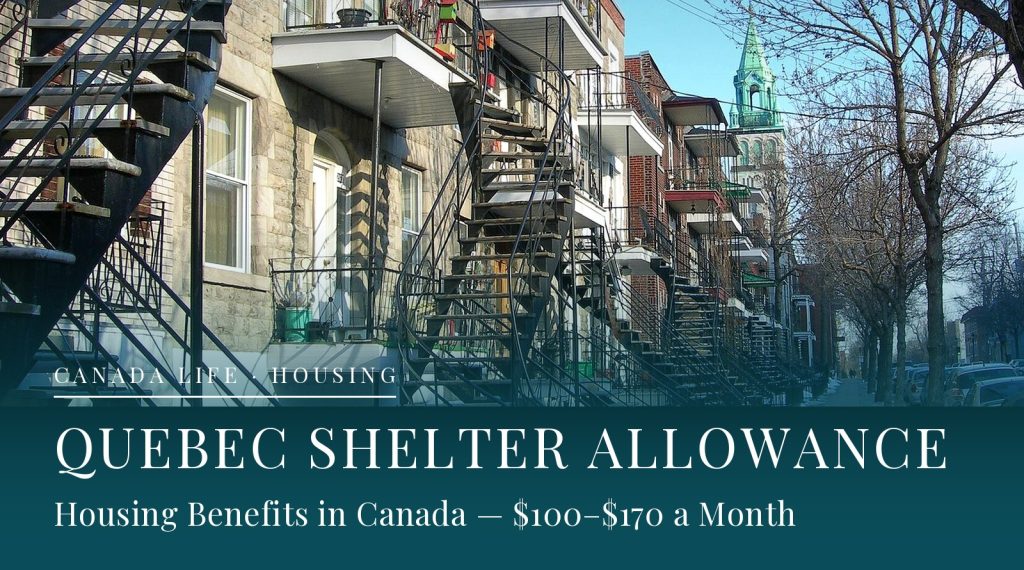
Housing Benefits in Canada — Quebec’s Shelter Allowance Pays $100–$170 a Month: Eligibility, How to Apply, and How Other Provinces Compare
Last updated: November 7, 2026
Search for help with rent in Canada and the first name that comes up is the Canada Housing Benefit (CHB). Try to apply under that name, though, and you hit a wall — because there is no single, Canada-wide application window for rent support. The CHB is simply the name of the money Ottawa sends down to the provinces; the actual applications and payments happen province by province, under completely different names and rules. Quebec is the most distinctive case of all: the federal CHB money didn’t create a new program there — it went into growing the province’s existing shelter allowance, the Allocation-logement. This guide walks through how the CHB actually works, Quebec’s three layers of housing support (the shelter allowance, the rent supplement, and low-rent housing), how other provinces compare, and who qualifies as a newcomer or temporary resident — all from federal and provincial sources, checked in November 2026.
THE SHORT VERSION
- The Canada Housing Benefit isn’t a benefit you apply for — it’s funding Ottawa sends to the provinces. You always apply to your province or local housing agency
- If you live in Quebec, there is exactly one door: the Allocation-logement. Depending on how much of your income goes to housing, you receive a flat $100, $150 or $170 a month (for the October 1, 2026 – September 30, 2027 period, assessed on your 2025 income)
- The biggest help comes from supply-side programs like Quebec’s PSL and HLM, which cap your rent at 25% of your income — but the waits are long and the bar is high
- For newcomers and temporary residents, Quebec’s Allocation-logement has the widest door: its published eligibility rules include no citizenship or permanent-residence requirement. Living in Quebec and filing Quebec taxes are the real gateways
🏛️ 1. The Canada Housing Benefit — Funding, Not a Front Desk
The CHB is one pillar of the National Housing Strategy announced in 2017. It was designed as a $4 billion program over 2020–2028 — $2 billion federal, matched by $2 billion from the provinces and territories — with a goal of supporting 300,000 households by 2027–28, at an average of roughly $2,500 per household per year (figures from CMHC’s National Housing Strategy documents).
Here’s how it flows. The federal government (through CMHC) signs a bilateral agreement with each province or territory and sends the money down; each province then pays it out under its own program name. So the same CHB dollars become the COHB in Ontario, the Canada-BC Housing Benefit in British Columbia, the Rent Assistance Benefit in Alberta, and the Saskatchewan Housing Benefit in Saskatchewan. The CHB is not a federal benefit you apply for through the CRA. The application point is always your provincial government or local housing agency.
Quebec took a different road. It signed its own agreement (the Canada-Quebec Housing Agreement, signed October 6, 2020, worth roughly $3.7 billion over 10 years), and an annex to that agreement earmarked the federal CHB contribution — $454.3 million — not for a new program, but to strengthen the existing Shelter Allowance Program, the Allocation-logement. The full enhancement package is worth more than $1.1 billion (Quebec $684 million + federal $454 million), according to the joint Canada–Quebec announcement of August 13, 2021. Revenu Québec’s official guide (IN-165) also states plainly that the program is funded by the SHQ (Quebec’s housing corporation) and the CMHC.
The takeaway fits in one line: if you live in Quebec, there is no separate “Canada housing benefit” to apply for. Applying for the Allocation-logement is how you receive the CHB in Quebec.
One note: the “$500 one-time housing top-up” and the question of whether the shelter allowance is taxable come up often in searches, but we couldn’t confirm either point in official sources within the scope of our research — so this guide doesn’t state them as fact either way.
🧱 2. Quebec’s Three Layers — Cash, Rent Supplement, Public Housing
Quebec’s housing support comes in three layers with very different mechanics: a layer that gives some cash back, a layer that pins your rent itself to 25% of your income, and a layer where you move into public low-rent housing. The first step is figuring out which layer fits your situation.
| Feature | Allocation-logement (shelter allowance) | PSL (rent supplement) | HLM (low-rent housing) |
|---|---|---|---|
| Type | Flat cash support | Tops up the rent gap in private rentals | A unit in public low-rent housing |
| What you pay | Your rent as-is, with part reimbursed | Fixed at 25% of income | 25% of income (heating included) |
| Apply to | Revenu Québec | Your local housing office (office d’habitation) | Your local housing office (office d’habitation) |
| Wait | None (paid if eligible, retroactive) | Yes (limited supply) | Long (months to years) |
| Immigration status | No citizenship requirement (see section 7) | Centred on citizens and permanent residents | Citizenship or permanent residence required |
💰 3. Quebec’s Shelter Allowance — Eligibility and Amounts ($100/$150/$170 a Month)
The Allocation-logement is Quebec’s flagship cash support for housing costs: the SHQ funds it, and Revenu Québec handles the applications and payments. The figures below apply to the October 1, 2026 – September 30, 2027 period, and eligibility is assessed on your 2025 income (Revenu Québec’s official eligibility and payment pages, viewed November 2026).
Eligibility — you must meet every condition
- You live in Quebec
- You were not tax-exempt in 2025. This condition screens out tax-exempt statuses such as diplomats
- You or your spouse own your home, rent an eligible dwelling (a room, apartment, or house), or pay rent to someone you live with. It’s not renters-only — homeowners can apply too
- You or your spouse has a dependent child, or turns 50 or older by September 30, 2027. Either one is enough. Conversely, a single person or couple under 50 with no children is not eligible
- If you were living in Quebec on December 31, 2025, you must have filed your 2025 Quebec tax return; if you weren’t in Quebec that day, you prepare a return and attach it to your application
- As of December 31, 2025, your and your spouse’s bank accounts, TFSA (CELI) and investments total $50,000 or less (registered accounts such as RRSPs, and the FHSA (CELIAPP), are excluded from the count)
- You spend at least 30% of your 2025 household income on housing
- Your household income is below the caps in the table below
Some homes are excluded outright. If you already live in an HLM, already receive the PSL rent supplement, or live in a hospital, CHSLD (long-term care home) or rehabilitation centre, you can’t receive the allowance — housing that already gets public support can’t stack a second one (as stated on Revenu Québec’s application form LEX-165).
The amount — a flat rate set by your housing-cost burden, not by your rent
This is the part people most often get wrong. The allowance doesn’t “take a slice off your rent.” The flat amount is set purely by which band your housing costs fall into as a share of household income.
| Housing costs as a share of 2025 household income | Per year (per month) |
|---|---|
| 30% – 49% | $1,200 ($100/month) |
| 50% – 79% | $1,800 ($150/month) |
| 80% or more | $2,040 ($170/month) |
Above the “full-amount” income cap, there’s a phase-out band where every extra dollar of income reduces the annual amount by a dollar, until eligibility disappears entirely at the final cap.
Income caps (based on 2025 household income, Revenu Québec official figures)
| Household type | Cap for the full amount | Final cap in the phase-out band (housing costs ≥ 80% of income) |
|---|---|---|
| Single, age 50+ | $23,600 | $25,640 |
| Couple with no children, one partner 50+ | $33,100 | $35,140 |
| Couple with 1 child / single parent with 1–2 children | $40,600 | $42,640 |
| Couple with 2+ children / single parent with 3+ children | $46,800 | $48,840 |
📝 4. How to Apply — Online or Form LEX-165, and Retroactive Payments
The fastest route is Revenu Québec’s online application through “Mon dossier pour les citoyens” (My Account for Individuals); you can also mail in the paper form LEX-165. Before you start, Revenu Québec’s website offers an eligibility questionnaire that gives you a first read on whether you qualify.
💡 Tip: Run Revenu Québec’s online eligibility questionnaire before you gather any paperwork. With just your household type, income and housing-cost share, it gives you a preliminary yes or no — so you don’t prepare documents for an application that was never going to pass.
Two easy-to-miss rules matter here. First, you must reapply every year. There is no automatic renewal. Receiving it this year doesn’t mean the money keeps coming next year.
Second, finding out late doesn’t cost you. As long as you apply within the period (by September 30, 2027), approved amounts are paid retroactively to October 1, 2026, in a lump with your first payment.
Payment is by direct deposit or cheque, and how often you’re paid can vary with the amount. Approved amounts under $2 are not paid out.
🏠 5. PSL and HLM — Programs That Pin Your Rent to 25% of Income
If the shelter allowance “gives some of it back,” the PSL and HLM actually lower the rent itself. The real benefit is far larger than the allowance — the trade-off is that getting in is hard, and that’s the whole story of these programs.
PSL (Programme de supplément au loyer Québec — the rent supplement program): lets you live in a private rental, a co-op, or a non-profit (OSBL) building while keeping your rent at roughly 25% of your household’s total income. The SHQ (90%) and the municipality (10%) make up the difference to the landlord (Gouvernement du Québec’s official program page). The main stream (Volet 1) requires meeting the same allocation rules as low-rent housing — in practice, the same eligibility screening as the HLM (citizenship or permanent residence, income caps, residency requirements). The exception stream (Volet 2) is for households in five crisis situations — such as domestic violence or losing a home to disaster — who would struggle to meet the standard requirements quickly. You apply through your local office d’habitation, or through the co-op, non-profit or private landlord that manages PSL units; supply is fixed, so waits happen.
HLM (Habitation à loyer modique — low-rent housing): public rental housing funded by the SHQ and run by local housing offices. Rent is 25% of household income (heating included), though electricity, parking and the like can be added on top (Gouvernement du Québec’s official HLM page). The core of eligibility looks like this:
- You are a Canadian citizen or permanent resident living in Quebec
- You lived in Quebec (or in the housing office’s territory) for at least 12 of the 24 months before applying. Places like Montreal require residency within their territory
- Your household income is at or below the cap (PRBI) for your region and household size, you can live independently, and you owe no unpaid debts to a former social-housing landlord
You apply by filing with your local office d’habitation (in Montreal, the OMHM) and joining the waiting list. Waits range from months to years depending on the area and unit size, and you must renew your application every year to stay on the list.
🗺️ 6. Other Provinces at a Glance
For anyone moving out of Quebec — or just comparing — here’s what official sources confirm for the major provinces, in one table. It’s also the clearest illustration of how differently the same CHB money shows up from province to province.
| Province | Program | Monthly support | Key eligibility | How to apply |
|---|---|---|---|---|
| Quebec | Allocation-logement | Flat $100/$150/$170 (burden bands 30/50/80%) | Has a child or is 50+, housing ≥ 30% of income, assets ≤ $50,000, files Quebec taxes | Revenu Québec online (Mon dossier) or form LEX-165; reapply yearly; retroactive |
| Ontario | COHB | Formula-based: (80% of local average market rent or actual housing costs, whichever is higher, capped at 100% of average rent) − 30% of income | Must first qualify for the social housing waitlist; priority groups; tax filing; can’t combine with RGI | Through your local Service Manager (no direct online application) |
| BC | RAP | Gap-filling; existing recipients average about $700 | At least 1 child, gross income ≤ $60,000, assets < $100,000, 12 months in BC | BC Housing; reapply yearly |
| BC | SAFER | Gap-filling; average about $337, minimum $50, eligible rent capped at $1,150 | Age 60+, gross income ≤ $40,000, rent > 30% of income | BC Housing; reapply yearly |
| Alberta | RAB | Gap-filling, based on local benchmarks (no single province-wide cap) | Below local income limits, assets ≤ $25,000, needs assessment | Find Housing → local housing management body |
| Alberta | TRAB | Flat amounts by region and size (e.g., $207–$378), minimum $100, up to 2 years | Working or worked within the last 24 months; 7 metro areas only; assets ≤ $25,000 | Find Housing → local housing management body; first come, first served |
| Saskatchewan | SHB | Flat $210–$390 (rates in effect July 1, 2026) | Housing ≥ 35% of income; income and asset cap tables apply | Saskatchewan Housing Corporation |
BC also has the CBCHB (Canada-BC Housing Benefit) for vulnerable households that fit neither RAP nor SAFER — but you can’t apply for it directly: BC Housing and non-profit housing providers select and invite people from priority groups. Saskatchewan’s SHB is useful as a comparison point because, unlike most provinces that publish only a formula, its flat-rate table is posted in full on the official page.
✈️ 7. Newcomers and Temporary Residents — The Door Depends on Your Status
Housing support is one of the areas of the welfare system where immigration status is examined most strictly. Quebec’s shelter allowance is the exception.
The Allocation-logement eligibility list published by Revenu Québec contains no citizenship or permanent-residence requirement. The conditions are: living in Quebec, not being tax-exempt for the year, having filed Quebec taxes (or filing a return with the application), the household-shape condition (a child, or age 50+), and the asset, income and housing-cost tests. That means someone living in Quebec on a work permit with legal status, who files Quebec taxes, can become eligible if the other conditions are met. The real gateway isn’t the type of immigration document — it’s your tax-filing history and whether you’re tax-exempt. That said, filing taxes effectively requires a social insurance number (SIN), and anyone whose status makes them tax-exempt (certain diplomatic or international-organization statuses, for example) is excluded. For individual cases, the safest check is Revenu Québec’s eligibility questionnaire or a call to 1-855-291-6467.
💡 Tip: File your taxes from your very first year in Quebec. The shelter allowance is just one example — almost every housing program uses tax filing as a shared prerequisite. Your filing history is where eligibility starts.
The PSL’s main stream and the HLM, by contrast, have a citizenship/permanent-residence wall. The HLM’s official eligibility states “Canadian citizen or permanent resident living in Quebec,” with the 12-of-the-last-24-months Quebec residency rule on top — refugee claimants and temporary residents are not eligible. The PSL’s main stream follows the same allocation rules. Its crisis stream (Volet 2), though, is a separate path for households in crisis who can’t meet the standard requirements quickly, so if that’s your situation, it’s still worth asking your local housing office.
Other provinces follow a similar pattern. BC’s RAP and SAFER are open to citizens, permanent residents, government-assisted refugees and refugee claimants, among others — but people still in a private sponsorship period are excluded, and every household member must meet the requirements. Ontario’s COHB presupposes social-housing waitlist eligibility, which verifies the legal status of every household member. Alberta’s RAB and TRAB target citizens, permanent residents, convention refugees, and applicants whose private sponsorship has broken down; temporary foreign workers and international students are generally excluded. We couldn’t confirm Saskatchewan SHB’s immigration-status requirements in its official guidance, so this guide doesn’t state them as settled.
Read as a pattern, it comes down to this: short-term cash benefits have a relatively wider door, while supply-side programs that allocate an actual home narrow to citizenship or permanent residence plus long-term residency. And because the “excluded during a private sponsorship period” rule repeats across provinces, anyone who arrived under a sponsorship should be especially careful.
🇰🇷 8. How It Compares With South Korea’s Housing Benefit
South Korea has a program with the same name. Korea’s Housing Benefit (주거급여) targets households whose recognized income — income and assets combined — is at or below 48% of the standard median income, and it doesn’t look at the income of support obligors such as parents. Renters get help with rent; homeowners get help with repairs — in effect, Quebec’s Allocation-logement (cash) and HLM/PSL (supply-side) folded into a single program. (Figures per Bokjiro and the MyHome portal, 2026.)
| Feature | South Korea — Housing Benefit (2026) | Quebec — Allocation-logement (2026–27 period) |
|---|---|---|
| Income test | Recognized income ≤ 48% of standard median income (1 person: ₩1,230,834/month · 4 people: ₩3,117,474) | Household-type income caps + housing costs ≥ 30% of income + assets ≤ $50,000 |
| How the amount works | The lower of your actual rent and the regional standard rent is the cap (Seoul: ₩369,000/month for 1 person · ₩571,000 for 4) | Flat $100 / $150 / $170 a month by housing-burden band |
| Age gate | None | You must have a dependent child or be 50+ |
| Youth provision | If an unmarried child aged 19 to under 30 from a recipient household lives apart, the youth portion is paid separately | No equivalent provision |
| Applying | Community centre or Bokjiro; paid on the 20th of each month | Revenu Québec; reapply every year; retroactive if you apply within the period |
The mechanics differ, but the direction is the same. Korea “puts a cap on your actual rent,” so the ceiling is higher where rents are expensive, like Seoul. Quebec sets a flat amount from the burden ratio alone — simpler, but the gap to big-city rents is wide. Either way, the first gate isn’t the numbers: it’s whether your tax filings and income documentation are in order.
❓ Frequently Asked Questions
Q. I live in Quebec — can I apply for the Canada Housing Benefit separately?
No. Quebec signed its own agreement with Ottawa and channelled the CHB funding into strengthening the existing Allocation-logement. There is no separate CHB for Quebec residents to apply for; applying for the Allocation-logement is how you receive the CHB in Quebec.
Q. Where and how do I apply for the Canada Housing Benefit?
It’s not a benefit you apply for through the CRA. Ottawa sends the money to the provinces, and each province pays it under its own program name, so you always apply through your own province’s window: Revenu Québec in Quebec, your local Service Manager in Ontario, BC Housing in BC, local housing management bodies in Alberta, and the Saskatchewan Housing Corporation in Saskatchewan.
Q. Who qualifies? What are the conditions?
It varies by province. The common threads: a low-income household, a heavy housing-cost burden, and up-to-date tax filings. Quebec’s allowance adds a household condition — a dependent child or age 50+ — plus the $50,000 asset cap. Supply-side programs that pin rent to 25% of income (Quebec’s HLM, Ontario’s RGI, and the like) also look at citizenship or permanent residence and how long you’ve lived there.
Q. How much do you get? How is the amount decided?
Quebec’s shelter allowance is a flat amount based on the share of household income going to housing: $100/month (30–49%), $150/month (50–79%), $170/month (80%+) — for the October 2026 to September 2027 period, assessed on 2025 income. Other provinces work differently: Ontario’s COHB is formula-based on local average rents and income, BC’s RAP fills the gap (existing recipients average about $700/month), and Saskatchewan’s SHB publishes a flat table of $210–$390/month.
Q. Can you summarize Quebec’s shelter allowance conditions in one place?
You must meet all eight: ① you live in Quebec ② you were not tax-exempt in 2025 ③ you’re a homeowner, a tenant, or someone who pays rent to a person you live with ④ you have a dependent child, or you turn 50 by September 30, 2027 ⑤ you’ve filed your 2025 Quebec taxes ⑥ your bank accounts, TFSA and investments total $50,000 or less ⑦ you spend at least 30% of household income on housing ⑧ your household income is below the cap. Living in an HLM or receiving the PSL excludes you.
Q. Where do I get the application form for Quebec’s shelter allowance?
The paper form is Revenu Québec’s LEX-165. But you can apply online, and applying through “Mon dossier pour les citoyens” on Revenu Québec’s site is the fastest route. Before applying, you can gauge your eligibility with the questionnaire on their website.
Q. Can I apply online?
For Quebec’s shelter allowance, yes — Revenu Québec takes online applications. Ontario’s COHB is different: it’s not something you apply for directly on a provincial portal; you go through your local Service Manager. The window differs by province, and there’s no single “apply online” button that ends the story — that’s a defining feature of this benefit.
Q. Can I estimate my amount in advance?
Revenu Québec’s website has an eligibility questionnaire, so you can gauge whether you qualify before applying. The amount itself is simple in structure: if housing was 30–49% of your 2025 household income, it’s $100/month; 50–79%, $150/month; 80% or more, $170/month — if you know your ratio, you can read it straight off the table. That said, the income caps and phase-out bands vary by household type, so your final amount is set by the assessment.
Q. How is Quebec’s rent supplement (PSL) different from the shelter allowance?
The shelter allowance is cash: you pay your rent in full, then get a flat $100–$170/month back. The PSL adjusts the rent itself to about 25% of your household’s total income even in a private rental, with the SHQ and the municipality covering the difference to the landlord — a much bigger effective subsidy. The trade-offs: PSL supply is limited, so there’s a wait, and the main stream goes through HLM-level screening (centred on citizens and permanent residents). The windows differ, too: Revenu Québec for the allowance, your local office d’habitation for the PSL.
Q. Can I receive it without permanent residence (work permit, temporary resident)?
For Quebec’s shelter allowance, the door is open. Revenu Québec’s published conditions include no citizenship or permanent-residence requirement; living in Quebec, filing Quebec taxes, and not being tax-exempt are the core conditions. Someone living in Quebec on a work permit who files taxes can become eligible if the other conditions (a child or age 50+, the asset, income and housing-cost tests) are also met. The HLM, the PSL’s main stream, and most supply-side programs, by contrast, are built around citizens and permanent residents. For an individual decision, the safe route is Revenu Québec’s eligibility questionnaire or a call to 1-855-291-6467.
So here’s the order of operations. If you live in Quebec, have a child or are 50 or older, and your taxes are filed, start with the Allocation-logement at Revenu Québec before any other program. You do have to reapply every year, but apply within the period and it’s retroactive. If your rent burden is extreme and you hold permanent residence or higher, it’s also worth registering on the HLM waitlist and asking about the PSL at your local office d’habitation. And in every province, filing your taxes every year is the shared prerequisite for almost all housing support. Programs and amounts are renewed annually (Quebec’s allowance every October), so right before you apply, check the current period’s rules once more on the agency’s official page.
You May Also Like
[Link placement — Canada Child Benefit guide: https://laviebyj.com/life-tips/canada-child-benefit-explained/ ]
[Link placement — Canada Pension × Korean National Pension guide: https://laviebyj.com/life-tips/canada-korea-pension-totalization/ ]
— J.
📋 §5 Format Checklist (Draft Only — Remove Before Publishing)
| Item | Standard | This draft |
|---|---|---|
| Red key phrases | 10+ for money/information posts, max 1 per paragraph | 12 (measured by validate_format.py; per-paragraph max 1) |
| Blue tips | 1–3 | 2 (§4 eligibility questionnaire · §7 file taxes from your first year) |
| H2 orange | Every H2, each with 1 emoji | Applied to all H2s (9 body sections + FAQ + this checklist) |
| FAQ sources | Answerable questions from the top-questions file | 10 of the 14 shortlisted in housing-top-questions-2026-11-06.md (original #1·2·3·4·6·7·8·9·11·12). #13 ($500 one-time top-up) and #14 (whether the allowance is taxable) are not covered in the research, so they’re excluded from the FAQ and handled in §1 without asserting either way |
| Sources | research-rentbenefit-ca-2026-11-04.md only; nothing outside the research | All figures checked against the research file. Saskatchewan SHB’s immigration-status requirements could not be confirmed in official guidance, so §7 states that without asserting them. The Korea comparison (§8) uses the 2026-11-06 mini-research (research-kr-housing-benefit-mini-2026-11-06.md — Ministry of Land notice No. 2025-506, cross-checked against Bokjiro figures) |
| Reference dates | Match the Korean master | Quebec allowance: Oct 1, 2026 – Sep 30, 2027 period, assessed on 2025 income (Revenu Québec official). Saskatchewan SHB: rates in effect July 1, 2026. BC RAP/SAFER: April 2025 standards |
| Tables | lbj-guide-table wrapper | 4 tables (Quebec three-layer comparison · burden-band amounts · income caps · province comparison) plus the §8 Korea comparison table, wrapped like the Korean master |
Get the Free Canada Savings Checklist
Join the newsletter — get the free PDF checklist and weekly Canada savings tips in your inbox.
Read Next


Some links in this post are referral or affiliate links. If you sign up or buy through them, I may receive a bonus or commission at no extra cost to you. It helps keep this blog running — thank you!