Tonight, the Aurora May Reach Montréal — Seeing the Northern Lights in Canada Without Going to Yellowknife
Imagine this: last night, the aurora lit up the sky over Montreal — and you found out the next morning, from photos on your neighbourhood’s social media. Wouldn’t that sting? Hi, I’m J. The northern lights aren’t something you can only see by travelling far away, to Yellowknife or Iceland. On nights when the aurora pushes far to the south, it can appear in the sky right over your own neighbourhood tonight.
The catch: those nights come only once or twice a year, and they arrive unannounced. Sleep through, and the night is gone. So this post asks one question — how do you know that night is coming? The answer is checking the aurora in real time. There are apps and sites, a surprising number of them, so here’s what to look at, and in what order.
THE SHORT VERSION
- For tonight’s chances, check the NOAA 30-minute aurora forecast and your location’s probability in an app — a few days out, use the 3-day Kp forecast
- Montréal’s line is Kp 6 and up — Kp 5 can mean a low glow on the northern horizon from a dark spot, Kp 7 or more can spread overhead
- The key to not missing it is alerts — turn on an app’s push notifications and your phone tells you first on storm nights
- The last gate is clouds — a good aurora forecast means nothing under cloud cover. Check clouds on the weather radar
🌌 Why don’t you have to go all the way to Yellowknife?
Here’s the heart of it — that band sometimes, just sometimes, bulges far down to the south. The aurora appears under a ring (the auroral oval) centred on the north pole. Normally that ring sits over northern Canada, which is what makes northern towns like Yellowknife the classic viewing spots.
But on nights of strong solar activity, the ring swells and pushes far south. When its reach touches southern Canada, people living as far south as Montreal can meet the aurora in their northern sky. Living in Canada, you get a chance like that once or twice a year — no trip to Yellowknife required.
One more thing: the aurora doesn’t have to be directly overhead to be visible. According to NOAA, a bright aurora can be seen from as far as 1,000 km away. Even if it never reaches the sky above you, a band of light hanging beyond the northern horizon is a sight in itself.
And the timing isn’t bad right now. Solar activity rises and falls on an 11-year cycle, and this cycle is still active past its peak, so nights when the aurora reaches the south come more often than usual. In the end it comes down to one thing: knowing that night in advance.
🌠 Does it really come this far south? Nights it actually happened
You’d be forgiven for doubting it, but this isn’t just a far-north story. In the last few years there have been nights when the aurora genuinely came down over Montreal and the skies of southern Quebec and Ontario. Here are the ones with dates on record.
May 10, 2024 — the strongest night (G5). The strongest solar storm since 2003 hit that night. The Canadian Space Agency officially released an aurora timelapse filmed in Boucherville, right next door to Montreal. Local coverage gathered aurora photos taken across Montreal, too.
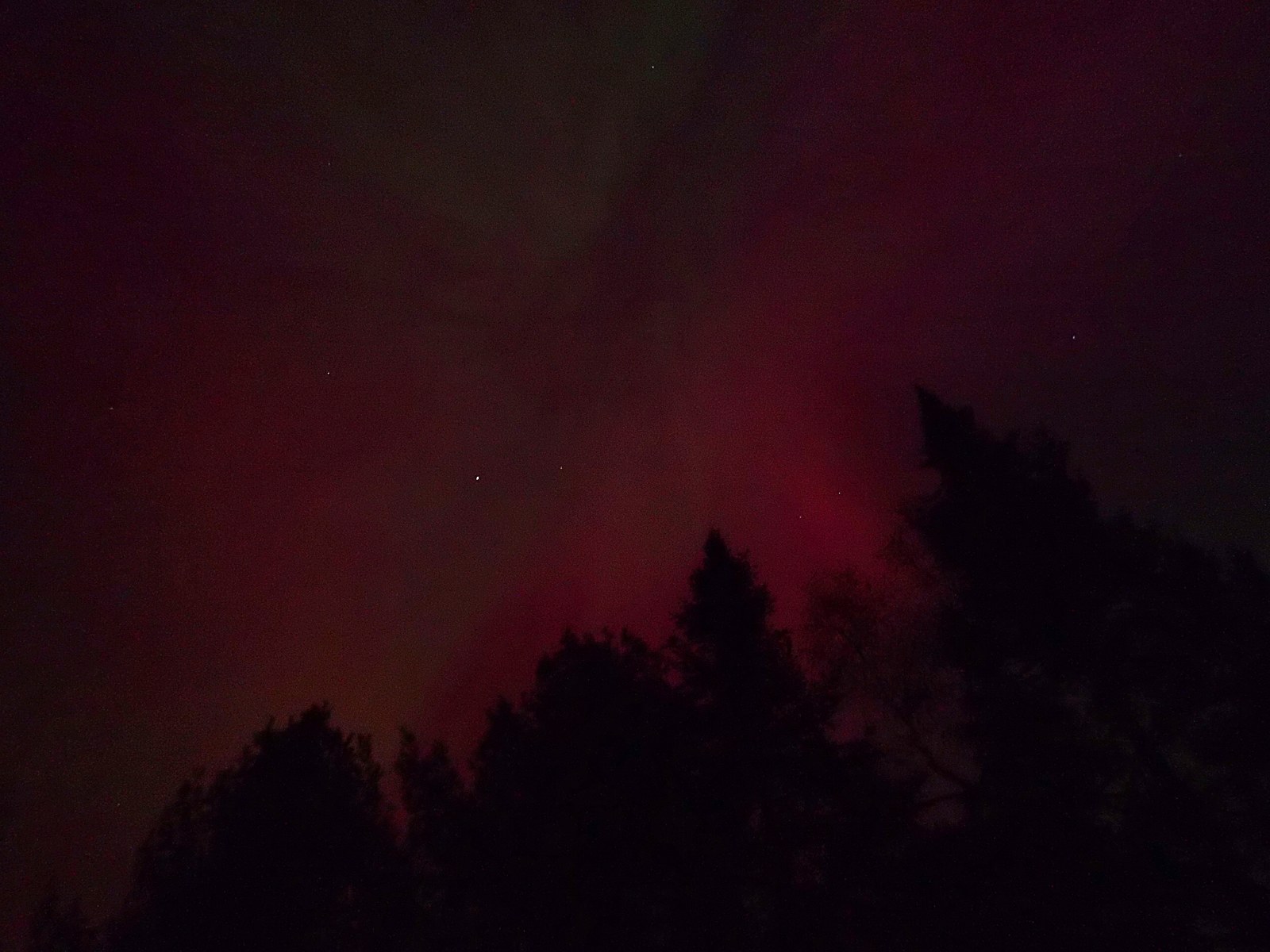
That night, a Montreal photographer wrote: “I thought the aurora was something you had to travel to see — that weekend, the aurora came to our house.” Even from a home in the west of the city it was faintly visible to the naked eye, and much clearer on camera. There’s also a record of someone seeing the aurora from Montreal again that night for the first time in 35 years — since the storm that caused the great Quebec blackout of 1989.
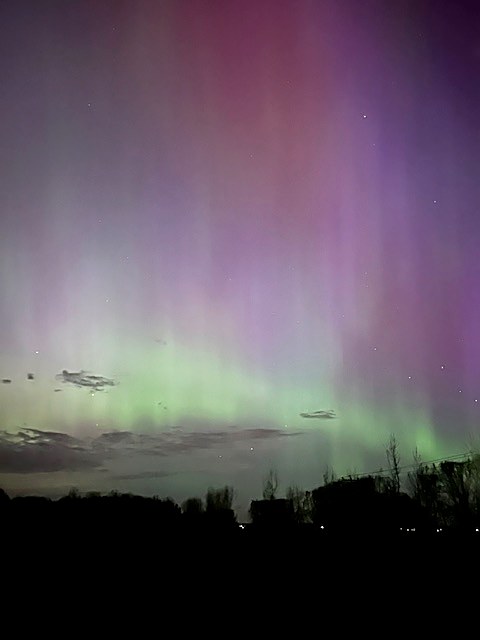
October 10, 2024 — all the way to Quebec City and Ottawa (G4). The second-biggest storm of that year. In Quebec City, a photo of the aurora dancing over the Cap-Rouge railway bridge was picked as a “best image of the night” by an international astronomy magazine, and a red aurora was photographed at a lakeshore outside Ottawa. In Hamilton, in southern Ontario, the aurora climbed right overhead around 10 p.m., and on Pelee Island — the southernmost point in Canada — the sky filled with aurora.
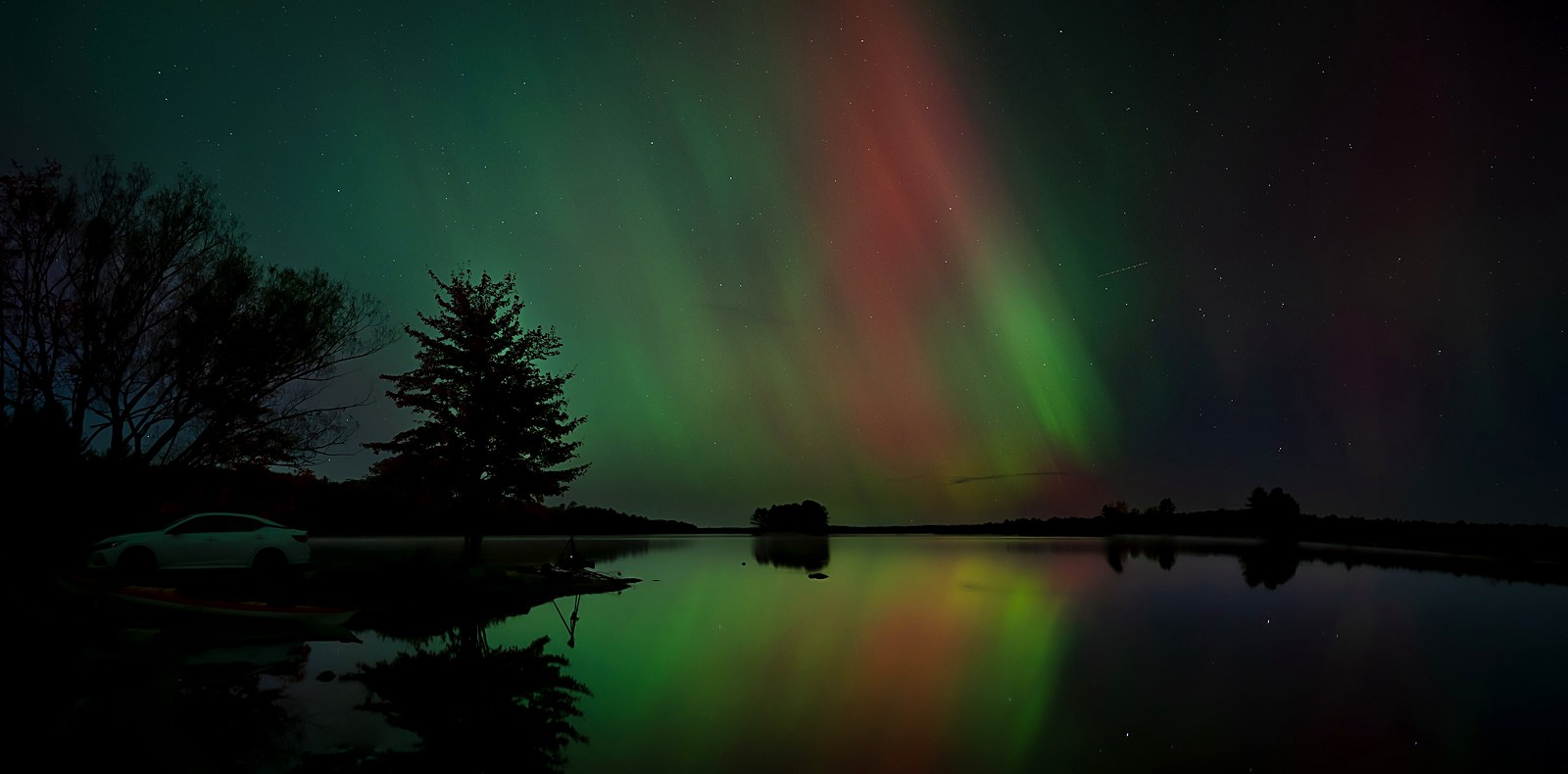
November 11, 2025 — the storm came, but Montreal was clouded out (G4). This storm arrived with the strongest solar flare of its year. Across southern Ontario, people reported seeing red and green light with the naked eye — but around Montreal, many people were shut out by cloud and snow. A storm arriving and you seeing it are two different things. That’s why the cloud check later in this post is the last gate.
So “once or twice a year” is no exaggeration. For the aurora to climb overhead in Montreal you need a strong storm of Kp 7 or more, those storms are uncommon to begin with, and your own sky has to be clear that night. In an active period like the one we’re in now, a night where the weather also cooperates comes once or twice a year. One caveat: we are in the maximum phase of the Sun’s 11-year cycle, which is why these nights are stacking up — when the Sun quiets down, they thin out to once every few years.
❓ Where do you check whether tonight’s the night?
There are plenty of tools, but in practice, three steps are enough.
1) A few days ahead — NOAA’s 3-day geomagnetic forecast. Published daily by the U.S. Space Weather Prediction Center (SWPC), it shows how the Kp index is expected to move over the next three days, in three-hour blocks. If Kp spikes on a weekend night, mark that night as a candidate.
2) The day itself — check your location’s probability in an app. Aurora apps show a number: “your chance of seeing it tonight: X%,” based on where you are. Canada’s Space Weather Forecast Centre (Natural Resources Canada) also divides the country into three zones — polar, auroral and sub-auroral. Montreal sits in the sub-auroral zone, and when that zone rises to “storm” level, it’s a sign the south has a chance.
3) Right before you go out — NOAA’s 30-minute aurora forecast (OVATION). This map is the final call for tonight. Built from solar wind data, it shows where the aurora will appear, and how strong, 30 to 90 minutes from now. When the green band sags south and hangs close to your area — and the colours deepen toward red — a strong aurora is near.
💡 Tip: the order is “forecast → probability → 30-minute map.” Pick candidate nights a few days out, check the probability on the day, then confirm with the 30-minute map before heading out — far fewer wasted trips.
🔢 What is Kp, and what does Montreal need?
The Kp index measures how active Earth’s geomagnetic field is, on a scale of 0 to 9. The higher the number, the further south the aurora band reaches, and the brighter and livelier it moves. From Kp 5 it’s classed as a “geomagnetic storm,” graded from G1 (Kp 5) to G5 (Kp 9).
One thing not to get wrong: whether you can see the aurora is decided not by map latitude but by geomagnetic latitude. The magnetic north pole leans toward Canada, so in North America the aurora shows at lower Kp values than in Europe at the same latitude. That’s why Montreal, at 45.5°N on the map, gets more chances than you’d expect.
| Kp | Grade | In Montreal |
|---|---|---|
| 4 or less | No storm | Realistically, don’t expect it. That’s a northern-Canada night |
| 5 | G1 minor storm | Very dark, clear spot: faintly possible, low on the northern horizon |
| 6 | G2 moderate storm | Where realistic hopes start — a band begins to show in the northern sky |
| 7 | G3 strong storm | Can spread overhead; a night it may show even from the city |
| 8–9 | G4–G5 | A major event, once every few years if that |
In SpaceWeatherLive’s city table, calculated by geomagnetic latitude, Montreal is listed as a city where the aurora reaches the northern horizon from Kp 5. So: keep an ear out for Kp 5 alerts, get ready to go out at Kp 6, and treat Kp 7 as a night you’d regret missing. Kp is a planet-wide average, though — it never guarantees your own sky that night.
🔔 How do you get alerts?
Aurora nights come once or twice a year, so checking the map every single night is a losing game — you’ll miss it in the end. The real heart of this post is setting up alerts. Turn them on once, and on storm nights your phone tells you first.
| Tool | Format | What it’s good at | Alerts · cost |
|---|---|---|---|
| My Aurora Forecast | App (iOS · Android) | Chance % for your location, Kp, OVATION-based aurora map, forecasts hours and weeks out | Free push alerts · all features free (with ads) |
| SpaceWeatherLive | Site · app | Deep real-time data — Kp, solar wind, magnetic field (Bz) — including Canadian magnetometer graphs | Push alerts (when storm level is reached) · site free |
| NOAA SWPC forecasts | Site | 30-minute aurora forecast map, 3-day Kp forecast — the original data source behind every app | No alerts (check yourself) · free |
| Canadian Space Weather Forecast Centre | Site | Current conditions and 24-hour forecast for Canada’s three zones (polar · auroral · sub-auroral) | No alerts (check yourself) · free |
| AuroraWatch | Site · email | Run by the University of Alberta — real-time probability for the Edmonton area | Free email alerts (yellow above 50% chance · red above 70%) · Alberta-based |
For Montreal, the lightest setup is: keep My Aurora Forecast’s push alerts on day to day, and on an alert night, make the final call with NOAA’s 30-minute map. If you want to read the numbers yourself, open SpaceWeatherLive and go as deep as the solar wind and the Bz direction. AuroraWatch is Alberta-based, so keep it as a reference for western trips — or just to know Canada has a service like it.
And there’s one more, unexpected signal. On days when the aurora is likely to reach far south, it makes the local news. If the evening news says “the northern lights might be visible tonight,” take that as your cue to check that night. Then confirm once more with the app and the 30-minute forecast map.
💡 Tip: set your alert threshold at Kp 5. Montreal’s main event starts at Kp 6, but forecasts do miss — one step lower is how you don’t get caught out.
🔭 Where should you go out to see it?
First, one thing to be clear about. However good the aurora night, you can’t see it by staying home at night. In the end you have to go out — to somewhere at least a little darker. Four things to look for when you pick your spot after an alert:
- An open northern horizon: the aurora appears in the northern sky. Avoid spots where buildings or forest block the north; open ground, a shoreline or a hill facing north is best.
- Away from light pollution: on Montreal island the city lights are strong enough to wash out a faint aurora. Even a short drive out changes what you see. For a night you’re seriously targeting, the Mont-Mégantic International Dark Sky Reserve east of Montreal is Quebec’s signature spot — the world’s first dark sky reserve, designated in 2007, about a 2.5-to-3-hour drive.
- Avoid moonlight: on full-moon nights the moonlight fades the aurora. A moonless or thin-moon night works in your favour.
- Aim for 10 p.m. to 2 a.m.: the aurora is most often liveliest in the hour or two around midnight. On strong nights the window widens, from evening to dawn.
And if your eyes can’t quite make it out, don’t turn back right away. A faint aurora that looks like a pale haze to the eye often shows up clearly green when you photograph the northern sky with your phone in night mode. Take one shot first, then decide — that’s the trick.
☁ The last gate is clouds
Even if every aurora condition lines up, cloud cover ends the story. In practice, clouds are the most common reason for a wasted trip. So the last step of any aurora check is always checking the clouds.
I’ve written up how I check cloud movement on the weather radar before going out, in a separate post. Whether it’s rain cloud or snow cloud, watching which way a cloud mass is drifting, and how fast, lets you judge whether “the sky might open around midnight.” The aurora forecast and the radar, layered together — that’s the complete routine for catching the aurora close to home.
👉 In Canada, We Read the Radar, Not Just the Forecast — How to Track Snowstorms and Weather Alerts
📺 On nights you can’t go out, Yellowknife’s sky from home
Some nights the conditions line up but you can’t get out. That’s what AuroraMAX is for. Led by the University of Calgary together with the Canadian Space Agency, this aurora observatory project runs a camera in Yellowknife that streams the night sky live.
Through aurora season, August to May, the broadcast starts automatically when the sun sets in Yellowknife, and you can replay the previous night, too. It’s good for getting a feel for what the northern sky is doing right now, and perfect for a night when you want to watch the aurora from home. It’s not a Montreal forecast, of course — for your own neighbourhood’s call, use the tools above.
❓ Frequently asked questions
Q. Can you really see it from Montreal itself?
On a strong night (Kp 7 or more), yes, it can show from the city. But city light makes the same aurora look much fainter, so on Kp 5–6 nights, heading somewhere dark is the surer bet.
Q. Which months are best?
The season runs from autumn to spring, when nights are long and dark. Geomagnetic storms also tend to cluster around the equinoxes (March–April, September–October). Summer’s short, bright nights make it especially hard in the south.
Q. If I just turn alerts on, will I really not miss it?
Your chances go way up. Forecasts do miss some nights, though, so on an alert night, double-check the 30-minute forecast map and the clouds before you head out.
Q. Do aurora apps cost money?
Every tool in this post offers its core features free. My Aurora Forecast carries ads but is fully free; the SpaceWeatherLive site is free, too.
Q. Can I watch with kids?
It’s the middle of the night, and often a cold season, so warm clothing is the main thing. Waiting in the car and stepping out when it appears makes it very doable with kids. Start close to home, somewhere dark.
OFFICIAL LINKS
- NOAA 30-minute aurora forecast (OVATION): swpc.noaa.gov — Aurora 30 Minute Forecast
- NOAA 3-day geomagnetic forecast: swpc.noaa.gov — 3-Day Geomagnetic Forecast
- NOAA tips on viewing the aurora: swpc.noaa.gov — Tips on Viewing the Aurora
- Canadian Space Weather Forecast Centre: spaceweather.gc.ca — current conditions & forecast
- AuroraMAX live webcam: auroramax.com
- Canadian Space Agency, northern lights: asc-csa.gc.ca — Northern lights
- SpaceWeatherLive auroral activity: spaceweather.live — Auroral activity
- AuroraWatch (University of Alberta): aurorawatch.ca
- For the cloud check, this post: How to Read Canada’s Weather Radar
The chances to see the aurora come in the long-night season, from autumn to spring — and that season is starting right now. Turn on one alert, and keep an eye out. On a day the news mentions the aurora, check once more; on a night when the conditions line up, don’t just stay home — go out. These chances come only once or twice a year, after all.
Where did you first see the aurora? If you’ve caught it near home, I’d love to hear just the name of the area, in the comments.
— J.
Get the Free Canada Savings Checklist
Join the newsletter — get the free PDF checklist and weekly Canada savings tips in your inbox.
Read Next


Some links in this post are referral or affiliate links. If you sign up or buy through them, I may receive a bonus or commission at no extra cost to you. It helps keep this blog running — thank you!