Montreal Bike Share BIXI: The Complete Guide — 267 Stations Rolling All Winter, Fares & How to Ride
Last updated: November 12, 2026
Bonjour! It’s J. —
That seasonal BIXI membership you’ve been using all summer expires for good on November 15 at 11:59 p.m. But BIXI doesn’t hibernate. Winter service starts on November 16, 2026 and runs through April 14, with 267 stations — 33 more than last year. Here’s what you actually need to know before you ride: how bike share works in snowy Montreal, what’s changed this year, the fares, and the bikes built for winter — all from BIXI’s official announcements.
📖 Read first: STM Montreal Guide: OPUS Cards, Fares & Free Rides (2026)
✔ Quick Take — just remember this
- The winter season runs November 16, 2026 to April 14, 2027 — BIXI’s fourth winter in a row.
- 267 stations stay open for winter, with 2,600+ bikes. LaSalle gets its first-ever station this year.
- Winter bikes are retrofitted with studded tires and anti-slip pedals. E-bikes only run until the end of November.
- There are only two ways to pay in winter: the monthly membership ($24/month + tax) or one-way rides.
- Seasonal memberships expire November 15 at 11:59 p.m. You’ll need a monthly membership to ride through winter.
- Have an OPUS card? You can unlock a BIXI right from Chrono, the ARTM transit app — an easy way to chain bike, metro and bus into one trip.
🚲 A bike share that doesn’t stop for winter — BIXI, year-round
This is BIXI’s fourth winter of year-round service. The reaction at first was “who rides a bike in the middle of a Montreal winter?” — but according to BIXI, the share of people who say they’ve ridden a bike in winter climbed to 69% in 2026, double the level of the first year-round season. Winter cycling here is no longer a hobby for a hardcore few; it’s becoming an everyday way to get around.
Stations operate 24 hours a day, 7 days a week. That said, service can be suspended in weather that threatens safety, like a major snowstorm — so on heavy snow days, check before you head out.
The winter network is smaller than the summer one. In the regular season, BIXI runs across 20 cities with 1,180 stations and more than 13,000 bikes. For winter, it narrows down to Montreal’s core: stations near Orange and Green line metro stations, along the REV bike network and bike paths that get cleared, and at the spots that saw the most use during the regular season. Most are in off-street locations, which keeps them easy to reach even in winter.
The real charm of winter bike share is that your own bike never has to grind through snow and road salt. Winter roads are rough on components — all that de-icing salt corrodes everything — but with BIXI, the operator handles station snow clearing and bike maintenance. You just pick up and drop off.
✨ What’s new this year — 267 stations, and a first for LaSalle
The biggest change is scale. Stations are up 33 from last year’s third winter, to 267, and the fleet has grown to more than 2,600 bikes. Docking points are up 15% too.
| Item | 2025–26 season (third winter) | 2026–27 season (fourth winter) |
|---|---|---|
| Stations | 234 | 267 |
| Bikes | 2,300 | 2,600+ |
| Montreal boroughs | 10 | 11 (LaSalle added) |
| Cities | 3 (Montreal, Westmount, Montréal-Est) | 3 (same) |
Two local changes stand out. First, LaSalle gets its first station. The borough wasn’t part of the winter network before, so this is a first winter season for LaSalle riders. Parc Jean-Drapeau also gains two year-round stations, putting BIXI within reach of a winter park outing.
One thing worth knowing: there’s a buffer period. A few stations inside the winter zone that are slated for removal stay in place until they’re fully dismantled in December, so between November 16 and mid-December you can actually use more than 267 stations.
On the flip side, stations outside the winter zone can’t be used after November 15 at 11:59 p.m. — check ahead whether your usual station makes the winter cut. The station map is posted on BIXI’s official year-round page, and it lands in the app on November 16.
💡 Tip — BIXI’s official guide notes that station locations and counts can change without notice. In winter, make it a habit to check the map in the BIXI app before you leave: is your station operating, and are bikes actually there?
❄️ What makes a winter BIXI different?
The 2,600 regular BIXIs heading out for winter aren’t just summer bikes left outside. They’re retrofitted for the season with studded tires and anti-slip pedals to grip slick pavement. Studded tires carry small metal pins in the tread that bite into ice. BIXI calls them the world’s only bike-share fleet retrofitted for winter. The winter fleet draws on existing bikes rather than the newest models — and the parts most sensitive to winter are ones that get swapped out frequently anyway, which is how BIXI says the operation works.
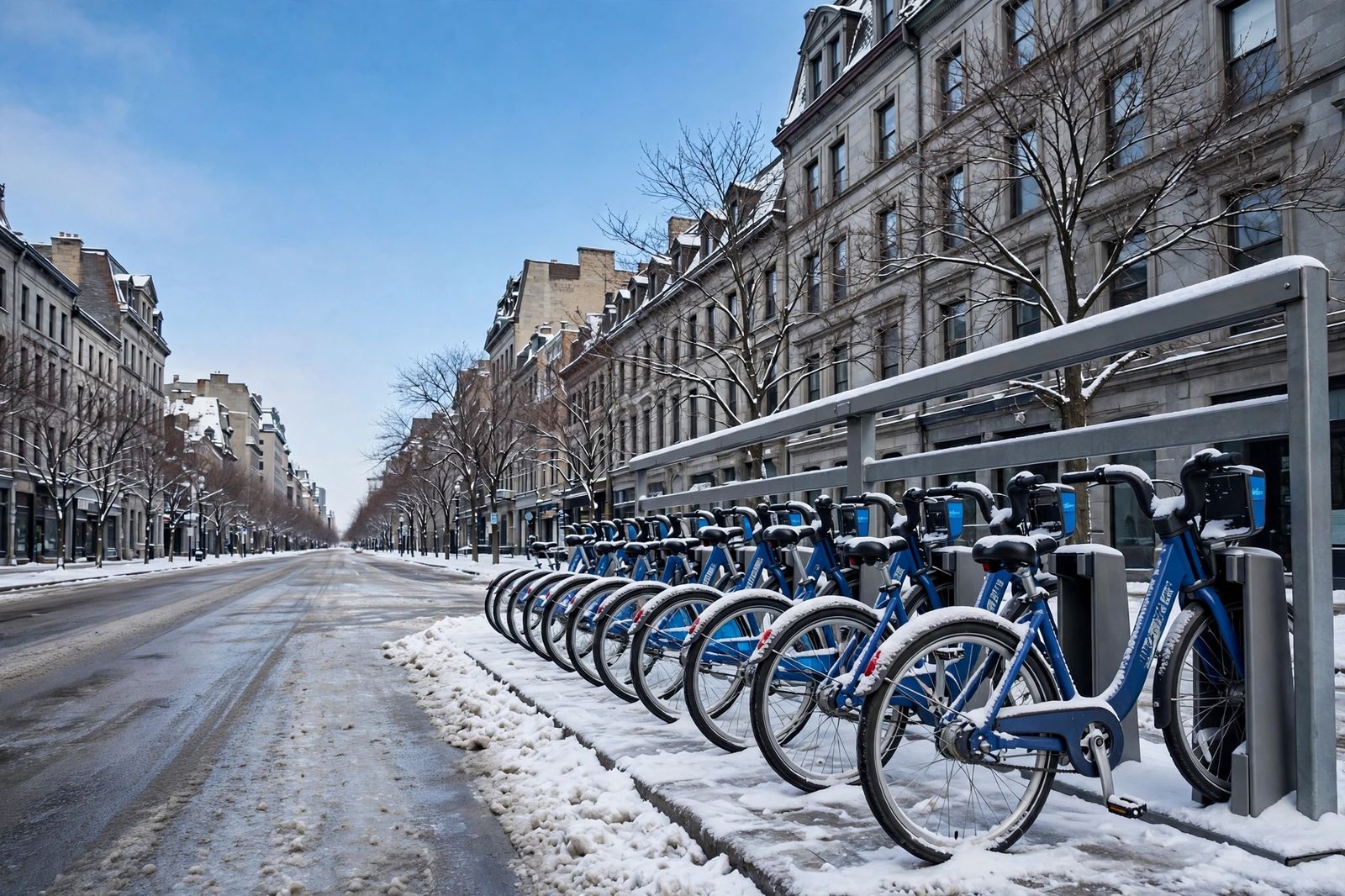
E-bikes are a different story. Cold and road salt eat into battery range and durability, so e-bikes stay in the network only until the end of November, then disappear until spring. Bike trailers go into storage until spring too. From mid-winter on, it’s regular bikes only — if your commute leans on electric assist for the hills, plan around that now.
💳 Fares and how it works — only two choices in winter
Winter pricing is simple. There’s no separate winter fare plan — you pick between the monthly membership and one-way rides. The fares below are confirmed as of November 2026, taxes extra. You can also check the full fare breakdown on BIXI’s official monthly membership page.
| Item | Monthly membership | One-way ride |
|---|---|---|
| Base price | $24/month + tax | $1.60 unlock fee per bike + tax |
| Regular bike | First 45 minutes of each ride included; 19¢/min after that | 21¢/min from the first minute + tax |
| E-bike | 19¢/min from the first minute | 36¢/min + tax |
| Deposit | None | $100 pre-authorization hold per bike |
If you’ll ride regularly through winter, the monthly membership is the baseline. It’s $24 a month plus tax, and the first 45 minutes of every regular-bike ride is included — short trips cost nothing extra.
You can join or cancel anytime; the membership auto-renews every 30 days and is charged 48 hours before the next period starts. Two things to watch: e-bikes are billed from the very first minute even for members, and usage fees like overage minutes are billed together on the 20th of each month.
Riding only once in a while? One-way works too — just know the unlock fee and per-minute rate kick in from the first minute, and a $100 pre-authorization hold lands on your card for each bike. A few days of riding adds up to the membership price fast, so if you’ll ride two or three times over the winter, the monthly membership is the better math.
💡 Tip — Members ride regular bikes for up to 45 minutes per ride with no extra charge. If a trip is running long, dock at a station along the way and unlock again — the 45 minutes restarts, and you dodge the overage fees.
📱 Pair it with your OPUS card — unlock a BIXI from the Chrono app
The link that ties BIXI together with the metro and the bus is Chrono, the transit app. Chrono is the ARTM’s official app for loading your OPUS card and checking its balance — and BIXI plugs right into it. According to Chrono’s official guide, OPUS card holders can unlock a BIXI directly in the Chrono app. Picture it: off the metro, and the same OPUS flow carries you straight onto a bike.
BIXI members get one more step of connection. Log in with your BIXI account in the Partners (Partenaires) section of Chrono’s main menu, and you can reserve and unlock a bike without leaving the app. Nearby stations, plus live bike and dock availability for each one, show on the Chrono map too — so a mixed metro-and-bike route comes together in a single app. The connection is explained in detail on Chrono’s official announcement page.
📖 New to OPUS? Start here: STM Montreal Guide: OPUS Cards, Fares & Free Rides (2026)
If OPUS cards are still new to you, start with my complete guide to Montreal’s OPUS card — where to get one, the fares, and the free-transfer rules — and then come back to this post. Metro and bus on OPUS and Chrono, the last stretch from the station by BIXI: put the two together, and most trips in Montreal come apart nicely without a car.
🧳 Seeing Montreal by bike gets you closer
This post is about the winter season, but you can’t really talk about BIXI without talking travel. Living in Montreal, I’ve found the city is compact — the sights sit packed within cycling distance of each other. That’s why I think spring through the first snowfall is the best time to explore by bike. Stations are everywhere, so you can dock near a sight, wander around, then grab another bike and move on to the next stop. It’s an easy way to fill a whole day.
📖 Widen the ride into a day trip: Canada Discovery Pass Guide — Prices and Every Quebec Spot It Covers
The shorter your trip, the better this works. Ride the metro for the long axis (with your OPUS card and the Chrono app), then finish the last stretch by BIXI, and you can cover several of the city’s core neighbourhoods in a day without renting a car. Visiting in winter? Read the snow safety notes further down before you plan your routes. Winter cycling has real charm, but it’s a different beast from a light spring-to-fall ride.
🚴 When the weather warms up, start with the Lachine Canal path
This may be a winter-season post, but there’s one ride I have to add for younger riders. If you want to try cycling in Montreal — a relaxed ride with friends — my number-one pick is the Lachine Canal bike path. It starts at the Old Port and follows the canal west to Lake Saint-Louis: 13.5 km one way, and Parks Canada puts the full ride at about an hour. The canal itself is a national historic site of Canada, so working historic locks and canal structures roll along right beside you the whole way.
The path runs flat, so it’s easy even on a first ride, and there are so many places to stop that it never gets dull. Swing by Marché Atwater (Atwater Market) mid-way for snacks, or sit down in a riverfront park for a break. The western end, Lachine’s Parc René-Lévesque, is a park at the tip of a peninsula reaching into the St. Lawrence, where the river and Lake Saint-Louis come together — a sunset spot, with a sculpture garden of 22 works on top of it. Ride out one way and end with the sun going down over the river: it’s a perfect half-day.
Just be clear on one thing: this is a spring-to-fall story. Parks Canada maintains the canal path from April 15 to November 15, so it isn’t part of winter operations. Neatly, BIXI’s winter season ends April 14 — right as the canal path reopens on April 15. Ride by this winter guide while the snow lasts; when the weather turns, move the stage over to the canal.
💡 Tip — The sunset from the park at the end of the path is this route’s highlight. Leave the Old Port in the afternoon and time your arrival in Lachine for dusk, and you get the Marché Atwater snacks and the river sunset in a single trip.
🌉 Three Montreal bike routes picked for the views
Three more routes, chosen for scenery, that pair well with the canal path:
| Route | Distance | Sights & highlights |
|---|---|---|
| Parc Jean-Drapeau — the F1 circuit (Circuit Gilles-Villeneuve) | 4.361 km per lap | Ride your bike on the actual circuit that hosts the F1 Canadian Grand Prix. When no race is on, it’s open to cyclists — and as an island park on the St. Lawrence, it comes with views of downtown across the river. |
| St. Lawrence riverfront path (Verdun · LaSalle · Lachine) | 21 km | An unbroken riverfront path with the St. Lawrence River at your side the whole way. It passes Parc des Rapides, overlooking the Lachine Rapids, and the Verdun beach — and it connects to the west end of the canal path, so you can stitch the two into one big loop. |
| Île-de-la-Visitation (north, toward the Rivière des Prairies) | 25–30 km round trip (from Parc Jeanne-Mance) | A ride along the Rivière des Prairies to a quiet island park at the city’s north end. With the Sault-au-Récollet historic district on the way, it’s a calm ride with a completely different mood from the downtown routes. |
Younger riders with legs to spare can take on a long-distance challenge too. From Parc Jean-Drapeau, follow the St. Lawrence Seaway dike path to the Sainte-Catherine lock and back — 45–60 km round trip (counted from Parc Jeanne-Mance). Riding a dike road above the river is nothing short of spectacular, and it’s a route Tourisme Montréal itself features for long rides.
⚠️ Check these before you ride
First: membership expiry. The seasonal membership you’ve used all summer doesn’t carry into winter. It expires November 15 at 11:59 p.m., and the next season starts April 15, 2027. To keep riding through winter, switch to the monthly membership. The regular season itself ends at that same moment, and stations outside the winter zone are unusable after it.
Second: the e-bike schedule. E-bikes operate only until the end of November, then leave the network until spring. From December on, only regular bikes remain — if you counted on electric assist for a hilly commute, redraw your winter routes now.
Third: check operating status. Stations that aren’t operating show grey in the app map and carry signs on site. The official guide stresses that road conditions can change day to day, so make checking the app before you leave your default habit.
🧤 Winter riding — the official safety advice
I’ll keep the safety notes to what’s in BIXI’s official guidance. In Quebec, wearing a helmet on a regular bike isn’t a legal requirement, but BIXI recommends one outside the summer season. With the short days, bright, visible clothing is strongly recommended too. The Highway Safety Code has to be followed all year, and BIXI clears station snow itself, coordinating with borough snow operations and starting with the busiest stations.
Let me add one caution squarely, from everyday life here in Montreal. In winter it snows — and when plows clear the streets, they often push the roadside snow over toward the bike lanes. So there can be stretches where snow piles up on the bike path, and it can be a bit dangerous. Studded tires help with grip, but where snow mounds mix with ice, a bike can still wobble. Right after a clearing, or the day after heavy snow, slow down — and if a bike path looks bad, don’t force your way through it.
In severe weather like a blizzard, service can be suspended. Notices go out on BIXI’s Facebook, Instagram and X accounts and on its website, and at those times every station on the app map turns grey. If the whole map is grey when you set out, it means BIXI isn’t running that day. For more on winter cycling in general, BIXI’s official guide also points to Vélo Québec’s winter cycling page.
🚦 Whatever the season — rules every cyclist has to follow
The section above was about winter only. These are Quebec’s year-round cycling rules — all of them from the SAAQ (Société de l’assurance automobile du Québec), and they apply exactly the same when you’re on a bike-share bike.
- Reflectors are mandatory at all times — white in front, red in back, with reflective devices on the wheels and pedals too. To ride in the dark (at night or in bad weather), it’s on you to add a white headlight in front and a red light at the back.
- Helmets depend on the bike — not mandatory on a regular bike, though the SAAQ strongly recommends one as the single best piece of safety gear there is. On an e-bike, a helmet is required by law. Choosing an electric BIXI? Sort the helmet out first.
- No earbuds or headphones — covering even one ear isn’t allowed. The fine runs $80 to $100.
- No riding on the sidewalk — unless a sign permits it or it’s truly necessary, stay on roads and bike paths. The fine is $80 to $100.
- Don’t hold your phone — using a portable electronic device while riding is prohibited, whether you’re holding it or not. Need directions? Fix the phone to a mount.
- Signals and hand signals are the basics — at red lights and stop signs, come to a complete stop even if the way looks clear, and before turning, check behind you and signal with your hand. Skipping the hand signal can cost you an $80 to $100 fine too.
Make a one-minute pre-ride check a habit as well. Look over tire pressure, brakes and chain — and never ride a bike whose brakes are broken; that’s the rule. Bright clothing, plus defensive riding that watches for opening car doors and potholes ahead, makes the whole ride safer.
📖 Winter weather, read properly: In Canada, We Read the Radar, Not Just the Forecast
❓ Frequently asked questions
Q. Can I keep riding all winter on my seasonal membership?
No. Seasonal memberships expire November 15 at 11:59 p.m. and can’t be used in winter. To ride during the winter season (November 16 to April 14), you’ll need a monthly membership ($24/month + tax) or one-way rides.
Q. Are e-bikes around all winter?
No. Cold and road salt affect the batteries, so e-bikes operate only until the end of November, then leave the network until spring. From mid-winter on, only regular bikes with studded tires are running.
Q. How do I check which stations are open in winter?
The station map is posted on BIXI’s official year-round page, and it’s available in the app from November 16. Stations that aren’t operating appear grey on the app map, so checking the app before you leave is the most accurate way.
Q. Does BIXI still run on heavy snow days?
Basically yes — service runs 24 hours a day, 7 days a week — but in severe weather like a blizzard, it can be suspended for safety. When that happens, BIXI announces it on its social channels and website, and every station on the app map turns grey.
Q. I have an OPUS card — can I use BIXI too?
Yes. In Chrono, the ARTM app that manages OPUS cards, OPUS holders can unlock a BIXI directly, and BIXI members can log in with their BIXI account inside Chrono to reserve and unlock. For OPUS cards and fares, see my complete OPUS guide on this blog.
To sum up: this year’s BIXI winter season runs November 16 to April 14, with 267 stations and more than 2,600 winter bikes fitted with studded tires. As long as you don’t miss that seasonal memberships expire on November 15, the rest is just checking the day’s operating status in the app as you go. There’s a reason more people ride through a Montreal winter every year. If a BIXI station is new in your neighbourhood this winter — especially somewhere like LaSalle, getting one for the first time — take it out for a light spin.
💛 — J.
Can I keep riding all winter on my seasonal membership?
No. Seasonal memberships expire November 15 at 11:59 p.m. and can’t be used in winter. To ride during the winter season (November 16 to April 14), you’ll need a monthly membership ($24/month + tax) or one-way rides.
Are e-bikes around all winter?
No. Cold and road salt affect the batteries, so e-bikes operate only until the end of November, then leave the network until spring. From mid-winter on, only regular bikes with studded tires are running.
How do I check which stations are open in winter?
The station map is posted on BIXI’s official year-round page, and it’s available in the app from November 16. Stations that aren’t operating appear grey on the app map, so checking the app before you leave is the most accurate way.
Does BIXI still run on heavy snow days?
Basically yes — service runs 24 hours a day, 7 days a week — but in severe weather like a blizzard, it can be suspended for safety. When that happens, BIXI announces it on its social channels and website, and every station on the app map turns grey.
I have an OPUS card — can I use BIXI too?
Yes. In Chrono, the ARTM app that manages OPUS cards, OPUS holders can unlock a BIXI directly, and BIXI members can log in with their BIXI account inside Chrono to reserve and unlock. For OPUS cards and fares, see my complete OPUS guide on this blog.
Get the Free Canada Savings Checklist
Join the newsletter — get the free PDF checklist and weekly Canada savings tips in your inbox.
Read Next


Some links in this post are referral or affiliate links. If you sign up or buy through them, I may receive a bonus or commission at no extra cost to you. It helps keep this blog running — thank you!