Scanner Price Accuracy Code Canada: Get Free Items (2026)
Last updated: November 7, 2026
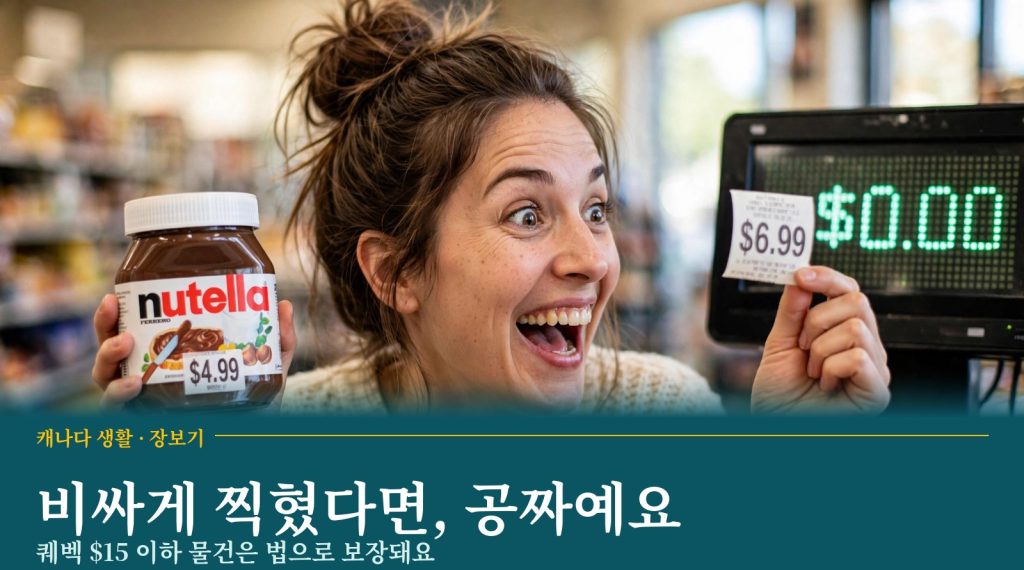
That $4.99 Item That Rang Up as $6.99? In Quebec, It’s FREE
Bonjour! It’s J. — This is a genuine review from my own purchase — not sponsored.
Most Canadian shoppers don’t know this: if an item scans higher than the price on the shelf or in the flyer, you’re entitled to it FREE — or $10 to $15 off. It’s not a favor the store does for you. In Quebec, it’s the law. In the rest of Canada, it’s an industry code that major retailers signed onto. And cashiers almost never tell you.
I found out about it the hard way at Metro, where a discount scanned wrong and the price came out higher than advertised. The staff told me “it’s our policy” and offered a smaller fix. Here’s what I learned: under Quebec law, their “store policy” doesn’t override the minimum set by the government. If you live in Quebec — or shop anywhere in Canada — here’s exactly what you’re owed and what to say.
Rules below are current as of October 2026. Quebec’s threshold changed in May 2025 — most articles online still show the old numbers.
🌿 Quick Take
- If an item scans higher than the shelf or flyer price, you’re owed money: in Quebec it’s the law; in the rest of Canada it’s a voluntary code the major retailers signed onto.
- Quebec (since May 7, 2025): advertised price $15 or less → the item is FREE; over $15 → the price is corrected, plus $15 off.
- Rest of Canada: displayed price $10 or less → FREE; over $10 → $10 off the displayed price. Only the first unit gets the deal — the rest ring up at the corrected price.
- What to say: “This item scanned higher than the displayed price — could you please apply the price accuracy policy?” A dated photo of the shelf tag is gold.
- Not covered: items without a barcode, items with the price stickered on the item itself, prescription drugs, alcohol and tobacco.
- If a Quebec store refuses, escalate to the OPC (opc.gouv.qc.ca) with your receipt and a dated photo of the advertised price.
⚡ The Quick Rules

| Québec (Law) | Rest of Canada (Voluntary Code) | |
|---|---|---|
| Advertised price at or below threshold | ≤ $15 → item is FREE | ≤ $10 → item is FREE |
| Advertised price above threshold | > $15 → price corrected + $15 OFF | > $10 → $10 OFF the displayed price |
| Multiple units | First unit free/$15 off; rest at corrected advertised price | First unit free/$10 off; rest at corrected displayed price |
| Is it mandatory? | Yes — it’s the law (Consumer Protection Act) | Voluntary — participating retailers only |
⚖️ 1. Quebec: It’s the Law, Not a Courtesy
In Quebec, the price accuracy policy is mandatory under the Consumer Protection Act. Every retailer that uses barcode scanners must comply — Metro, IGA, Provigo, Super C, Walmart, Maxi, Costco, IKEA, all of them. No opt-in needed. It’s the law, province-wide.
Since May 7, 2025 (Bill 72), the threshold went up:
- Advertised price $15 or less → you get the item free
- Advertised price over $15 → the price is corrected to the advertised price, plus you get $15 off
Most articles online still say $10 — that’s the old number. The current Quebec threshold is $15 as of October 2026.
Stores must post the policy. Quebec merchants are required to display the price accuracy policy sign at every cash register (and self-checkout). If you don’t see it, that’s itself a violation. Fines for non-compliance are steep: $1,500–$37,500 for an individual and $3,000–$75,000 for a company — doubled for repeat offences.
What this means for my Metro situation: if the advertised price was $15 or less and it scanned higher, I was owed the item free — not whatever smaller remedy the staff called “our policy.” A store’s internal policy cannot go below the legal minimum.
🛒 2. Rest of Canada: The $10 Voluntary Code
Outside Quebec, the Scanner Price Accuracy Code has been around since 2002. It’s administered by the Retail Council of Canada and endorsed by the Competition Bureau. Participation is voluntary, but the big names all signed on:
Loblaws chains (Real Canadian Superstore, No Frills), Sobeys, Safeway, Walmart Canada, Costco Canada, Best Buy, Canadian Tire, Giant Tiger, Home Depot, London Drugs, Shoppers Drug Mart, Toys “R” Us, IGA, Save-On-Foods, Rona, and more.
The rules:
- Displayed price $10 or less, scans higher → the first item is FREE
- Displayed price over $10, scans higher → $10 off the displayed price
- Only the first unit gets the free/$10 benefit — additional units are sold at the correct displayed price
- You must ask. Cashiers apply it when you request it, not automatically.
This covers shelf prices, flyer prices, and online advertised prices — anything with a UPC/barcode scanned at checkout.

🗣️ 3. Exactly What to Say at the Register
You don’t need to argue or quote legislation from memory. Keep it simple and polite:
“This item scanned higher than the displayed/advertised price. Could you please apply the price accuracy policy?”
In French: “L’article a scanné plus cher que le prix affiché. Pouvez-vous appliquer la politique d’exactitude des prix, s’il vous plaît?”
Tips that make the difference:
- Point to the evidence. Show the shelf tag or flyer price. A dated photo of the shelf tag on your phone is gold — stores fix errors fast once reported.
- Notice it after you left? Keep the receipt and go back. You can still claim it — bring a screenshot of the advertised price if you have one.
- Buying multiples? The first unit is free (or $10/$15 off); the rest ring up at the correct advertised price. If a store gives you only the free item and refuses to correct the others, that’s not the rule — the rest should be at the advertised price.
- Stay calm. Most cashiers will call a supervisor and fix it. The ones who push back usually just don’t know the policy well.
🚫 4. What’s Excluded
The policy doesn’t cover everything. Exclusions include:
- Items without a barcode — weighed produce, bulk items with no UPC
- Individually price-ticketed items — if the price sticker is on the item itself
- Prescription drugs and behind-the-counter cosmetics
- Alcohol, tobacco, and goods with a legislated minimum price
📢 5. If the Store Refuses — Quebec
If a Quebec store won’t apply the policy correctly, you have a real escalation path: the Office de la protection du consommateur (OPC).
What to bring:
- Your receipt showing the higher scanned price
- A dated screenshot or photo of the advertised price (flyer, shelf tag, online listing)
- The store name, address, and date of the incident
Check opc.gouv.qc.ca first, then call an agent. Note: the OPC enforces the law and can prosecute — it doesn’t sue on your behalf as an individual. But stores take OPC complaints seriously, because the fines are real.
Real cases:
- Jysk (Brossard/Laval) — fined $6,000 in 2019 for not posting the policy
- Marché C & T (Montréal) — fined $2,500 in 2018 for the same reason
- Auto Dépôt (St-Jérôme) — fined $25,080 in 2025 for charging above advertised prices
These aren’t theoretical penalties. Stores get fined.
✅ 6. The Verdict: Claim It Every Time
🟢 CLAIM IT:
- Any item that scans above the shelf or flyer price — every single time. It’s your right, not a favor.
- In Quebec: free if advertised ≤$15, $15 off if over $15. Everywhere else: free if ≤$10, $10 off if over $10.
- Take a photo of shelf tags for items you buy often — prices change and errors are common.
🔴 DON’T LET IT GO:
- Don’t accept “it’s our policy” if the remedy is smaller than the legal minimum. In Quebec, the minimum is set by law — a store policy can’t undercut it.
- Don’t assume the cashier will apply it automatically. You have to ask.
🟡 KNOW THE RULE:
- Only the first unit gets the free/$10/$15 benefit — the rest are at the corrected advertised price.
- Exclusions apply (no-barcode items, price-ticketed items, prescriptions, alcohol/tobacco).
- Outside Quebec, only participating retailers are bound — check the list before you argue.
Official source: Office de la protection du consommateur — Québec price accuracy policy
Before you go, you might also find my guides on COSORI Air Fryer Recall and Get 1 Billion Free Muse Tokens (Only Within useful.
One more worth reading: my notes on Don’t Pay Full Price at Sephora.
Happy saving 💛
— J.
Educational information only — not financial advice.
🧮 Three Baskets, Priced Out
Run the rules above on real baskets and they stop being abstract. Start with the item in this guide’s title: advertised at $4.99, scanned at $6.99 — a $2.00 overcharge. In Quebec, where the advertised price is $15 or less, that item is free: you pay $0 instead of $6.99, and the shelf price wins completely.
Now buy three of them, all scanning wrong. Quebec corrects the price on every unit but gives the free treatment to the first only: $0 + $4.99 + $4.99 = $9.98, against $20.97 at the scanned price. Catching the error is worth $10.99 on that one item alone — more than the item itself costs.
Cross a threshold and the two systems split. An item advertised at $20, scanned higher: Quebec corrects it to $20 and takes $15 off, so you pay $5. Under the rest-of-Canada code, the same mistake takes $10 off the displayed price, so you pay $10. Same shelf, same error, a $5 difference — because Quebec’s free line moved from $10 to $15 in May 2025, a 50 percent rise, while the voluntary code, around since 2002, still works to the $10 line.
💬 You May Also Like
- Don’t Miss Out: $175 in Free Groceries Waiting for You (Metro, IGA & More)
- Black Friday 2026 Canada: Don’t Get Scammed — How to Spot Fake Deals
- Before 2026 Ends: Find Your Hidden Money in Canada (CRA Owes $1.8B in Uncashed Cheques)
Get the Free Canada Savings Checklist
Join the newsletter — get the free PDF checklist and weekly Canada savings tips in your inbox.
Read Next

Some links in this post are referral or affiliate links. If you sign up or buy through them, I may receive a bonus or commission at no extra cost to you. It helps keep this blog running — thank you!