
Mortgage Renewal in Canada: Don’t Sign the First Offer
Last updated: November 7, 2026
Bonjour! It’s J. — and today we’re talking about the most expensive envelope in Canadian mail: your mortgage renewal letter.
It arrives looking harmless. One rate, printed neatly. One signature line. Sign, send it back, done — that is exactly what your bank is counting on. But here is what nine years in Canada have taught me: the rate in that letter is an opening offer, not your bank’s best rate. Treating it like a bill to pay instead of a negotiation to win can cost you thousands over the next term.
So before you sign anything, let me walk you through the five things banks don’t volunteer at renewal — and the fixed-vs-variable decision that matters more than the rate itself.
🌿 Quick Take
- The rate in your renewal letter is a starting point for negotiation — not the best rate
- Start shopping 120 days before maturity; lenders will hold a rate while you compare
- Switching lenders with the same balance and amortization skips the stress test (since Nov 21, 2024)
- Fixed-rate penalties hide an IRD calculation — and big-bank posted rates make it worse
- Use your 10–20% prepayment privilege before you switch, to shrink any penalty
🤔 Fixed vs Variable: How to Choose at Renewal in 2026
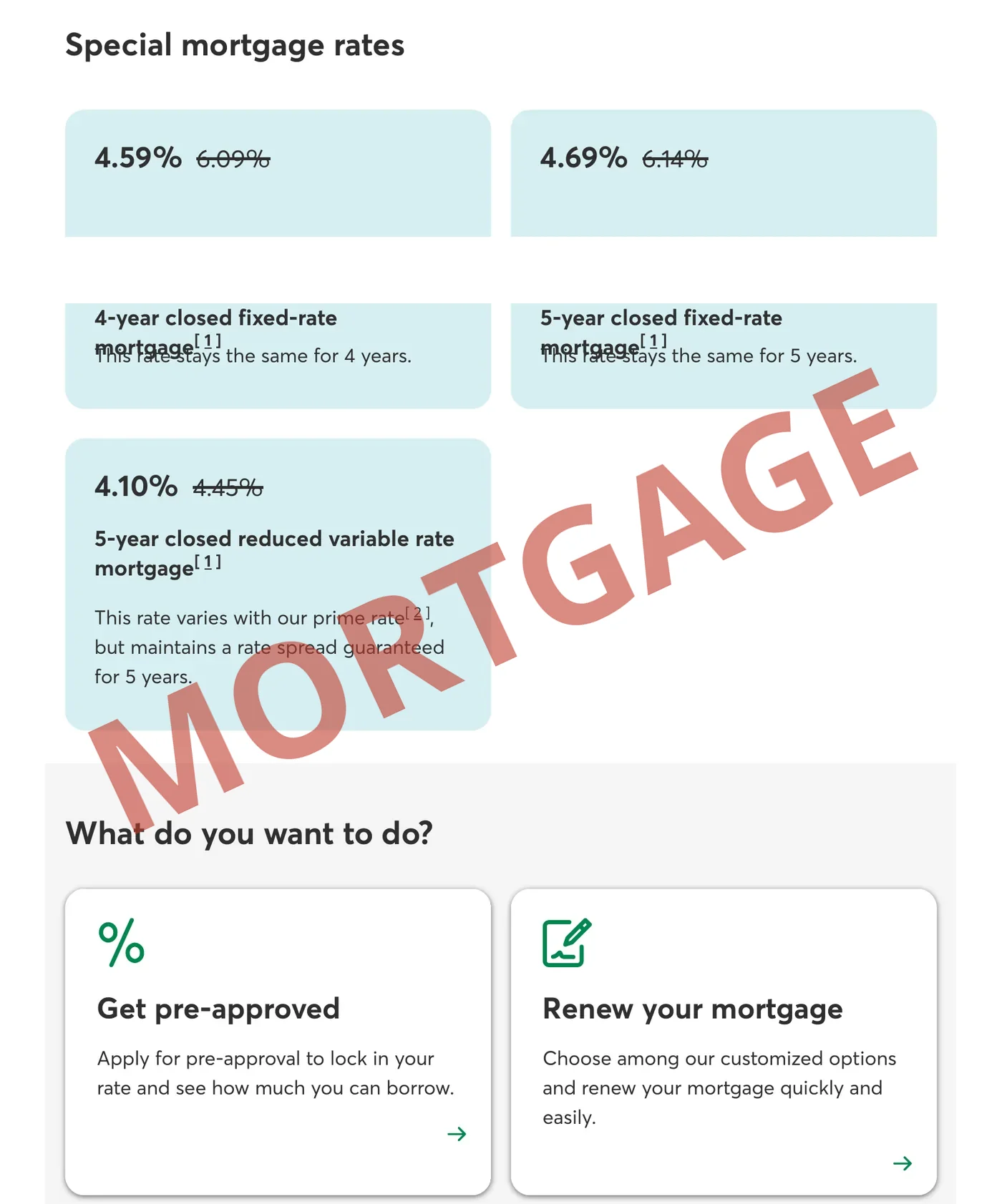
First, the lay of the land (as of October 2026). The Bank of Canada has held its policy rate at 2.25% since October 2025, and the big-bank prime rate sits at 4.45%. Variable mortgages price off prime minus a discount; fixed rates follow bond yields instead — which is why the two don’t move in lockstep.
One date to circle: the Bank of Canada announces its next rate decision on October 28, 2026. If your maturity falls this fall, having a rate held before that date beats scrambling after it.
Lean fixed if your budget has no wiggle room, a surprise payment increase would stress you out, or the gap between today’s fixed offers and variable offers is small enough that certainty is cheap.
Lean variable if you have a cushion, you might move or refinance mid-term (a variable penalty is usually just three months’ interest), or you genuinely expect holds and cuts rather than hikes.
And the honest middle path many Canadians take: a shorter 2–3 year fixed term — certainty now, another decision soon, while the rate picture clears up.
💡 Tip: if you go variable, ask one question in writing — is it an adjustable payment that moves with prime, or a fixed payment where only the interest split changes? The second type has a “trigger rate,” and you want to know yours before you sign.

🔍 5 Things Your Bank Won’t Volunteer at Renewal
1. You can switch banks without re-passing the stress test
This is the big one, and almost nobody was told. Since November 21, 2024, OSFI rules say that a straight switch — moving your mortgage to a new lender with the same balance and same amortization — is exempt from the mortgage stress test, even on uninsured mortgages.
Borrow more money or stretch the amortization, though, and it becomes a refinance — the stress test comes back. Keep the switch clean, and your current lender no longer owns you just because qualifying again sounds exhausting. The details are laid out in OSFI’s official backgrounder on the straight-switch exemption.
The primary sources are worth knowing by name: the exemption comes from OSFI’s backgrounder on the Minimum Qualifying Rate, and the federal government announced the same change for insured mortgages in its statement on straight switches and portfolio insurance. One limit to keep in mind: the exemption is an OSFI rule, so it applies to federally regulated lenders — the big banks and the other institutions OSFI supervises. Provincially regulated lenders, including Québec’s Desjardins caisses and other credit unions, set their own underwriting rules and may still run a stress test on a switch. If your mortgage sits with a caisse, ask about its policy before you count on the exemption.
2. The 21-day letter is the legal minimum — smart shoppers start at 120 days
Under FCAC rules, your lender must send your renewal offer at least 21 days before maturity. Twenty-one days is nowhere near enough time to shop, compare, and negotiate — and that’s rather the point.
The standard play is to start 120 days out. Most lenders will give you a rate hold for that window: today’s rate is reserved while you compare, and with many lenders, if rates drop before you sign, you get the lower one. Ask — in writing. A clear guide to the whole negotiation sequence is nesto’s mortgage negotiation guide.
This is also where I treat banks the way I treated them in my guide to Canada’s best free online banks: loyalty is lovely, but the statement doesn’t care. Compare first, feel loyal second.
3. The penalty formula — not the rate — is where lenders differ most
If there’s any chance you break your mortgage mid-term (a move, a separation, a refinance), this tip pays for the whole article. On a variable mortgage, the penalty is typically just three months’ interest. On a fixed mortgage, it’s the greater of three months’ interest or the IRD (interest rate differential).
Here’s the quiet part: the big banks calculate IRD using their posted rates, which can inflate your penalty far beyond their real loss. Two mortgages with the same rate can carry wildly different exit costs. Before signing, ask for your penalty calculation in writing — FCAC’s guidance on renewing your mortgage explains what lenders must disclose.
4. Your prepayment privilege can shrink the penalty before you switch
Most closed mortgages let you put down 10–20% of the original principal every year, penalty-free, plus increase your regular payments (the exact numbers are in your contract — check them). That privilege is a tool, not a trivia fact.
A lump-sum prepayment right before you switch lowers the balance any penalty is calculated on — and lowers the balance your new lender finances. If a bonus, tax refund, or savings pot is sitting idle, renewal season is when it works hardest.
5. A collateral charge can quietly lock you to your bank
Some mortgages are registered as a collateral charge rather than a standard charge. It sounds technical; the consequence is not. Moving a collateral-charge mortgage to a new lender usually means fresh legal and appraisal costs — roughly $1,000–$1,200 — which conveniently discourages switching.
Before renewal, find out which type you have (it’s in your mortgage documents, or one phone call to your lender). If it’s collateral, factor that cost into any switch — and think twice before signing into another one.

🗓️ The 120-Day Renewal Checklist
120 days out: find your exact maturity date and current balance. Ask your lender two things: your rate hold options, and whether your mortgage is a standard or collateral charge.
90 days out: collect at least three offers — your bank, one other lender, and a mortgage broker (brokers are usually paid by the lender on standard deals; ask upfront). Get a written penalty quote if there’s any chance you’d break a term early.
60 days out: take your best outside offer back to your current bank and negotiate. Banks routinely improve the letter rate when a real alternative is on the table — the first offer improves the moment you can walk away.
30 days out: make the fixed-vs-variable call using the criteria above, and use any prepayment privilege before the switch date if you’re moving lenders.
Before you sign: re-read the prepayment terms, the penalty formula, and the charge type on the new contract. The boring pages are where the money hides.

✨ Renewal Is a Negotiation, Not a Formality
Your mortgage is probably the biggest contract of your life, and renewal is the one moment every five years when you hold real leverage. The bank knows the rules in this article by heart — now you do, too.
I treat renewal season the same way I treat my year-end money checkups (like hunting down the hidden money CRA might owe you): an hour of checking, years of difference.
What is a quarter point actually worth? Take a $400,000 balance: one lender offers 4.00%, your bank’s letter says 4.25%. On a 25-year amortization with monthly payments, the lower rate cuts the payment by about $55 a month, saves roughly $980 in interest in the first year, and about $4,800 in interest over a five-year term — while paying off roughly $1,500 more principal along the way. (Illustration only, assumptions stated: the rate gap is held constant for the whole term; your figures will differ with your balance and amortization.) That is the dollar size of “just sign the letter.”
Quick question before you go: if your mortgage renews this year, are you team fixed or team variable? Tell me below — I read every answer.
Educational information only — not financial advice. Figures checked October 2026.
Happy renewing 💛
— J.
Do I need to pass the stress test again if I switch lenders at renewal?
Not for a straight switch at a federally regulated lender. Since November 21, 2024, OSFI does not require borrowers to re-qualify under the stress test when switching lenders at renewal, as long as the loan amount and amortization period stay the same.
Does this exemption apply at a Quebec caisse?
The exemption is an OSFI rule for federally regulated financial institutions. Quebec caisses are provincially regulated, so their rules may differ — check with your caisse before assuming the exemption applies.
📚 You May Also Like
- Stop Paying $215/Year in Bank Fees: Canada’s Best Free Online Banks Compared (2026)
- Before 2026 Ends: Find Your Hidden Money in Canada (CRA Owes $1.8B in Uncashed Cheques)
- 6 Best Cashback Sites 2026 | Get Paid Twice on Every Purchase
Get the Free Canada Savings Checklist
Join the newsletter — get the free PDF checklist and weekly Canada savings tips in your inbox.
Read Next


Some links in this post are referral or affiliate links. If you sign up or buy through them, I may receive a bonus or commission at no extra cost to you. It helps keep this blog running — thank you!