
TFSA Emergency Fund: The January 1 Rule (2026 Guide)
Last updated: November 5, 2026
Bonjour! It’s J. — today we’re talking about a rule that quietly costs Canadians real money every year, and that no bank has ever once mentioned to me in nine years of banking here: what happens when you take money out of your TFSA and put it back too soon.
Picture it. In June, you pull $5,000 out of your TFSA for a car repair. In September, a bonus lands, and you proudly put the $5,000 straight back. Responsible, right? CRA calls it an over-contribution — and charges you 1% of that $5,000 for every month it sits there. Nobody warns you. The tax bill simply arrives.
🌿 Quick Take
- Withdrawing from a TFSA is always tax-free — putting the money back is where the trap is
- Withdrawn amounts only return as contribution room on January 1 of the next year
- Re-deposit in the same year, with no room left, and CRA taxes the excess at 1% per month
- Interest inside a TFSA is never taxed; the same interest outside is taxed at your full marginal rate
- The 2026 TFSA dollar limit is $7,000 — and the room number in CRA My Account often lags months behind reality
📅 The January 1 Rule: Your Room Only Comes Back Next Year
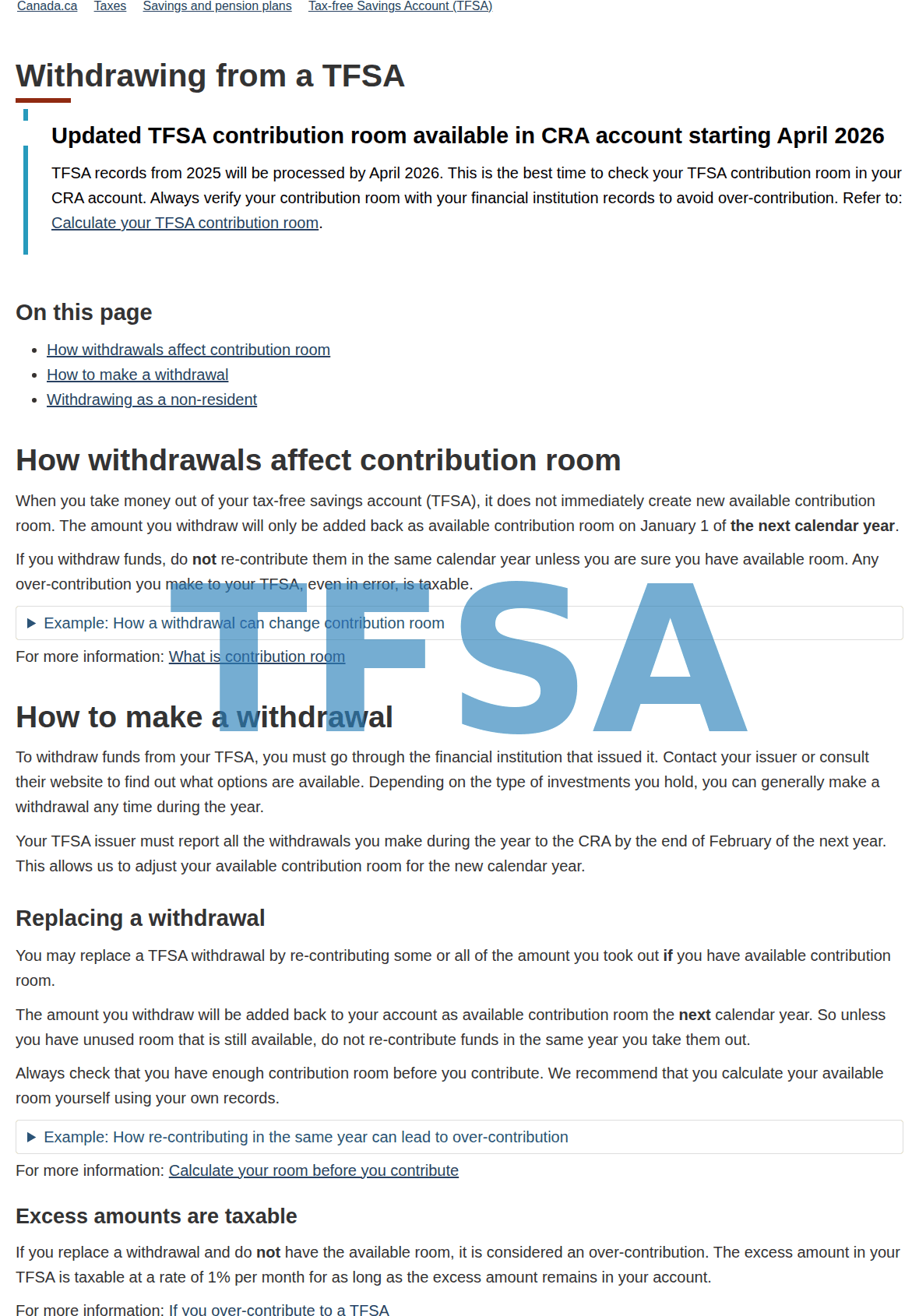
Here is the rule itself, straight from CRA. You can withdraw from a TFSA at any time, tax-free — that part is genuinely free. But the amount you withdrew only becomes contribution room again on January 1 of the following year. Not the next day. Not when your paycheque lands. January 1. CRA’s own page on withdrawing from your TFSA spells it out.
Now run the June–September story through that rule, with real numbers. Say your TFSA room was already fully used for the year:
- June: you withdraw $5,000 for the car repair. Perfectly legal, completely tax-free.
- September: you deposit the $5,000 back. But that room doesn’t exist again until January 1 — so the $5,000 is now an excess amount.
- September to December: CRA taxes the excess at 1% per month. $5,000 × 1% = $50 a month, for 4 months = $200.
- January 1: the withdrawn $5,000 finally returns as room, the excess disappears — and the $200 is simply gone.
Wait until January, and the exact same deposit costs $0. The only difference is a date on the calendar. CRA explains the charge on its page about over-contributing to a TFSA. And if this has already happened to you: withdraw the excess today. The 1% meter runs for every month the money stays in.
One relief valve worth knowing: if the excess came from a reasonable error — a genuine mistake, not carelessness — the CRA can waive the 1% tax. You apply by filing Form RC243, the TFSA return, asking for the waiver in writing, explaining the error and showing you withdrew the excess without delay. Be clear-eyed about the odds: relief is discretionary, and the courts have often refused it where the “error” was really misreading the rules or relying on bad advice. Still, if it genuinely was an honest mistake, asking costs you a form; not asking costs you the tax for certain.
💡 Tip: don’t trust the TFSA room number shown in CRA My Account. Banks report your deposits and withdrawals with a lag, so the figure can be months out of date. CRA itself tells you to verify your room against your own financial institution’s records — keep a simple note of every deposit and withdrawal.
🧾 Inside vs Outside the TFSA: The Same $800, Two Tax Bills
The January 1 rule is the trap. This next part is the prize — why parking your emergency fund inside a TFSA, when you have the room, is worth real money. Interest earned inside a TFSA is never taxed. Interest in a regular savings account is taxed in full, every year — and interest gets no 50% capital-gains discount; every dollar is taxed at your marginal rate.
| $20,000 emergency fund, 1 year at 4% | Interest earned | Tax* | You actually keep |
|---|---|---|---|
| Inside a TFSA (HISA or cashable GIC) | $800 | $0 | $800 |
| Regular savings account | $800 | $240 | $560 |
*A simplified, illustrative example only, using an assumed marginal tax rate of 30% — not a calculation of your actual tax. Yours may be lower or higher, and the TFSA line is $0 at any rate. Repeat that $240 difference over five years and you have handed CRA about $1,200 — tax on money that was just sitting there, being responsible.
🎯 How Much Do You Need — and How Fast Can You Build It?
The classic target is 3 to 6 months of essential spending — not your full lifestyle, just the must-pays: rent or mortgage, groceries, utilities, transit, insurance, minimum payments. Take an example household spending $3,200 a month on essentials: a three-month cushion is $9,600, and six months is $19,200.
That number can feel enormous, so shrink the first goal to $1,000. A $1,000 starter fund covers most surprise car repairs and appliance funerals — and it’s reachable in about a year at roughly $84 a month.
Then let automation do the heavy lifting. $300 a month becomes $3,600 after one year — plus roughly $65 of interest at 4%, because the balance grows as you go. At $400 a month, the $9,600 three-month cushion takes about two years. Slow? Maybe. But it builds while you sleep, which is the entire point of an emergency fund.
💡 Tip: schedule the transfer for payday morning, before the money can wander off. An emergency fund built “from whatever is left over” is a fund that never gets built — there is never anything left over.
🏦 Where You Park It: The Rate Gap Nobody Advertises
As of October 2026, a basic savings account at a big bank pays roughly 0.5% to just over 1%. High-interest savings accounts at online banks sit in the 3–4% range — though the headline rate is often a promotional rate with an expiry date, after which it quietly drops. Always read the ongoing rate, not the welcome banner.
On a $10,000 emergency fund, that gap is not pocket change. At 0.55%, your money earns about $55 a year. At 3.5%, the same $10,000 earns about $350. Same money, same effort (none) — roughly $295 a year apart. Those rates are snapshots of Canadian online-bank offers in October 2026, not permanent promises: a good share of the 3–4% figures are promotional rates that step down after a few months, so confirm the current rate — and the rate after the promotion ends — before you move money.
Where should the fund live? Inside your TFSA first, if you have room — the interest is never taxed. Once the TFSA is full, a regular HISA is the next home. I did the comparison homework in my guide to Canada’s best free online banks — ten minutes of reading that pays you every single year.
🔁 Moving Banks? Use a Direct Transfer — Never Withdraw and Re-Deposit
Found a better rate across the street? Moving your TFSA is painless — if you move it the right way. Ask the new institution for a direct transfer: the money travels bank-to-bank and never touches your hands. CRA’s transfer page calls this a qualifying transfer, and is clear that it is not a withdrawal and not a new contribution — your room is untouched.
The wrong way: withdrawing from Bank A and depositing into Bank B yourself. If your room is full, that innocent errand triggers the exact same 1% monthly trap until January 1. Same money, same year, same penalty.
One more question to ask before you move: does the old bank charge a transfer-out fee? Some do — and the new bank may reimburse it if you ask, especially for larger balances. Asking costs nothing. Not asking can cost you the fee.
💡 Tip: open the new TFSA first, then sign the new bank’s transfer form and let them pull the money over. The pull is the qualifying transfer. A push from you is a withdrawal — with the January 1 rule attached.
✨ A Quiet Rule Worth More Than Most Promotions
The TFSA is one of the most generous tools Canada hands ordinary savers — a new $7,000 of room every year (the 2026 limit), unused room that carries forward, and withdrawals that are always tax-free. It asks only one thing in return: respect the calendar. Room returns on January 1, transfers travel bank-to-bank, and the interest stays yours.
I fold this check into the same year-end routine as hunting down money CRA might already owe you: ten quiet minutes, once a year, that keep hundreds of dollars on your side of the ledger.
Quick question before you go: have you ever pulled money out of your TFSA mid-year — and did anyone warn you about the January 1 rule? Tell me below; I read every answer.
Educational information only — not financial advice. Figures checked October 2026.
Happy saving 💛
— J.
If I withdraw from my TFSA, when can I put the money back?
The amount you withdraw is added back to your contribution room on January 1 of the following year. If you re-contribute in the same year and you have no other room available, the excess is treated as an over-contribution.
What does CRA charge on a TFSA over-contribution?
CRA taxes the highest excess amount at 1% per month until it is removed or absorbed by new room. If it was a genuine mistake, you can ask CRA for relief by filing Form RC243 and explaining the error.
📚 You May Also Like
- Stop Paying $215/Year in Bank Fees: Canada’s Best Free Online Banks Compared (2026)
- Before 2026 Ends: Find Your Hidden Money in Canada (CRA Owes $1.8B in Uncashed Cheques)
- 6 Best Cashback Sites 2026 | Get Paid Twice on Every Purchase
Get the Free Canada Savings Checklist
Join the newsletter — get the free PDF checklist and weekly Canada savings tips in your inbox.
Read Next


Some links in this post are referral or affiliate links. If you sign up or buy through them, I may receive a bonus or commission at no extra cost to you. It helps keep this blog running — thank you!