Quebec Winter Tires: The December 1 Law, the Snowflake Symbol, and Which Tire Your Car Actually Needs
Last updated: November 5, 2026
Bonjour! It’s J. — If you drive in Quebec, December 1 is not just the start of the holiday season. It is the legal deadline for winter tires, and the rule is stricter than most people think: the tires in your garage might say “all-season” on the sidewall and still not count. This guide pulls the exact rules from the SAAQ and the Gouvernement du Québec, then compares all-season, all-weather and true winter tires — braking, fuel, noise, wear and cost included — so you can walk into the tire shop already knowing your answer.
🌿 Quick Take
- Winter tires are mandatory in Quebec from December 1 to March 15, inclusive — driving without them costs a $200 to $300 fine, plus fees.
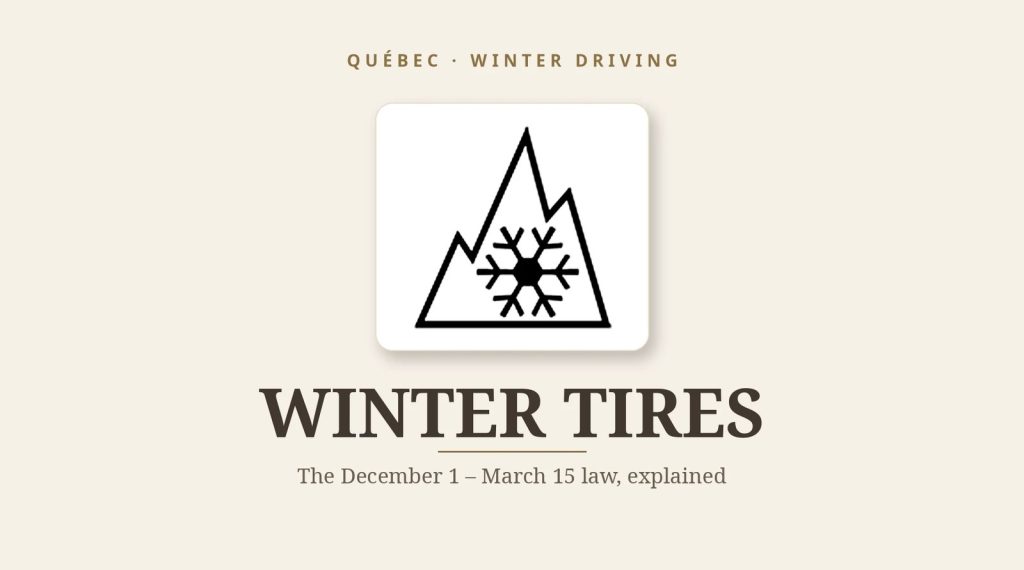
- Only one marking counts: the three-peak mountain snowflake pictogram (or studs). An “M+S” stamp alone does not make a tire legal here.
- All-weather tires carry that pictogram, so they are legal all year; regular all-seasons are not.
- A winter tire in good condition stays flexible down to −40 °C and can cut braking distance by about 25% (Gouvernement du Québec).
❄️ The Law in One Minute: December 1 to March 15
Quebec is the only province that makes winter tires compulsory by law, and the Highway Safety Code leaves little room for interpretation. From December 1 to March 15, both dates included, every motorized road vehicle registered in Quebec must run on winter tires — passenger cars, and also mopeds, motorized scooters and motorcycles. The rule even covers passenger vehicles rented in Quebec, so a rental car is not a loophole. Heavy vehicles, tool vehicles and farm machinery are the main vehicle categories excluded.
Get caught on the wrong tires and the fine is $200 to $300, plus costs. That range is the fine alone — once court costs and the contribution to the victims’ assistance fund are added, the total you actually pay typically tops $350. The short exception list is practical, not generous: the first seven days after buying from a dealer, the last seven days of a lease of a year or more, dealer (X) plates, a temporary transit registration, a motor home permanently converted into a dwelling, the spare tire, and emergency motorcycles. Vehicles registered outside Quebec and trailers fall outside the requirement, which matters for visitors driving in.
There is also a seven-day exemption certificate, requested through SAAQclic or at a SAAQ service centre, for specific situations: snowbirds leaving or returning to Quebec, a car bought from an individual, taking a stored vehicle out of storage, ending a long-term lease early, or returning an out-of-province rental. If one of those is you, arrange the certificate before you drive, not after the ticket.
One timing note from the government itself: spring weather here is fickle, and the Gouvernement du Québec suggests waiting a few weeks after March 15 before switching back. Read the official rules yourself on the SAAQ’s winter tires page and the government’s winter tire requirements page — both are linked again at the bottom of this guide.
🏔️ The Snowflake Symbol: Why “M+S” Is Not Enough
This is the part that surprises people. Since December 15, 2014, Quebec law recognizes a tire as a winter tire only if it is studded or carries the pictogram of a snowflake inside a three-peak mountain — the symbol known in the industry as 3PMSF (Three-Peak Mountain Snowflake). An “M+S” (mud and snow) marking by itself is not recognized, no matter how chunky the tread looks.

The difference is not bureaucratic; it is about testing. The snowflake is earned: a tire gets it only after passing a standardized snow-traction test with at least 10% better traction than a reference tire. “M+S”, by contrast, is a tread-pattern designation with no cold-weather performance test behind it. Transport Canada testing showed how wide that gap can be: an M+S tire without the pictogram needed up to 40% more distance to stop than a comparable tire that carried it.
One honest caveat, though: the pictogram is a minimum standard, not a performance ranking. In Tire Rack’s snow test of 30 truck and SUV tires, the pictogram-rated Cooper Discoverer Stronghold AT — an all-terrain tire — needed 22.1 m to stop on packed snow, slightly longer than the 21.4 m of the Michelin Defender LTX M/S2, a highway all-season tire with no pictogram at all. Legally, that Michelin still would not count in Quebec — the law draws its line at the symbol, not at test results. But the numbers carry a useful reminder: the snowflake certifies that a tire cleared the winter bar, and within the pictogram family, a dedicated winter tire still plays in another league — which is exactly what the comparison below is for.
This is also where the vocabulary matters. All-season tires are the default fitment on most cars — usually M+S, no pictogram, not legal here in winter. All-weather tires are a different product: built to run year-round but certified with the snowflake, so they are legal in Quebec in every season. When someone says their all-season tires “passed” a roadside check, they almost certainly mean all-weather tires. The next section puts all three side by side.
🔍 All-Season vs All-Weather vs Winter: The Full Comparison
Here is the comparison the SAAQ’s rules force every Quebec driver to make — including the two factors people ask about most, fuel and noise.
| All-Season (M+S) | All-Weather (snowflake) | Winter (snowflake) | |
|---|---|---|---|
| Legal in Quebec, Dec 1–Mar 15 | ❌ Not recognized | ✅ Legal, year-round | ✅ Legal — the reference |
| Rubber & the 7 °C line | Hardens below 7 °C and loses grip | Cold-flexible blend — a year-round compromise | Stays flexible down to −40 °C |
| Braking on snow & ice | Longest — up to 40% farther than a pictogram tire in Transport Canada testing | Clearly better than all-season on snow; a step behind a dedicated winter tire on ice | Shortest — good-condition winter tires cut braking distance by about 25% (Gouvernement du Québec) |
| Fuel economy | Best of the three in mild weather | Close second, all year | Slightly higher rolling resistance; correct pressure matters more than the tire type |
| Road noise | Quietest on dry pavement | In between | Noticeably more hum on dry pavement; studded versions are the loudest |
| Wear & lifespan | One set wears all year | One set wears all year — often a pricier tire | Two sets share the year, so each lasts more seasons — but the soft compound wears fast if left on in summer |
| Cost & hassle | No changeovers, no storage | No changeovers, no storage | Two changeovers a year (cheaper on a second set of rims), plus storage space or a tire-storage fee |
| Best for | Drivers where winter tires are not the law | One-car simplicity that stays legal | Maximum grip: high mileage, rural roads, storm driving |
Two rows deserve a comment. On fuel: the tire choice is a minor factor next to winter itself. Natural Resources Canada notes that as temperatures fall from 24 °C to 7 °C, city fuel consumption can climb 12% to 28% — cold air, winter-blend fuel and slushy roads do most of that damage. The SAAQ’s own advice is more actionable: an under-inflated tire increases fuel consumption and shortens the tire’s life, so check pressures monthly, especially after a cold snap. On noise: a winter tire’s aggressive tread and thousands of tiny sipes are what bite into ice — and what hum on dry asphalt. All-weather tires split the difference, which is exactly their design brief.
And a warning straight from the government page: do not keep winter tires on through summer. The soft compound wears quickly in heat, evacuates water less effectively (weaker aquaplaning resistance), and can stop longer than an all-season tire on wet summer pavement. The legal set is also the seasonal set.
And studded tires? The strongest grip on ice — with the most strings attached
One option sits outside the three-way comparison: studded tires, winter tires with small metal pins set into the tread. On bare ice, nothing else grips like them — if your driving is mostly icy rural roads, they are the safest choice of all, full stop.
The catch is the strings. Studs are the loudest option on pavement and they chew up road surfaces — and, the detail people discover too late, many indoor and underground parking garages ban them outright, because the pins damage concrete floors and coatings. If your home or workplace parking is indoors, check the rules before you buy, not after. Quebec also limits them to a season: studded tires are permitted only from October 15 to May 1, on passenger vehicles, taxis and light commercial vehicles (3,000 kg or less). Safest on ice, most restricted everywhere else — that is the honest trade.
🛠️ Is Your Set Still Legal — and Still Good?
A pictogram alone is not a pass. The SAAQ recommends that winter tires be installed with at least 4.8 mm (6/32″) of tread depth across the full width, because winter grip lives in those grooves: they clear snow and slush and shorten braking distances. The absolute legal floor for any tire is 1.6 mm — a winter tire anywhere near that line is finished, whatever the calendar says.
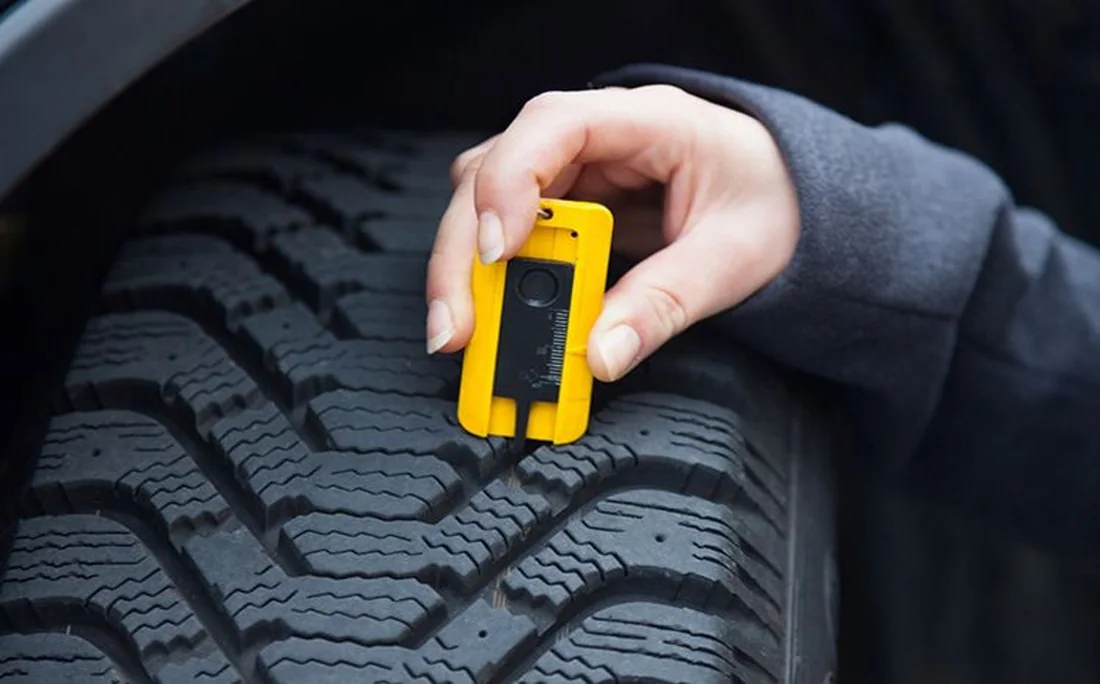
How to check the depth yourself — coin, wear bars, gauge
You do not need a shop visit to get a first reading. Three ways, from quickest to most precise:
- The quarter test. Take a Canadian 25-cent coin and slip it into one of the main grooves with the caribou’s nose pointing down. If you can see the tip of the snout, the tread is worn to roughly the 4.8 mm (6/32″) winter threshold or below — the tire will not grip well in deep snow, and its season is nearly over. Check several grooves, in different spots, on all four tires: the lowest reading is the one that counts. (This is the Gouvernement du Québec’s own trick — the photo above shows the gauge version.)
- The wear bars. Molded into the bottom of the grooves are small raised bars. When the tread surface wears down level with them, the tire is at the 1.6 mm legal limit — finished, whatever the calendar says.
- A depth gauge. The inexpensive tool in the photo gives the real number: push the probe into several grooves across the width and read the smallest value. It is the method shops use, and the only one that tells you exactly how much winter you have left.
Age matters too: the SAAQ notes that a tire’s quality starts to deteriorate after five years, so check the manufacturing week and year molded into the sidewall before paying to remount an old set. When the season ends, store the set the SAAQ way — cool, dry, stacked flat, away from heat, humidity and sunlight — and have the shop check overall condition, including the spare, at every changeover. Studded tires, if you run them, are permitted from October 15 to May 1 on passenger vehicles, taxis and light commercial vehicles (3,000 kg or less); chains are reserved for emergency, farm and snow-removal vehicles.
Mark them at removal, rotate at the changeover
Two habits make a set last noticeably longer, and both happen on changeover day. First: when a set comes off, mark where each tire sat — a chalk note or a tag on each wheel (front-left, front-right, rear-left, rear-right). Without that mark, next season’s rotation is guesswork.
It matters because the four corners do not wear evenly. On a front-wheel-drive car, the front tires do the driving and the steering, so they wear much faster. On a rear-wheel-drive car, the rears wear faster. All-wheel drive spreads the work more evenly, but corner-to-corner differences still build up. The fix is rotation: at each seasonal changeover, use your marks and mount the set in new positions, so wear evens out across all four and the whole set lasts longer. The common patterns: on front-wheel drive, the fronts move straight back and the rears cross to the front; on rear-wheel drive (and most all-wheel drive), it is the reverse — rears move straight forward, fronts cross to the back. Two limits: directional tires can only swap front-to-back on the same side, and if your car runs different sizes front and rear (staggered), front-to-rear rotation is off the table — side-to-side only, and only if the tires are not directional.
📅 Beat the Rush: Timing, Rentals and Paperwork
Every garage in the province fills up in November, because the whole province shares one deadline. Booking the changeover in October is the difference between a one-hour appointment and a two-week wait — and remember, winter can arrive before the law does. The SAAQ itself points out that tires are what adapt your car to early snow; December 1 is a legal minimum, not a weather forecast.
Renting or sharing instead? The law follows the car: rentals offered in Quebec must comply, which is one more thing to verify when you pick up the keys — worth a glance at the sidewall before you drive off. If you use car-sharing for winter trips, our Communauto Montreal guide covers the practical side, and our Globe car rental guide breaks down rates and the free-insurance angle. And while the SAAQ is on your mind, our Quebec car registration renewal breakdown shows what the other big SAAQ bill of the year actually contains, line by line.
🧭 So, Which Tire Should a Quebec Driver Actually Run?
One winter lesson I did not learn from a government page. Last winter, on a snowy day, I was stopped at a red light when the car behind me — rushing in just as the light was changing — could not brake in time on the snow and hit us from behind. Our bumper was torn, just like that. My tires were not the problem that day. The car behind me simply could not stop.
That is the part no comparison table can fix: in winter, your stopping distance is only half the equation — the other half is the car behind you. Leave more room than feels necessary, brake earlier and gentler than the light demands, and give the driver behind you time to do the same. The right tires matter enormously. So does the space around them.
Start from the law, then from your driving. If your car wears regular all-season tires, they have to come off for winter — that part is not a choice. The real decision is between a dedicated winter set and all-weather tires. Choose a dedicated winter set if you drive a lot, leave the city, face unplowed streets or simply want the shortest stopping distances of the three — and accept the twice-a-year changeover as the price. Choose all-weather tires if your driving is mostly urban and moderate, you have no storage space, and you value never thinking about changeovers — knowing you are trading away some ice performance and wearing one set all year. What never makes sense in Quebec: gambling a $200–$300 fine, and far worse odds in a skid, on an M+S stamp the law does not recognize.
Rules checked against the SAAQ and Gouvernement du Québec pages as of October 2026. Official sources: SAAQ — Winter Tires: Safe Winter Driving · Gouvernement du Québec — Requirements for Winter Tires
Tell me in the comments: dedicated winter set, or all-weather all year — and has a November garage rush ever caught you out? 👇
💛 — J.
❓ FAQ
Are all-season tires legal in Quebec in winter?
No — unless they carry the three-peak mountain snowflake pictogram, in which case they are actually all-weather tires. A regular all-season tire with only an “M+S” marking is not recognized as a winter tire under Quebec’s Highway Safety Code, and driving on it between December 1 and March 15 can bring a $200 to $300 fine, plus costs.
What exactly is the fine for not having winter tires in Quebec?
Between $200 and $300, plus costs, per the SAAQ. With those costs added, the total you actually pay typically tops $350. The requirement applies to vehicles registered in Quebec, including rental cars offered in Quebec; vehicles registered outside Quebec and trailers are exempt.
When should I put my winter tires on — exactly December 1?
December 1 is the legal deadline, not the ideal date. The SAAQ suggests installing them before winter sets in, because summer and all-season rubber starts losing grip once temperatures drop below 7 °C. Symmetrically, the government recommends waiting a few weeks after March 15 before switching back, since early-spring weather is variable.
Can I get an exemption from the winter tire rule?
In specific situations, yes: the SAAQ issues a seven-day exemption certificate, requested through SAAQclic or at a service centre. It covers cases such as leaving or returning to Quebec (snowbirds), buying a vehicle from an individual, taking a vehicle out of storage, or ending a long-term lease early. Separate automatic exceptions also exist, such as the seven days after a dealer purchase.
You May Also Like
- Quebec Car Registration Renewal 2026: My Real $350.86 SAAQ Bill, Line by Line
- Communauto Montreal Guide: Plans, Prices & Tips (2026)
- Globe Car Rental Montreal: Rates, Tips & Free Insurance
Get the Free Canada Savings Checklist
Join the newsletter — get the free PDF checklist and weekly Canada savings tips in your inbox.
Read Next


Some links in this post are referral or affiliate links. If you sign up or buy through them, I may receive a bonus or commission at no extra cost to you. It helps keep this blog running — thank you!