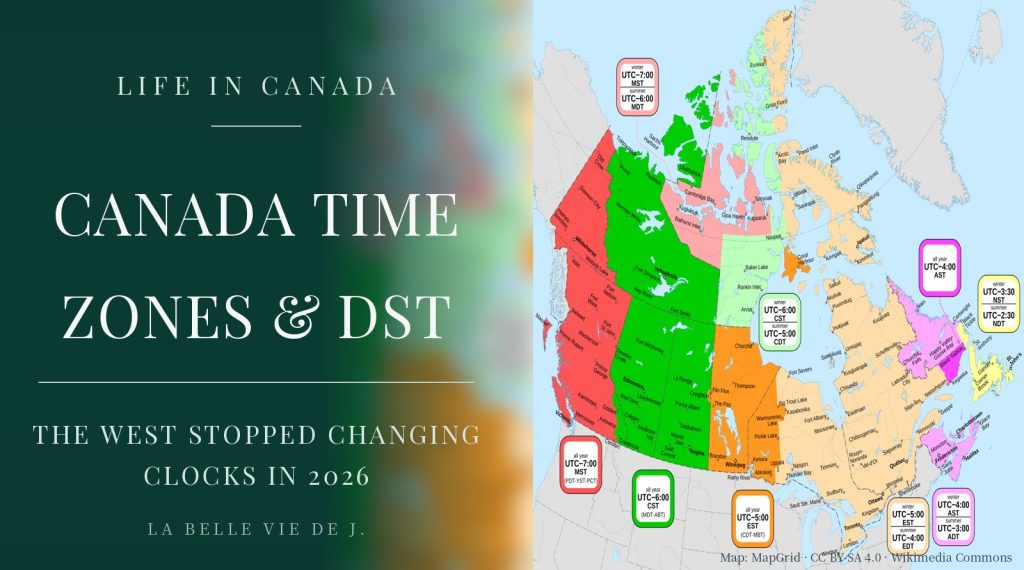
Canada Time Zones & Daylight Saving in 2026, Explained
Bonjour! It’s J. — When the clocks fall back in autumn, I feel like I’ve gained an hour. I wake up feeling as if I’d slept in, and the morning just feels easier. Spring is the opposite: when the clocks jump ahead, an hour feels stolen, and the whole day drags. Twice a year, I feel the change in my body — spring takes an hour away, and fall gives it back. If you live in Canada, you know exactly what I mean.
But starting in 2026, people in Vancouver, Calgary, and Winnipeg have graduated from that rhythm. This year, their provinces abolished the clock change altogether. Montreal and Toronto still change twice a year, but the West no longer does — so every province now plays by its own rules. Here’s what changed this year, and the full picture province by province.
📅 Current as of November 2026. This year brought so much change that even the federal government’s time page — maintained by the National Research Council of Canada — now warns that some of its content is no longer accurate after November 1, 2026, and points readers to provincial government pages instead. So for this post, I went through each province’s official announcements one by one.
The short version
- Starting in 2026, British Columbia, Alberta, Manitoba, and the Northwest Territories will never change their clocks again — they’ve locked onto daylight saving time
- Eastern cities like Montreal and Toronto still change twice a year, as before (next change: March 14, 2027)
- Saskatchewan and Yukon never changed their clocks in the first place — though the way they stay fixed differs
- Vancouver is now 16 hours behind Korea even in winter — one hour less than the old winter gap of 17 hours
- Quebec still changes for now, but abolition is under discussion — I’ll update this post when a decision lands
🕐 1. What Is Daylight Saving Time?
Daylight saving time (DST) is a system for using one more hour of evening daylight from spring through fall. The sun doesn’t actually stay up longer — we move our clocks one hour ahead of standard time, shifting our daily schedule toward the sun. That’s the accurate way to think about it.
Where clocks change, they spring forward one hour in spring (2 a.m. becomes 3 a.m.) and fall back one hour in autumn (2 a.m. becomes 1 a.m.). So the day after the spring change has 23 hours, and the day after the fall change has 25. That difference in the length of the day is exactly why spring feels stolen and fall feels given back.
One thing worth knowing: it’s not the federal government that decides this — it’s each province and territory. The National Research Council (NRC), a federal agency, only keeps the official time with atomic clocks. Whether to change clocks, and which time zone to use, is set entirely by provincial law. That’s how we ended up with the patchwork we have today.
In Quebec, daylight time is called heure avancée — literally, “advanced time.” If you see that phrase in a Montreal government notice, it’s talking about daylight saving time.
📜 2. Why Did Daylight Saving Time Begin?
It started with a simple calculation: use less lamplight in the evening and save energy. The first countries to adopt it nationwide were Germany and Austria in 1916, in the middle of World War I, to save the coal used for lighting. The campaign of British builder William Willett — longer bright evenings after work would mean more outdoor activity and spending — also helped the idea spread.
But here’s a fun twist: the first place in the world to actually do it was Canada. On July 1, 1908, residents of Port Arthur, Ontario (now part of Thunder Bay) moved their clocks ahead one hour — eight years before Germany’s national adoption, and still recorded as the world’s first daylight saving time. Sandford Fleming, the railway engineer who proposed the time zone system itself, was Canadian too. Canada has deep ties to how the world keeps time.
So why are more places abolishing it now? The debate has shifted. The question is no longer “should we have daylight saving time?” but “if we lock the clock, which side do we lock it on?” There’s broad agreement that changing twice a year is itself the biggest cost to our daily rhythms (93% in BC’s public engagement and 92% in Manitoba’s survey supported ending the change). The split is between locking onto daylight time for lighter winter evenings, and locking onto standard time for the sake of winter mornings and body clocks. In Canada right now, the answer differs by province.
💡 Fun fact: the story that Benjamin Franklin proposed daylight saving time is only half true. His 1784 essay was satire — if you want to save candles, get up earlier — not a proposal to move the clocks. And the idea that it was created for farming is a myth, too: farmers were actually closer to the opposing camp.
🗺️ 3. Canada’s Six Time Zones
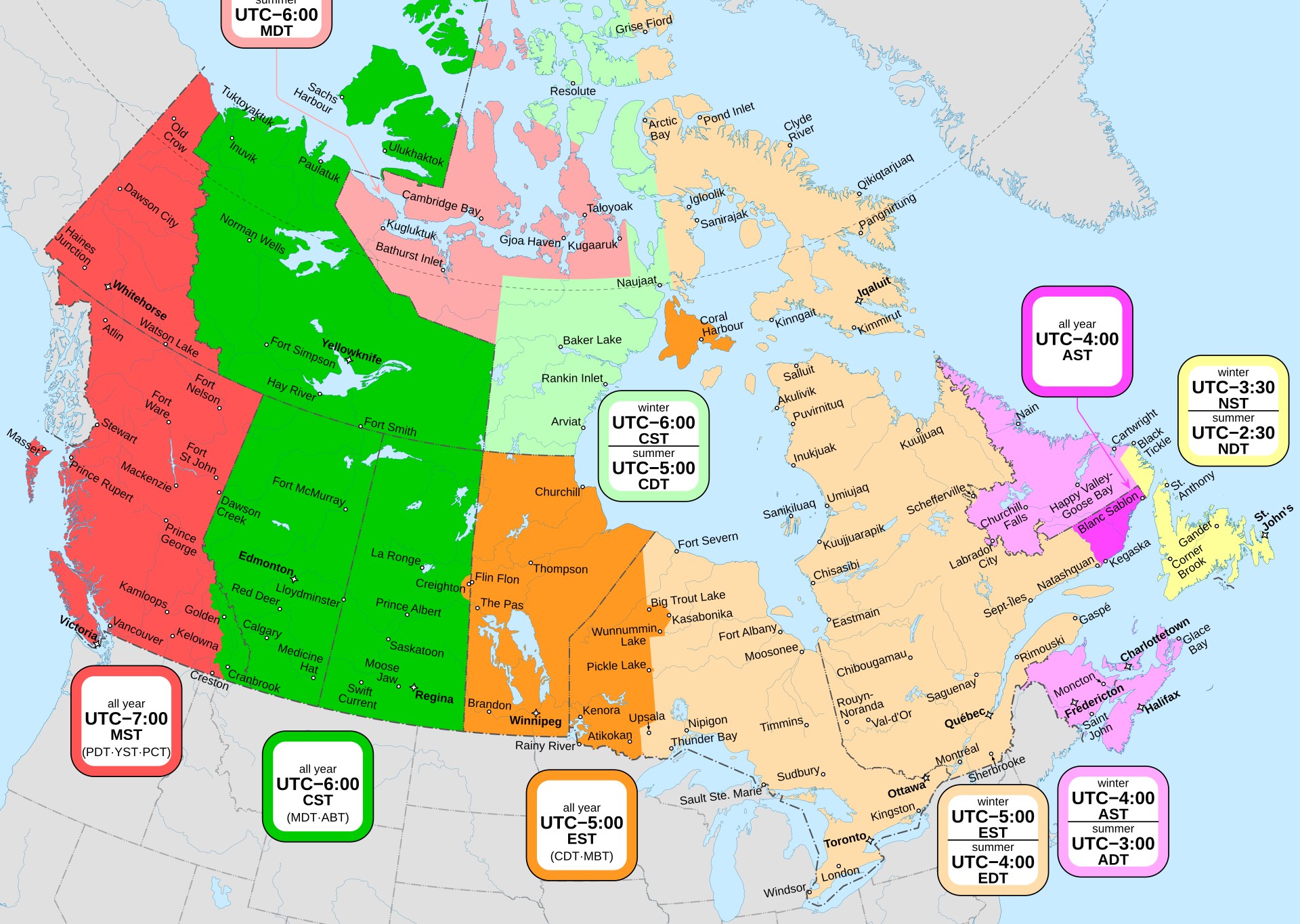
Canada is so wide from east to west that it has six time zones. Between Vancouver at the western edge and St. John’s at the eastern edge, the gap runs from three and a half to four and a half hours depending on the season. The table below is based on standard time, with the time actually in use added for the regions that locked in permanently in 2026.
| Time zone | Standard time | Daylight time | Major cities | How it actually runs after November 2026 |
|---|---|---|---|---|
| Pacific | UTC-8 | UTC-7 | Vancouver, Victoria, Kelowna | Mainland BC is locked to UTC-7 year-round |
| Mountain | UTC-7 | UTC-6 | Calgary, Edmonton, Yellowknife | Alberta and the Northwest Territories are locked to UTC-6 year-round |
| Central | UTC-6 | UTC-5 | Winnipeg, Regina, Saskatoon | Saskatchewan stays on UTC-6, Manitoba on UTC-5 |
| Eastern | UTC-5 | UTC-4 | Toronto, Ottawa, Montreal, Quebec City, Iqaluit | Seasonal change continues, as before |
| Atlantic | UTC-4 | UTC-3 | Halifax, Moncton, Charlottetown | Seasonal change continues, as before |
| Newfoundland | UTC-3:30 | UTC-2:30 | St. John’s, Corner Brook | Seasonal change continues, as before |
Both are called the “Central” time zone, yet Saskatchewan is locked to UTC-6 and Manitoba to UTC-5 — so Regina and Winnipeg are now one hour apart all year. We’ve entered an era where the same zone name no longer means the same time. The story behind Newfoundland’s 30-minute offset gets its own section further down.
🔀 4. What Changed in 2026?
Here’s the timeline of what happened in the West this year. The spring change on March 8, 2026 was nationwide. For British Columbia (BC), it turned out to be the last clock change ever — after that, BC chose not to fall back in autumn and to stay on summer time (UTC-7). The law behind it was passed back in 2019 but held back to stay in step with the United States; this year, the implementing regulation came into force and made it final.
Alberta followed. In a 2021 referendum, permanent daylight time narrowly lost — 49.8% in favour, 50.2% against. Five years later, the option that lost the vote was put in place by government decision. From November 1, 2026, Alberta stays on UTC-6 year-round under the name Alberta Time, and the province says it will collect public feedback one year after implementation.
Manitoba announced on September 17, 2026 and locked in right away on November 1. Of roughly 72,000 survey responses, 92% chose to end the change, and 58% chose permanent daylight time. The amusing part: it’s called Manitoba Standard Time, but in substance it’s permanent daylight time (UTC-5). The Northwest Territories also locked to UTC-6 year-round to stay aligned with Alberta, and Ontario’s northwestern Central Time region (Kenora and area) joined Manitoba on UTC-5 as of November 1.
The change even redrew the border picture. The Canada Border Services Agency (CBSA) announced adjusted operating hours at land border crossings from November 1, 2026 to March 14, 2027 — because the U.S. still fell back as usual, time calculations across the border now differ by season.
💡 Tip: If you moved west this year or travel there often, check once that your calendar apps and car clock aren’t still changing the time under the old rules. Provincial governments all give the same advice: keep your devices’ automatic time setting up to date.
📋 5. Province by Province — Does Yours Still Change?
All 13 provinces and territories, in one table. “2026 start / end” are the dates the clocks actually moved this year. Locked regions either sprang forward one last time in spring and never fell back (permanent daylight time), or never moved at all (year-round standard time).
| Province / Territory | Time zone | Clock change | 2026 start | 2026 end | Notes |
|---|---|---|---|---|---|
| British Columbia | Pacific (mainland) + Mountain (parts of the east) | Abolished — permanent DST (Pacific Time PCT, UTC-7 year-round) | 2026-03-08 (last change) | None | Mountain-time areas in the east are unaffected (see the fun-facts section below). Same time as Yukon year-round |
| Alberta | Mountain | Abolished — permanent DST (Alberta Time ABT, UTC-6 year-round) | 2026-03-08 | None | Went ahead in 2026 after the 2021 referendum defeat. Public feedback to be collected one year after implementation |
| Saskatchewan | Central (geographically Mountain) | Never observed — year-round standard time (CST UTC-6, since 1966) | N/A | N/A | The new Time Act of 2026-10-30 unified the whole province, including Lloydminster, on one time. Time option areas now: 0 |
| Manitoba | Central | Abolished — permanent DST (Manitoba Standard Time MBT, UTC-5 year-round) | 2026-03-08 | None | Called Standard Time, but permanent DST in substance. Winnipeg now matches Toronto’s clock in winter |
| Ontario | Eastern (most) + Central (northwest) | Observed in most of the province (seasonal change continues) / northwest Central region locked permanently | 2026-03-08 | 2026-11-01 (most areas) / None (northwest) | Province-wide permanent law not yet in force (conditional on Quebec and New York). Year-round EST areas like Atikokan exist separately |
| Quebec | Eastern (most) + Atlantic (eastern tip) | Observed (seasonal change continues) | 2026-03-08 | 2026-11-01 | Only the Basse-Côte-Nord stays on AST year-round. Abolition under discussion, no decision yet |
| New Brunswick | Atlantic | Observed | 2026-03-08 | 2026-11-01 | No official announcement of a change could be confirmed |
| Nova Scotia | Atlantic | Observed | 2026-03-08 | 2026-11-01 | No official announcement of a change could be confirmed |
| Prince Edward Island | Atlantic | Observed | 2026-03-08 | 2026-11-01 | No official announcement of a change could be confirmed |
| Newfoundland and Labrador | Newfoundland (island & southeastern Labrador) + Atlantic (most of Labrador) | Observed | 2026-03-08 | 2026-11-01 | Half-hour offset maintained |
| Yukon | Yukon Time (formerly Pacific family) | Not observed — permanently locked (Yukon Standard Time UTC-7, since 2020) | N/A | N/A | A different method from Saskatchewan: instead of locking to standard time, it redefined the DST offset as its standard time |
| Northwest Territories | Mountain family | Abolished — permanent DST (NWT Time UTC-6 year-round) | 2026-03-08 | None | A decision to stay in step with Alberta. Regulation in force 2026-08-21 |
| Nunavut | Three zones: Eastern, Central, Mountain | Observed in most areas | 2026-03-08 | 2026-11-01 | Only Southampton Island (Coral Harbour) is locked to EST year-round |
One caution when reading the table: “never observed” and “abolished” may look like the same result, but what’s underneath is different. Saskatchewan chose to stay on standard time; Yukon, BC, Alberta, and Manitoba chose to stay on daylight time. They picked the side with brighter winter evenings — so even among “places that don’t change their clocks,” winter sunsets feel different.
Travelling between time zones inside Canada now means checking the difference more often. If you’re heading to Toronto, my Toronto PRESTO Card Guide | TTC Fares, Transfers & the 47-Ride Cap (2026) will make planning your days a lot easier.
📞 6. How Many Hours Behind Korea?
Korea has no daylight saving time and uses Korea Standard Time (UTC+9) all year, so the gap used to move with Canada’s seasons. Now that the West has locked in, the math is much simpler. Korea is always ahead — that hasn’t changed.
| Canadian city | Winter (standard time period) | Summer (DST period) | After the 2026 change |
|---|---|---|---|
| Montreal (Eastern) | 14 hours (EST UTC-5) | 13 hours (EDT UTC-4) | No change — the old pattern continues |
| Toronto (Eastern) | 14 hours | 13 hours | No change |
| Vancouver (Pacific) | Previously 17 hours (PST UTC-8) | 16 hours (PDT UTC-7) | Locked at 16 hours year-round — the winter gap shrank from 17 to 16 |
| Calgary · Edmonton (Mountain) | Previously 16 hours (MST UTC-7) | 15 hours (MDT UTC-6) | Locked at 15 hours year-round |
| Winnipeg (Central) | Previously 15 hours (CST UTC-6) | 14 hours (CDT UTC-5) | Locked at 14 hours year-round — in winter, its gap with Korea now matches Montreal’s |
| Regina (Saskatchewan) | 15 hours (CST UTC-6) | 15 hours | Always locked at 15 hours |
| Halifax (Atlantic) | 13 hours (AST UTC-4) | 12 hours (ADT UTC-3) | No change |
| St. John’s (Newfoundland) | 12 hours 30 minutes (NST UTC-3:30) | 11 hours 30 minutes (NDT UTC-2:30) | No change — the only major city with a half-hour gap from Korea |
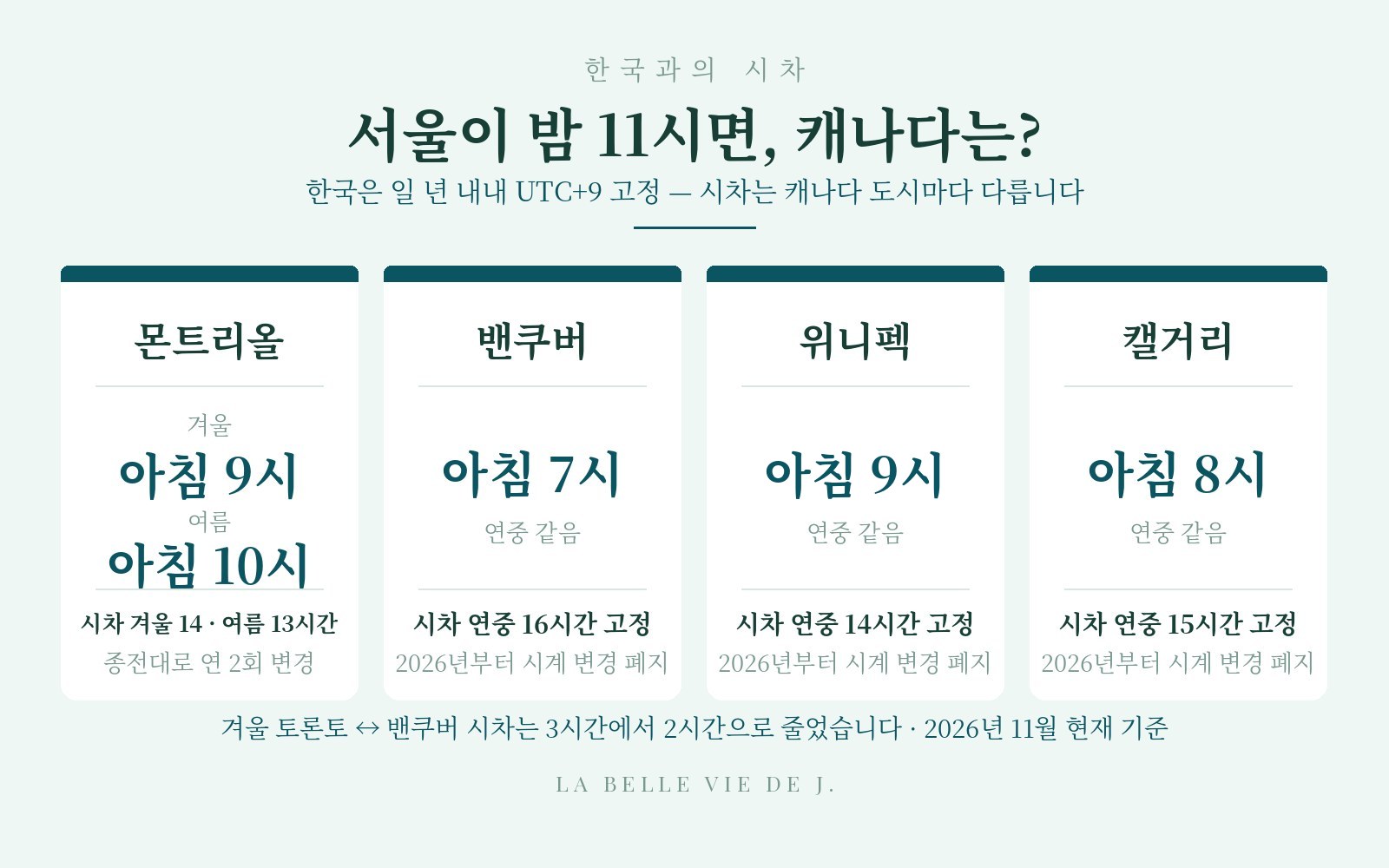
Here’s how it feels in practice. When it’s 11 p.m. in Korea, it’s 9 a.m. the same day in Montreal in winter, or 10 a.m. in summer. When it’s Monday 9 a.m. in Korea, Montreal is still at Sunday 7 p.m. in winter — the weekend-is-ending feeling lands completely differently. And at that same 11 p.m. in Korea, Vancouver is at 7 a.m. — and now that calculation holds in winter, too.
For calls with family in Korea, the change is biggest in the West. You used to have to ask “is Vancouver on winter time right now?” first — now you just memorize one number: 16 hours, all year. In exchange, scheduling inside Canada gained a step. A winter call from Toronto to Vancouver is now a 2-hour difference instead of the old 3, and Toronto to Calgary narrowed from 2 hours to 1 hour. In winter, Toronto and Winnipeg are on exactly the same time.
If you live in Montreal, one OPUS card covers both the metro and the bus — fares and free-ride eligibility are all in my Montreal STM guide to OPUS cards, fares and free rides.
🧩 7. Places Where the Clock Splits Inside a Single Province
A province-by-province table misses some fun details. In border regions, the clock can split inside a single city or a single island.
Lloydminster, a city split down the middle by a provincial border, is the classic example. Straddling Saskatchewan and Alberta, the whole city used to follow Alberta time — making it an “island within the province” in winter, an hour behind the rest of Saskatchewan. But in 2026, Alberta locked to UTC-6, and Saskatchewan’s new Time Act (in force October 30, 2026) unified the whole province, Lloydminster included, on UTC-6 — so for the first time in history, the entire province keeps the same time all year.
Quebec has a line of its own. Along the 63rd meridian west, the west side uses Eastern Time, while the Basse-Côte-Nord on the eastern mainland (including Blanc-Sablon) stays on Atlantic Standard Time (UTC-4) all year. In winter terms, it’s a part of Quebec that lives one hour ahead of the rest of the province. Even in that same east, though, the Magdalen Islands (Îles-de-la-Madeleine) observe Atlantic daylight time in summer, and the Minganie region, including Anticosti Island, is set by law to Eastern Time regardless of location — an exception among exceptions.
And then there’s Newfoundland’s half hour. St. John’s standard time is UTC-3:30 — 30 minutes ahead of Atlantic Time. It’s said to come from a historical offset matched closely to the city’s local solar time before standardization, and it’s the reason Canadian broadcast schedules say “9 o’clock, 9:30 in Newfoundland.” It’s also the only half-hour time zone in North America.
Elsewhere, the Dawson Creek area in northeastern BC has long used Mountain Standard Time (UTC-7) year-round — and by coincidence, that number now matches mainland BC’s new locked time, so the names differ but the clock reads the same all year. Nunavut alone spans three time zones — Eastern, Central, and Mountain — and within it, only Southampton Island stays fixed on Eastern Standard Time year-round.
⚠️ 8. Everyday Things to Watch
If you live where the clocks change, a few precautions help on changeover weekends. On the fall changeover night, the hour from 1 a.m. to 2 a.m. happens twice. It’s the one night of the year when a 1:30 a.m. meetup, an overnight work log, or an early-morning flight can get ambiguous — so make it a habit to check the time zone abbreviation on your booking confirmation (EST or EDT?).
On the spring changeover, the opposite happens: 2 a.m. to 3 a.m. simply doesn’t exist. It’s an easy stretch to get wrong in alarms and connection math on days with early departures or arrivals. Flights and trains usually print the time zone abbreviation alongside the time — on changeover weekends, read the abbreviation, not just the numbers.
If you’re in the West, watch for device time errors this year especially. There have been reports of older devices, car clocks, and outdated operating systems falling back in autumn under the old rules and ending up an hour off. Provincial guidance is consistent: turn on automatic time settings, keep updates current, and if it’s still wrong, set it manually.
The same goes for driving across the U.S. border. With the border agency having adjusted crossing hours from autumn until the next spring changeover, check the operating hours once more before an early-morning border run.
💡 Tip: On changeover weekends, don’t trust only your phone clock — sweep the manual clocks, like the microwave and the car, on Monday morning. As long as you live where the clocks change, this checkup is a twice-a-year ritual.
❓ Frequently Asked Questions
Q. Does Montreal still change its clocks?
Yes, for now. Quebec kept the old pattern in 2026 — forward on March 8, back on November 1. Ontario (Toronto) is the same, so no new time difference appears when you travel or call between Montreal and Toronto. That said, abolition is under discussion in Quebec, so things could change once a decision is made.
Q. Why doesn’t Vancouver change its clocks anymore?
Because BC passed a law locking the province onto daylight time starting in 2026. The spring-forward on March 8, 2026 was the last change; with no fall-back, BC stays on UTC-7 all year. The province chose to keep an extra hour of evening light in winter, too — and in the 2019 public engagement, 93% of responses supported year-round daylight time.
Q. How many hours is the difference with Korea?
It depends on the city. Montreal and Toronto are unchanged: 14 hours in winter, 13 in summer. Vancouver is now fixed at 16 hours year-round, Calgary at 15, and Winnipeg at 14. Halifax is 13 hours in winter and 12 in summer, and St. John’s has the half-hour twist: 12 hours 30 minutes in winter, 11 hours 30 minutes in summer. In every case, Korea is ahead.
Q. Will Quebec stop changing soon, too?
No decision yet. In the 2024 public consultation, about 91% of roughly 214,000 responses supported ending the change, and there have been reports of an intention to abolish it — but the Quebec government has not announced an official decision or start date. Ontario has a permanent daylight time law on the books, too, but it’s conditional on Quebec and New York State moving together, so for now the East keeps changing twice a year. Check the “current as of” date at the top of this post — I’ll update it when a decision lands.
💛 — J.
Does Montreal still change its clocks?
Yes, for now. Quebec kept the old pattern in 2026 — forward on March 8, back on November 1. Ontario (Toronto) is the same, so no new time difference appears when you travel or call between Montreal and Toronto. That said, abolition is under discussion in Quebec, so things could change once a decision is made.
Why doesn’t Vancouver change its clocks anymore?
Because BC passed a law locking the province onto daylight time starting in 2026. The spring-forward on March 8, 2026 was the last change; with no fall-back, BC stays on UTC-7 all year. The province chose to keep an extra hour of evening light in winter, too — and in the 2019 public engagement, 93% of responses supported year-round daylight time.
How many hours is the difference with Korea?
It depends on the city. Montreal and Toronto are unchanged: 14 hours in winter, 13 in summer. Vancouver is now fixed at 16 hours year-round, Calgary at 15, and Winnipeg at 14. Halifax is 13 hours in winter and 12 in summer, and St. John’s has the half-hour twist: 12 hours 30 minutes in winter, 11 hours 30 minutes in summer. In every case, Korea is ahead.
Will Quebec stop changing soon, too?
No decision yet. In the 2024 public consultation, about 91% of roughly 214,000 responses supported ending the change, and there have been reports of an intention to abolish it — but the Quebec government has not announced an official decision or start date. Ontario has a permanent daylight time law on the books, too, but it’s conditional on Quebec and New York State moving together, so for now the East keeps changing twice a year. Check the “current as of” date at the top of this post — I’ll update it when a decision lands.
Get the Free Canada Savings Checklist
Join the newsletter — get the free PDF checklist and weekly Canada savings tips in your inbox.
Read Next


Some links in this post are referral or affiliate links. If you sign up or buy through them, I may receive a bonus or commission at no extra cost to you. It helps keep this blog running — thank you!