Quebec Student Loans — You Don’t Have to Repay It All: The 15% AFE Loan Remission, Explained
📅 This guide is current as of November 2026 (2026–2027 academic year). Amounts and conditions change every year, so double-check the official pages linked below before you apply.
Bonjour! It’s J. — The first question that comes up whenever someone looks into student aid in Canada is, “In Quebec, do you really have to pay it all back?” This time, I’ve put everything about student loans in one place.
In Canada, student financial aid is run province by province. Some provinces deliver it together with the federal government, while others — like Quebec — run their own system entirely. So borrowing in Quebec and borrowing in Ontario are completely different, from the name of the program to the conditions attached. This guide follows the order of the questions people ask most. In Quebec, if you graduate on time, the government forgives 15% of your student loan. The catch is that the conditions are strict — miss them without realizing, and money you could have kept is gone for good.
THE SHORT VERSION
- In Quebec, AFE forgives 15% of your loan if you meet two conditions: graduate on time + receive a bursary every year you study
- You must apply for the forgiveness within 3 years of finishing your studies — after that, it’s gone
- Ontario’s OSAP pairs strong federal grants with interest-free federal loans, but it has no forgiveness program after graduation
- You apply for student aid based on the province you live in, not the province where your school is
🎓 1. In Quebec, do you have to pay back the whole student loan?
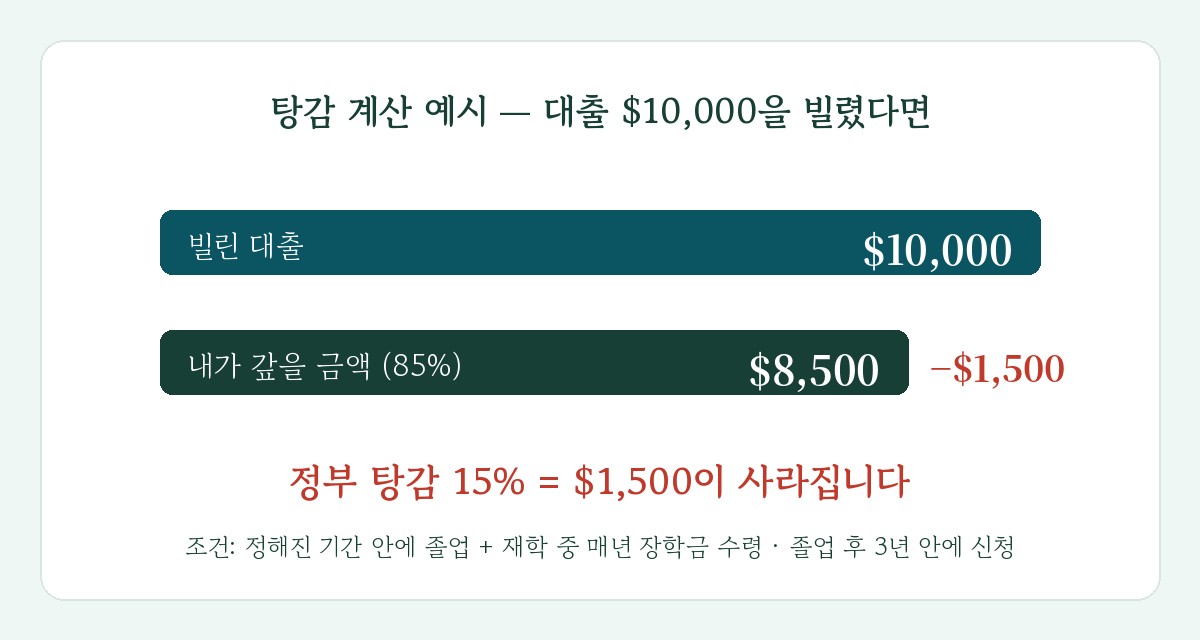
No. Meet the conditions, and 15% of the loan never has to be repaid. Quebec has a program that wipes out part of your loan after graduation — in French, the remise de dette (loan remission). The government pays 15% of your total borrowed amount directly to the financial institution that holds your loan, and your remaining balance drops by that much.
There are two conditions. First, you have to finish your program within the standard timeframe set by your school. Second, you must have received a bursary (bourse) in every academic year of that program. If there’s even one year where you only got a loan and never reached the bursary portion, that program is out of the forgiveness program entirely. That’s why applying every year and receiving a bursary is where forgiveness really starts.
You apply within 3 years of finishing your studies, using Form 1113 (Demande de remise de dette) with your final transcript attached. Eligibility and how to submit are laid out in Quebec’s official loan remission guide. Miss the deadline, and even a fully eligible borrower gets nothing.
💡 Tip: From your very first year, your file has to be set up so that it produces a bursary, not just a loan — that’s what carries through to forgiveness at graduation. Miss a single year in the middle, and the whole program is excluded.
💰 2. How does Quebec student aid actually pay out?
Quebec’s student aid program, AFE (Aide financière aux études), is run by the province alone, completely separate from the federal system. The money comes out in a fixed order: once your financial need is calculated, it’s covered by a loan first, and only the part above the loan ceiling is paid as a bursary.
This is where a lot of people get confused. During the academic year, the entire amount is first advanced by your bank as a loan. Then, once the year ends and your income is verified, the government repays the bank for the portion that was supposed to be a bursary. In other words, a bursary isn’t cash in your hand — it’s the part of your loan balance that simply disappears.
Your need is calculated as recognized expenses (tuition, living costs, and so on) minus the contribution expected from you, your parents, and your spouse. The lower the income — and therefore the greater the need — the more of the total goes past the loan ceiling and comes out as a bursary.
📝 3. Who can apply?
Eligibility looks at two things: your status and your residence. For status, you must be a Canadian citizen, a permanent resident, or a refugee or protected person. On top of that, you have to live in Quebec — or be treated as a Quebec resident, for example when your parents live in Quebec.
Put the other way around: without permanent residence, you cannot apply. If your PR application is still in process, or you’re in Canada as a visitor, you can’t apply for AFE — and the same goes for Ontario’s OSAP. So if permanent residence is in your plans, the first question is how to line up the timing of your eligibility with the timing of admission and application.
One more requirement: you have to be enrolled full-time in a recognized program at a designated institution. Checking whether your school and program qualify for AFE comes first.
🔢 4. How much can you get?
The amount differs from person to person, because it follows the need calculation. The recognized living allowance that anchors it is $663 a month if you live with your parents, and $1,415 a month if you live on your own. Recognized expenses like tuition are added on top, and the contributions from you and your family come off.
There’s also a cumulative ceiling on how much you can borrow in total. For an undergraduate degree, the total debt limit is $36,000, and for programs studied outside Quebec the limit rises to $55,000 — because higher out-of-province tuition counts as a recognized expense.
Graduate studies work the same way. Master’s and doctoral programs can also apply for AFE; only the total debt limits are set higher than for undergraduates. A master’s is $48,000 ($42,000 for shorter programs of under 20 months), and a doctorate is $55,000. These limits are not annual — they’re the total amount of loan you can accumulate over the entire period of study at that level. The 15% forgiveness after graduation also applies to graduate studies. There’s one condition, though: to get forgiveness at the graduate level, you must already have received forgiveness for your undergraduate studies. Someone who received undergraduate forgiveness and then meets the conditions again at the graduate level (full-time study, graduating within the set period, a bursary every year) can apply one more time, at that level.
It’s also worth knowing that tuition for Quebec residents is among the lowest in Canada, so when you study inside Quebec, the amount you actually need often comes out smaller than in other provinces.
🗓️ 5. When and how do you apply?
Applications open every May, online through your own student financial assistance file on Quebec’s official student aid page. There is no automatic renewal — you apply fresh every academic year, and that “apply every year” step connects directly to the forgiveness condition from section 1 (a bursary every year).
The deadline is within 30 days after the last month of study in that academic year. To apply, you’ll need your permanent code (code permanent), your Social Insurance Number (SIN), your school and program codes, and income information for you, your parents, and your spouse.
💡 Tip: Applying right when applications open in May is the safest route. With the document deadline factored in (within 45 days of applying), it’s far less rushed than leaving everything to just before the semester starts.
🏦 6. When does repayment start, and how much is the interest?
Repayment starts 6 months after your full-time studies end. In Quebec you repay the financial institution (bank) that issued your loan directly, so the repayment terms are set in your agreement with that bank. The detailed rules for repayment schedules and interest are in Quebec’s official repayment guide.
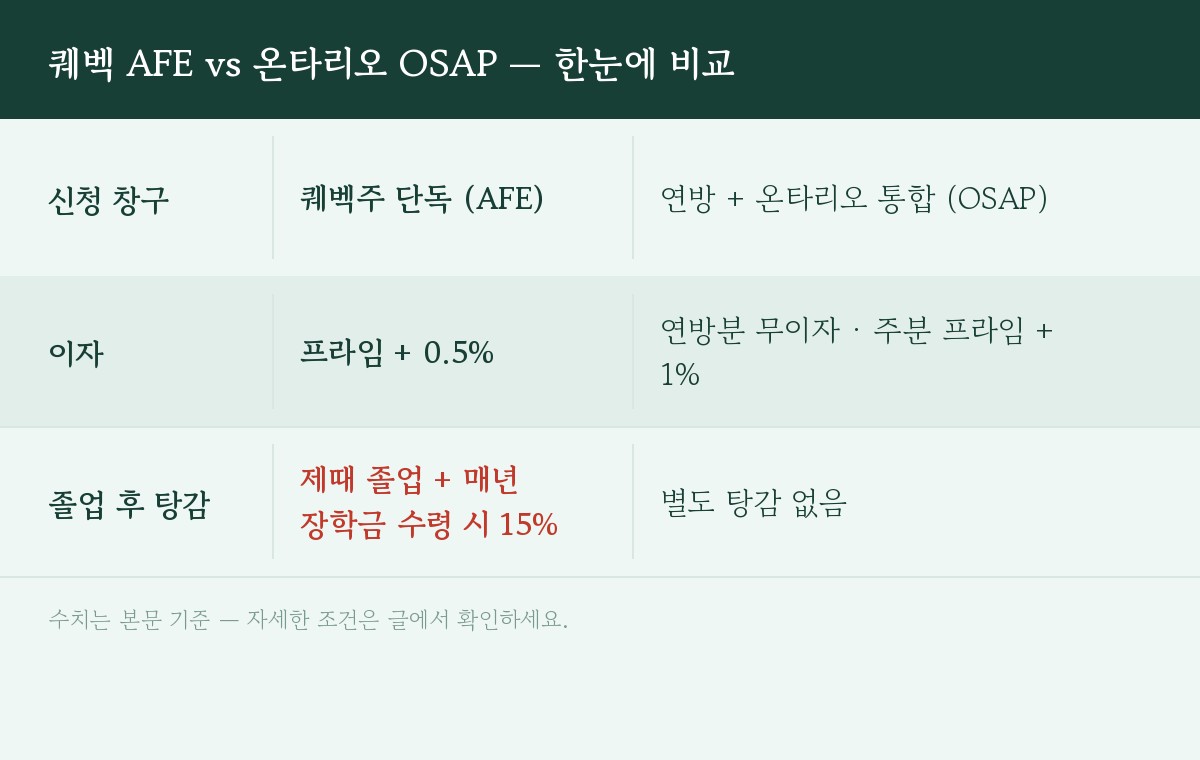
Interest is prime rate + 0.5% (floating). While you’re studying full-time, the government covers the interest for you; interest that accrues during the 6-month grace period after your studies end is added to your principal. You can also choose to start repaying right after finishing, or to pay the interest first.
🛟 7. What if repaying gets hard?
If you’ve graduated but your income is low and repayment feels out of reach, there’s a program to use before you ever fall behind. With a deferred repayment arrangement (remboursement différé), you can reduce or pause payments in 6-month stretches, renewable up to a cumulative maximum of 60 months.
During the deferral, the government pays the interest — it’s interest you don’t owe, so deferring doesn’t make your debt grow. There are conditions: for example, at least 6 months must have passed since you finished (or stopped) your studies, and you must be within 10 years of the end. If repayment starts getting difficult, check your options right away. Eligibility and how to apply are in Quebec’s official deferred repayment guide.
🍁 8. How is Ontario’s OSAP different?
Ontario’s OSAP is structured the opposite way from Quebec. The federal and provincial governments are integrated: one application assesses federal student aid and Ontario aid together, and repayment goes through a single place, the National Student Loans Service Centre (NSLSC). Applications start at Ontario’s official OSAP page, and repayment details are in the OSAP repayment guide.
The strength sits on the federal side. Federal grants (free assistance) go up to $4,200 a year, and interest on federal loans was permanently eliminated in April 2023. Interest applies only to the Ontario portion (prime rate + 1%). That’s a sharp contrast with Quebec’s AFE, where interest applies to the entire loan.
There is one change to be aware of. For programs starting on or after August 1, 2026, the grant share of the Ontario provincial portion drops to a maximum of 25%, with the rest coming out as loans. And OSAP has no post-graduation reduction like Quebec’s 15% forgiveness — instead, it’s built around the Repayment Assistance Plan (RAP), which lowers your payments when your income is low.
🧭 9. What happens to student aid if you go to university in another province?
There’s one principle: you apply for student aid based on the province where you live, not the province where the school is. Live in Quebec and attend a university in Ontario, and you still apply through Quebec’s AFE. Live in Ontario and study in another province, and you receive OSAP.
A Quebec resident heading to a university in another province applies for AFE as usual, and the debt limit is set at $55,000 rather than the undergraduate $36,000. However, tuition is charged at that province’s regular rate rather than the Quebec resident rate, so the amount you borrow grows. The 15% forgiveness after graduation also applies if you graduated from a school outside Quebec. Quebec’s student aid administrative rules set out separate forgiveness criteria for “studies outside Quebec,” so if you received a bursary every year at a designated school outside Quebec and graduated within the set period, you can apply for the same 15%.
On the other hand, if your family moves to another province before you start, the story changes. Ontario’s OSAP requires a period of Ontario residence before your studies begin, so if the move and the start of school don’t line up, you can end up in a gap where neither province will fund you. If a move is in the plan, the safe approach is to work backwards from the admission date.
✅ 10. To wrap up — just remember this
- In Quebec, finishing your degree pays off in cash. Graduate on time with a bursary every year, and 15% of your loan disappears. Apply within 3 years of finishing.
- In Ontario, the federal side does the heavy lifting. Federal grants and interest-free federal loans come with it, but from August 2026 the provincial grant share drops to a maximum of 25%.
- What counts is where you live, not where the school is. Apply through your home province’s system, and eligibility opens with citizenship, permanent residence, or protected-person status.
Good reads to go with this
· The Complete Guide to Toronto’s PRESTO Card — living in Ontario
· The Complete Guide to Montreal STM & OPUS — living in Quebec
· Canada Child Benefit (CCB), Explained — a guide to family benefits
💡 Tip: Conditions and amounts shift a little every academic year. Before you apply, check that year’s rules once more on the official pages below.
OFFICIAL SOURCES
· Quebec student loan remission guide — Québec.ca loan remission guide
· Loan remission application Form 1113 — Download Form 1113 (PDF)
· Quebec student aid — applications and the full program overview — Québec.ca student aid overview
· Student aid when studying outside Quebec — Québec.ca studying outside Quebec
· Quebec student loan repayment guide — Québec.ca repayment guide
· Ontario OSAP application and overview — Ontario.ca OSAP
· Ontario OSAP repayment guide — Ontario.ca OSAP repayment guide
❓ Frequently Asked Questions
Q. In Quebec, do you really not have to pay back the whole student loan?
Not the whole amount — it’s 15%. If you graduate within the period set by your school and received a bursary every year while studying, the government repays 15% of your borrowed loan for you (remise de dette). The same standard applies if you graduated from a school outside Quebec. Apply with Form 1113 within 3 years of the end of your studies.
Q. Can I apply for student aid without permanent residence?
No. Both Quebec’s AFE and Ontario’s OSAP are for citizens, permanent residents, and protected persons. You can’t apply while a PR application is in process or while you’re in Canada as a visitor.
Q. When does student loan repayment start?
In both Quebec and Ontario, 6 months after your full-time studies end. In Quebec you repay the bank that issued your loan directly; in Ontario you repay through the NSLSC, all in one place.
Q. How much interest is charged on student loans?
Quebec’s AFE charges prime rate + 0.5% on the entire loan (the government covers interest while you study). Ontario’s OSAP federal portion is interest-free (permanently eliminated in 2023), and only the Ontario portion carries prime rate + 1%.
Q. If I go to university in another province, where do I apply for student aid?
You apply to the province where you live, not where the school is. A Quebec resident attending a university in Ontario still applies through Quebec’s AFE, and the debt limit applies at the higher $55,000. Tuition, however, is paid at that province’s regular rate.
Q. What happens if repaying becomes difficult after graduation?
In Quebec, deferred repayment (remboursement différé) lets you reduce or pause payments in 6-month stretches, up to a cumulative maximum of 60 months, with the government covering the interest during that time. In Ontario, there’s the Repayment Assistance Plan (RAP), which reduces or eliminates payments based on your income.
In Quebec, do you really not have to pay back the whole student loan?
Not the whole amount — it’s 15%. If you graduate within the period set by your school and received a bursary every year while studying, the government repays 15% of your borrowed loan for you (remise de dette). The same standard applies if you graduated from a school outside Quebec. Apply with Form 1113 within 3 years of the end of your studies.
Can I apply for student aid without permanent residence?
No. Both Quebec’s AFE and Ontario’s OSAP are for citizens, permanent residents, and protected persons. You can’t apply while a PR application is in process or while you’re in Canada as a visitor.
When does student loan repayment start?
In both Quebec and Ontario, 6 months after your full-time studies end. In Quebec you repay the bank that issued your loan directly; in Ontario you repay through the NSLSC, all in one place.
How much interest is charged on student loans?
Quebec’s AFE charges prime rate + 0.5% on the entire loan (the government covers interest while you study). Ontario’s OSAP federal portion is interest-free (permanently eliminated in 2023), and only the Ontario portion carries prime rate + 1%.
If I go to university in another province, where do I apply for student aid?
You apply to the province where you live, not where the school is. A Quebec resident attending a university in Ontario still applies through Quebec’s AFE, and the debt limit applies at the higher $55,000. Tuition, however, is paid at that province’s regular rate.
What happens if repaying becomes difficult after graduation?
In Quebec, deferred repayment (remboursement différé) lets you reduce or pause payments in 6-month stretches, up to a cumulative maximum of 60 months, with the government covering the interest during that time. In Ontario, there’s the Repayment Assistance Plan (RAP), which reduces or eliminates payments based on your income.
💛 — J.
Get the Free Canada Savings Checklist
Join the newsletter — get the free PDF checklist and weekly Canada savings tips in your inbox.
Read Next


Some links in this post are referral or affiliate links. If you sign up or buy through them, I may receive a bonus or commission at no extra cost to you. It helps keep this blog running — thank you!