
[Fortune 4-Panel] 4 Winter Rituals for a Sealed-Up Home (Series ⑳)
Bonjour! It’s J.
Winter turns every home into a sealed jar. Windows stay shut, the heating hums, candles come out — and the air inside quietly stops being the air you think you’re breathing. Today, four winter rituals for a sealed-up home, built on what the research actually says.
🌿 Quick Take
- ① Condensation is a signal — wet windows mean the air is too wet
- ② Humidity between 40 and 60 — dry air is a virus’s favorite weather
- ③ Candles and incense, honestly — burn small, ventilate, cap the flame
- ④ The five-minute air reset — fresh air is a cognitive upgrade
🪟 ① Condensation Is a Signal, Not a Smudge
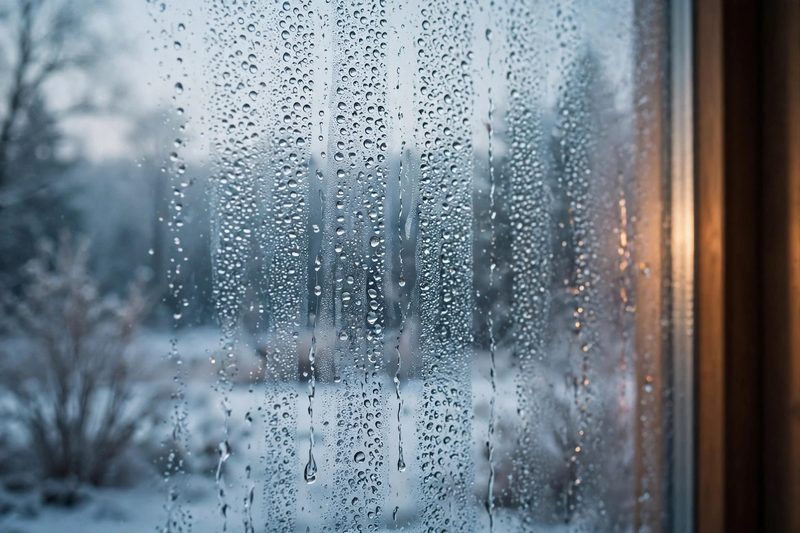
Those droplets on the glass are your home filing a report. Indoor air holds more water than the cold pane can handle — and where water sits day after day, mold learns the address. Wipe it, yes. But read it first.
- Wipe and dry, every morning it appears. A dry cloth on the glass and the sill takes thirty seconds. A sill that stays wet for weeks is a mold nursery with a view.
- Find the source before the scent. Cooking steam, long showers, laundry drying indoors — winter stacks them all into the same sealed air. Vent at the source and the windows clear.
- Leave a finger of space. Furniture pressed flat against a cold exterior wall traps still, damp air behind it. A few centimeters of breathing room prevents the hidden patch nobody sees until spring.
✨ The principle behind it: The U.S. Environmental Protection Agency’s mold guide is blunt: keep indoor humidity below 60 percent — ideally between 30 and 50 percent — and “if you see condensation or moisture collecting on windows, walls or pipes, act quickly to dry the wet surface” (EPA, A Brief Guide to Mold, Moisture and Your Home). Condensation is not a cosmetic flaw. It is the earliest, cheapest warning the house gives you.
🌡️ ② Keep the Air Between 40 and 60
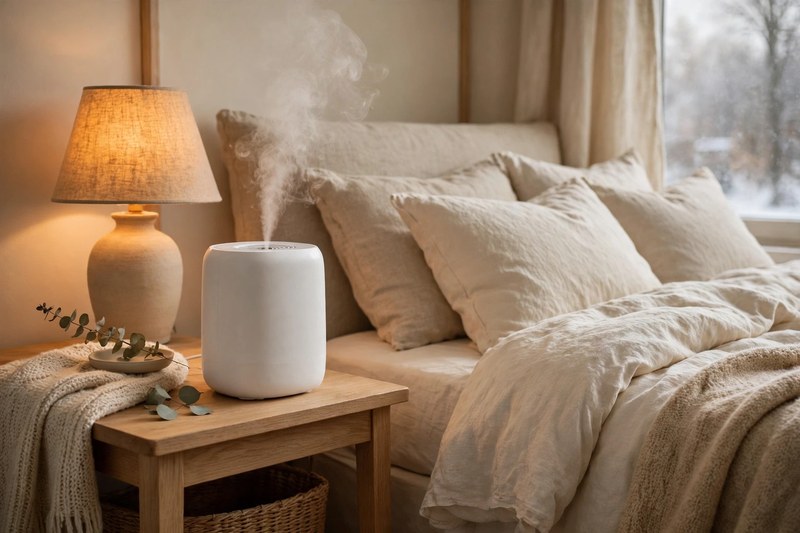
Heated winter air is desert air. Your nose and throat dry out, your skin complains — and, less visibly, the viruses of the season travel better in it. A small hygrometer costs less than the candles beside it. Trust the number, not the feeling.
- Measure before you humidify. Put the hygrometer where you sleep, not where you steam vegetables. Many “dry” homes are only dry in one room.
- Aim for the middle band. Roughly 40–50 percent in winter balances comfort against the condensation of panel one. Chasing 60 trades one problem for another.
- Clean the humidifier like a kettle. A neglected tank aerosolizes whatever grows in it. Empty it daily, descale weekly — the mist should be water, not an ecosystem.
✨ The principle behind it: In a controlled animal study, influenza spread most efficiently at low relative humidity (20–35 percent), fell sharply at 50 percent, and was completely blocked at 80 percent (Lowen et al., 2007, PLoS Pathogens). It is an animal experiment, not a promise about your living room — but the physics of dry air and thirsty mucous membranes points the same way. Winter humidity is not a spa luxury; it is part of the season’s hygiene.
🕯️ ③ Candles and Incense: Burn Small, Ventilate, Cap the Flame
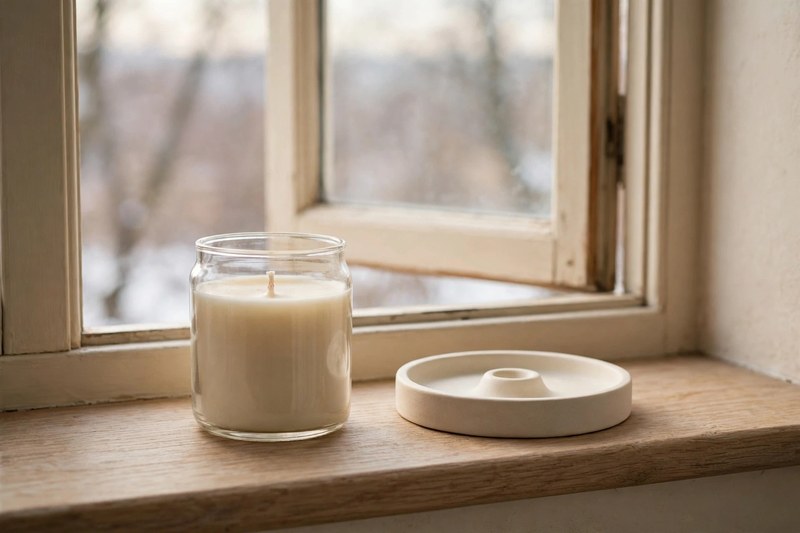
Here is the part nobody puts on the candle label. A flame is a small indoor combustion source, and in a sealed winter room its smoke has nowhere to go. Candles and incense are not the same problem, though — the measurements differ by orders of magnitude, and so should your habits.
- Incense is the heavy emitter. In a Korean sealed-room measurement, burning incense averaged over 1,900 µg/m³ of fine particles (PM2.5) beside the product, while a lit candle measured around 17 µg/m³ — a gap of more than a hundredfold (Park et al., 2024, Journal of Environmental Health Sciences). Burn incense rarely, briefly, and never in a closed bedroom.
- For candles, the danger moment is the ending. In the same study, blowing a candle out spiked fine particles to an average of 2,366 µg/m³, while smothering it with a lid stayed near 13 µg/m³. Cap it, don’t blow it — a roughly 180-fold difference for one changed gesture.
- Ventilation is the other half of the ritual. After incense, ten minutes of open-window ventilation cut fine particles by more than 90 percent, and the U.S. EPA lists candles and incense among indoor particle sources, advising ventilation while they burn. Scent first, fresh air immediately after — in that order.
✨ The principle behind it: You may have heard that incense smoke is “like cigarette smoke.” Here is what the data actually supports: in a 1996 laboratory comparison, incense emitted about 45 mg of particles per gram burned versus roughly 10 mg per gram for tobacco — a per-gram, particles-only, laboratory figure (Mannix et al., 1996, Science of the Total Environment). Headlines that turn that into “one stick equals four cigarettes” are swapping units. And for candles, chamber research across wax types found no wax that was consistently cleaner — what raised emissions was added fragrance and how the candle was burned, not soy versus paraffin (Salthammer et al., 2021, Environment International). The honest rule: treat scent as a mood tool, treat smoke as smoke, and let ventilation finish every burn.
🌬️ ④ The Five-Minute Air Reset
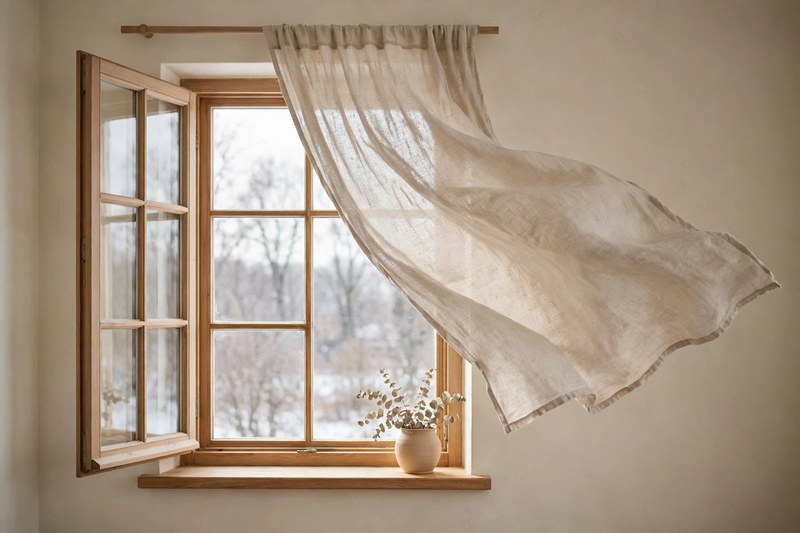
A sealed home exhales nothing. Every breath you take adds carbon dioxide to a fixed volume of air, and by evening a closed-up living room can feel heavy for a reason that has a number. The cure is not a gadget. It is five wide-open minutes.
- Short and wide beats long and cracked. Open windows fully for five minutes, ideally on two sides. The air exchanges before the walls cool — the German call it shock ventilation, and it is why their winter homes stay fresh without staying cold.
- Tie it to fixed moments. Morning wake-up, after cooking, after guests, before bed. A habit attached to an event survives; a resolution attached to nothing evaporates.
- Cook and shower with the fan already on. Extraction works at the source or barely at all. Steam and cooking particles removed in the first minute never join the evening’s air.
✨ The principle behind it: In Harvard’s COGfx controlled-exposure study, office workers’ cognitive scores averaged 61 percent higher on well-ventilated “green” days and 101 percent higher with enhanced ventilation, compared with conventional conditions around 1,400 ppm of CO₂ (Allen et al., 2016, Environmental Health Perspectives). Your home is not their laboratory — but a winter brain running on recycled air is the same organ. Five minutes of cold, clean air is the cheapest upgrade in this entire series.
Four small rituals, one sealed season. Read the windows, mind the humidity, burn honestly, and reset the air — a winter home that breathes is a home that takes care of its people.
💡 J’s Tip — Buy the hygrometer before the candle. One small instrument tells you whether your home needs moisture, ventilation, or neither. Winter air problems are invisible until they are measured — and once they are measured, they are usually one habit away from solved.
Wishing you a beautiful day.
A sealed home is only half the winter story — the bathroom’s water and the windows’ light are working on the same air:
🚿 Water, Working for You
The room where water lives has its own hygiene physics — 4 Bathroom Rituals That Keep Water Working for You (Series ⑲)
🪟 Windows Are Lungs, Too
The light side of the same glass — 4 Window & Light Rituals That Brighten a Home’s Space Energy (Series ⑯)
📅 Start the Year Breathing
The rituals of people who start the year ready for what it brings — 4 New Year Rituals of People Ready for Good Luck (Series ⑧)
Happy living 💛 — J.
💌 You May Also Like
Get the Free Canada Savings Checklist
Join the newsletter — get the free PDF checklist and weekly Canada savings tips in your inbox.
Read Next


Some links in this post are referral or affiliate links. If you sign up or buy through them, I may receive a bonus or commission at no extra cost to you. It helps keep this blog running — thank you!