
[Fortune 4-Panel] 4 Closet Rituals for the Changing Season (Series ㉑)
Bonjour! It’s J.
Twice a year, the closet asks a quiet question: what will you carry into the next season, and in what condition? A seasonal swap done with care is less about luck than about laundry, dry air, and honest labels — and that care is exactly what today’s four panels are made of.
🌿 Quick Take
- ① Wash it before you store it — moth larvae prefer soiled fabric
- ② That musty smell is a message — a mould compound, not a mystery
- ③ Sixty degrees is the mite line — warm washes leave most mites alive
- ④ Cedar and lavender, honestly — pleasant, but not proven protection
🧥 ① Wash It Before You Store It
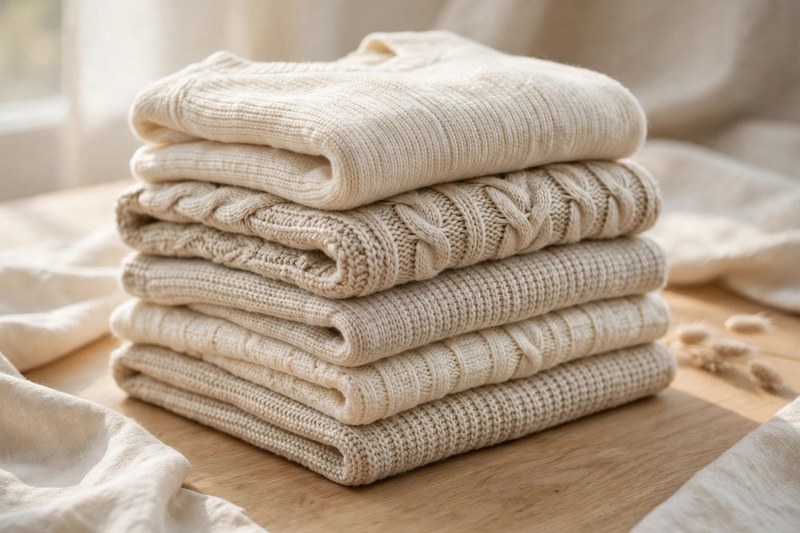
The sweater you wore three times in March feels clean. To a clothes moth larva, it reads differently — traces of perspiration and food are exactly what make a fabric worth eating. The wash before storage is not tidiness; it is removing the menu.
- Everything going away gets washed. Knitwear, coats that allow it, scarves, gloves — if it touched skin or a dinner table, it goes through a wash or a proper clean before it goes into storage.
- Check the quiet stains. Cuffs, collars and underarms hold the perspiration and spills we forget by spring. Those spots are where damage starts, months later, in the dark.
- Airtight is the finish line. Clean garments go into a sealed container or a zipped storage bag. Clean and sealed is the whole system — everything else is decoration.
✨ The principle behind it: The University of California’s pest management program (UC IPM, Clothes Moths, Pest Notes) states it plainly: fabrics with food, perspiration or urine stains are more subject to moth damage, and larvae feed more readily on soiled fibres than clean ones. The same guidance notes that laundering in water at least 120°F (about 49°C) for 20–30 minutes kills all life stages — and that stored items should start out clean and pest-free, in an airtight container.
👃 ② That Musty Smell Is a Message

You open the closet in October and there it is — that flat, earthy, slightly sweet mustiness. That smell is not “old closet.” It is chemistry, and it is telling you mould has been at work. Read the message before you reach for a fragrance to cover it.
- Air it before you scent it. Leave the doors open, let a room fan move air through, and give stored clothes a day on a rack. Stale air out first; any sachet comes after, if at all.
- Hunt the moisture, not the smell. Check the wall behind the clothes for cold spots or damp, feel for garments stored before they were fully dry, and look at the floor line. Mustiness always has a water source.
- Dry is the deodoriser. A small dehumidifier, a ventilated door, space between hangers — mould struggles in moving, dry air. Fix the humidity and the smell loses its author.
✨ The principle behind it: Researchers identified 1-octen-3-ol, a volatile compound released by fungi, as responsible for much of the distinctive mouldy odour associated with fungal colonisation (Inamdar et al., 2013, Proceedings of the National Academy of Sciences). In plain terms: the musty smell is a mould metabolite your nose detects well. One honest limit — that study examined mould odour chemistry in affected buildings, not closets specifically. But the molecule does not care which room it is in, and neither should the response: find moisture first, fragrance last.
🌡️ ③ Sixty Degrees: The Mite Line
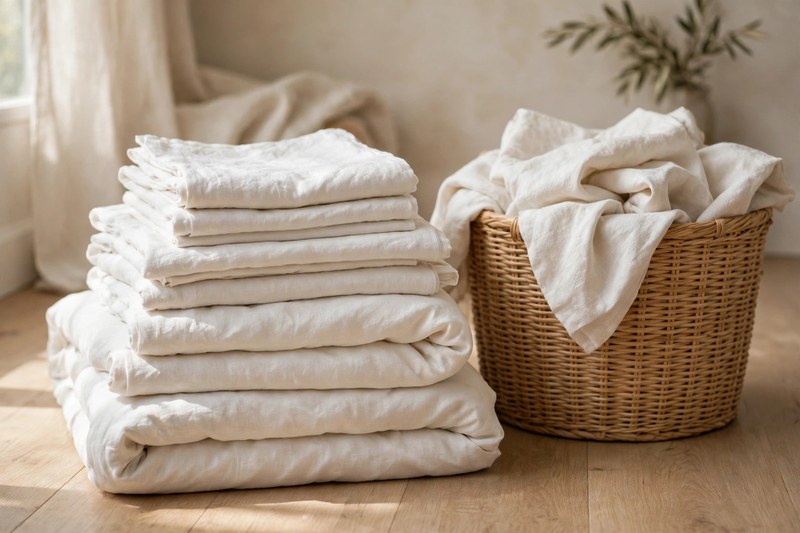
The season swap is also bedding season — duvets come out, summer sheets go away. For the wash that matters most, the number is not “warm.” It is 60. House dust mites are remarkably unimpressed by anything less.
- Bedding gets the hot wash. Sheets, duvet covers and pillowcases that tolerate it go in at 60°C — at the season change, and regularly through the months they are in use. Check care labels first; most cotton bedding handles it well.
- Warm is a gesture, not a result. A 30 or 40°C cycle freshens fabric and removes much of the allergen load in the rinse — but as the numbers below show, the mites themselves mostly survive it.
- Steam is the other door. For items that cannot take a 60°C wash, steam treatment reached the same endpoint in the research — a useful route for delicate or bulky pieces.
✨ The principle behind it: In a controlled washing study, mite survival barely moved at low temperatures: mortality was 6.5% at 30°C and 9.6% at 40°C — but at 60°C, and with steam, all mites were killed, and residual allergen (Der f 1) fell from 26.8% after a 30°C wash to 1.3% after 60°C (Choi et al., 2008, Annals of Allergy, Asthma & Immunology). Sixty is not a preference. It is the line the data draws.
🌿 ④ Cedar, Lavender — and Honest Limits

Here is the panel where this series refuses to sell you a story. Cedar blocks smell wonderful. Lavender sachets are lovely. As proven moth protection, the evidence for both is thin — and pretending otherwise would undo everything the first three panels built.
- Enjoy cedar; do not rely on it. Cedar oil can kill small larvae but not large ones, its effect fades after several years, and the sealed container around the clothes matters more than the wood the container is made of.
- Lavender is for pleasure, not protection. Keep the sachet because opening the closet makes you happy. Just know that expert guidance classifies herbal oils, lavender included, as largely unproven against clothes moths.
- Mothballs demand respect. Their active ingredient (1,4-dichlorobenzene) is toxic, and the vapour only reaches an effective concentration inside an airtight container. Used loosely in an open closet, you get the exposure without the effect — keep them away from children and pets, or skip them entirely.
✨ The principle behind it: UC IPM’s assessment is unusually candid: the effectiveness of cedar chests and cedar-lined closets is “debatable,” and of herbal oils it says little is known about their effectiveness (UC IPM, Clothes Moths, Pest Notes). The honest conclusion is the useful one — the wash and the airtight box do the protecting. Cedar and lavender are welcome to do the perfuming.
Four small rituals, one closet. Washed before storing, aired instead of masked, bedding at sixty, and sweet-smelling extras kept honest — the new season starts with clothes that are simply, verifiably cared for.
💡 J’s Tip — Do the swap in one honest pass. Wash, dry completely, inspect, then seal — in that order, garment by garment, on one afternoon. Half of all storage damage is just a damp or soiled piece sealed in with the rest. One careful pass now is the whole ritual; the closet keeps the promise all season.
Wishing you a beautiful day.
If your closet is ready for the season, the green corner and the bedroom are waiting — honest plants, and nights that restore:
🪴 Greenery, Honestly
What houseplants really do — and what they were never going to do: 4 Plant Rituals That Green a Room Honestly (Series ㉒)
🛏️ Nights That Restore
The bedroom rituals that give the day back its energy: 4 Bedroom Rituals for Nights That Restore Your Luck (Series ⑰)
❄️ A Sealed-Up Home, Breathing
Winter’s air has its own rules — 4 Winter Rituals for a Sealed-Up Home (Series ⑳)
Happy living 💛 — J.
💌 You May Also Like
Get the Free Canada Savings Checklist
Join the newsletter — get the free PDF checklist and weekly Canada savings tips in your inbox.
Read Next


Some links in this post are referral or affiliate links. If you sign up or buy through them, I may receive a bonus or commission at no extra cost to you. It helps keep this blog running — thank you!