Black Friday 2026 Canada: Don’t Get Scammed — How to Spot Fake Deals
Last updated: November 5, 2026
Bonjour! It’s J. — Black Friday 2026 in Canada falls on Friday, November 27. ⚠️ One in three Black Friday “deals” is not a real deal. Visualping tracked more than 1,500 products from early October to Cyber Monday 2025, and a third of the Black Friday prices offered no real saving over their autumn low. Retailers inflate prices for weeks, then “discount” them back to normal. Here’s how to spot the real deals and avoid getting scammed on November 27.
Black Friday 2026 is coming — Friday, November 27 — and if you play it right, it’s genuinely the best time of year to buy big-ticket items in Canada. But here’s the thing nobody tells you: not every “deal” is actually a deal. Stores are very good at making regular prices look like bargains.
🌿 Quick Take
- Watch out: one in three Black Friday “deals” offered no real saving in Visualping’s 2025 tracking of 1,500+ products — retailers inflate prices for weeks, then “discount” them back to the normal price.
- The key move: build your wishlist now, with exact model numbers rather than categories, and check each item’s autumn price history before you pay — early sales are already live.
- A genuine deal is measured against the stable regular price, not the “was” price on the tag. Screenshot October prices — your own record beats their tag.
- Black Friday 2026 is Friday, November 27; the deepest real discounts land on electronics, small appliances and beauty sets.
- Protect your wallet: shop only official retailer sites and apps, never pay by wire transfer or gift cards, set a total budget, and give anything not on your list a 24-hour cooling-off rule.
This guide is about shopping Black Friday like a strategist, not like a bargain zombie. You’ll learn how to spot real discounts, avoid the classic traps, protect yourself from scams, and walk away with things you actually wanted — at prices that are actually good.
📅 1. When Is Black Friday 2026?
Black Friday is always the day after American Thanksgiving — Friday, November 27, 2026. In Canada, the sales have stretched well beyond a single day: most major retailers run “Black Friday week” deals, and Cyber Monday follows on Monday, November 30 with online-focused offers.

| Example / check from this guide | Number to remember |
|---|---|
| Anchor-pricing TV example | $1,299 marked down to $799 — real only if $1,299 was ever the real price |
| Shipping can erase a deal | $15 shipping may lose to a local store |
| Luxury goods in social media ads | 80% off offers are a scam warning sign |
| Black Friday 2026 | Friday, November 27 |
| Cyber Monday 2026 | Monday, November 30 |
Canadian retailers fully embraced Black Friday years ago, partly to stop shoppers from crossing the border to the US. That means you get competitive deals at home — no road trip required.
🇨🇦 2. How Black Friday Works in Canada
Here’s what to expect: big-box electronics stores, department stores, and online marketplaces all compete aggressively. The deepest discounts tend to be on TVs, laptops, small appliances, and headphones — categories with high margins where retailers can cut prices dramatically and still profit.
One Canadian-specific note: watch for French-language flyers in Quebec and bilingual deals — the offers are the same, but Quebec consumer protection law gives you stronger return rights than most provinces. More on that below. The rules are published by Quebec’s consumer protection office, the Office de la protection du consommateur.
🧠 Retail psychology — how stores make you Spend
Before you shop, understand the playbook being used on you. Retailers don’t discount randomly — they engineer the feeling of a deal.
Anchor pricing is the big one: a $1,299 TV marked down to $799 feels like a steal, but only if $1,299 was ever the real price. Some retailers inflate the “regular” price before the sale so the discount looks bigger. This is exactly why tracking prices before November matters. Canada’s Competition Bureau publishes the legal test for a genuine reference price on its ordinary selling price page.
Doorbusters and loss leaders are the ultra-cheap headline items with tiny stock — they get you through the door (or onto the site), where you buy other full-priced things. Scarcity cues (“only 3 left!”, countdown timers) create urgency that short-circuits rational comparison. And the decoy effect: a slightly worse model priced close to the good one makes the good one feel like the smart choice — even if neither is discounted much.
Knowing these tactics doesn’t make you cynical. It makes you immune.

📝 3. Build Your Wishlist Now
The number one Black Friday mistake is browsing without a plan. Decide now what you actually need: a new laptop? A stand mixer? Winter boots? Write it down. A focused list turns Black Friday from an impulse-spending trap into a targeted mission.
Tip: For each item on your list, note the specific model, not just the category. “Sony WH-1000XM5” is trackable; “headphones” is not. Specificity is what lets you verify a real deal.
📊 4. Track Prices Before November
This is the single most powerful thing you can do. Starting now, record the current regular price of everything on your wishlist. When Black Friday arrives, you’ll know instantly whether “40% off” is real or theatre. One more force moving prices: tariffs. When import costs rise, shelf prices creep up for months — I broke down the pattern in my Canada tariffs 2026 explainer, so track imported items even more closely.
- Use price history tools and browser extensions that show how an item’s price moved over the past months.
- Screenshot prices you see in October — your own record beats any “was” price on a tag.
- Remember: a genuine deal is measured against the stable regular price, not the inflated “was” price on the tag. If a store raised the price in October only to “cut” it in November, that is not a deal.
🛒 5. Where to Shop: Online vs. In-Store
Online wins for price comparison and avoiding crowds, but in-store often has doorcrasher items that never appear on the website. My approach: research online, buy where the total is lowest after shipping and tax.
- Check the store’s price-match and return policy before you buy — some retailers shorten return windows during Black Friday week.
- Factor in shipping costs and sales tax; a “deal” with $15 shipping may lose to a local store.
- For big-ticket items, in-store lets you inspect the actual unit — worth the trip.
🛡️ 6. Protect Your Wallet: Scams and Budget Rules
Black Friday attracts scammers along with shoppers. Stick to official retailer sites and apps, and be suspicious of social media ads offering luxury goods at 80% off.
- Never pay by wire transfer or gift cards — legitimate stores do not ask for these.
- Set your total budget before the sale starts, and give yourself a 24-hour cooling-off rule for anything not on your wishlist.
- A sale only saves money on things you were going to buy anyway.
💡 Tip: Set a spending limit before November 27. The best deal is the one you planned for — impulse buys are how retailers win.
✅ 7. Your Black Friday Game Plan
On the day itself, work your list in order — and check three things before you pay, in this order: your tracked October price, the final total with tax and shipping, and the return window. Then screenshot the listing and your checkout total before you pay. If you need a price adjustment or a return later, that screenshot is your proof — and it takes five seconds. When the list is done, close the tabs. The sale will be back next year; your budget has to last longer than the weekend.
How this guide pairs with my fake-deal deep-dive: this post is the planning side — wishlist, budget, timing, and the scam rules that keep you safe. When you are staring at one specific deal and asking “is this discount even real?”, the deep-dive itself is now folded into this same guide, in the section right below — it goes through the red flags one by one and shows how to verify a price with CamelCamelCamel, Keepa and RedFlagDeals before you pay. Prefer the checklist on its own page? It also lives as a standalone guide: How to Spot Fake Black Friday Deals (2026 Edition).
🔍 How to Spot Fake Black Friday Deals: The 2025 Data, the Red Flags & the Verification Checklist
The 2025 Data Is Ugly
Some numbers, because numbers do not bluff:

| 2025 check (from this guide) | Figure |
|---|---|
| Share of Black Friday deals that were not real (Visualping analysis of 1,500+ products) | One-third |
| Fake deals in luggage | 61% |
| Fake deals in microwaves | 50% |
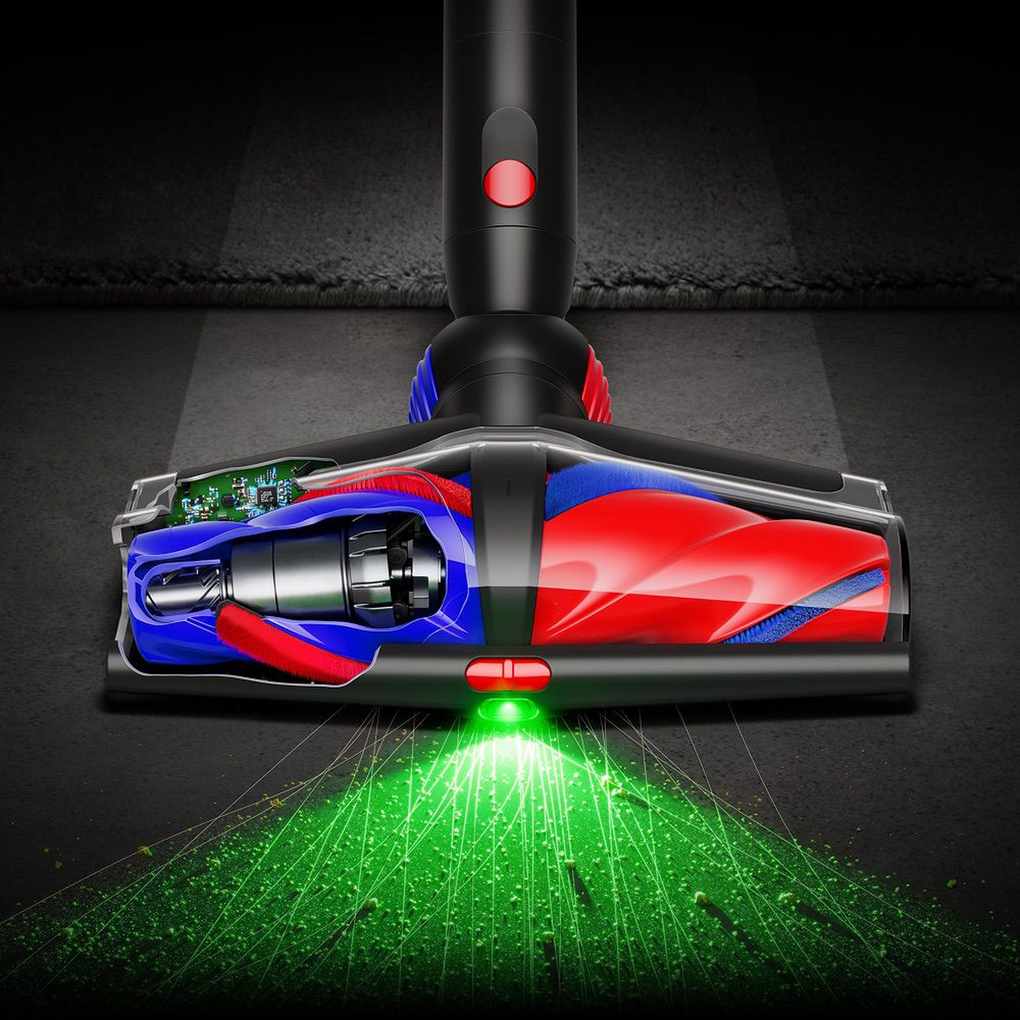
| Dyson V15 lowest price | $949.93 — in mid-October, not on Black Friday |
- One in three Black Friday “deals” was cheaper earlier in the season.
- The Dyson V15’s lowest price was mid-October ($949.93) — not Black Friday.
Retailers are not necessarily breaking the law; many are just inflating a “was” price or repricing something they had already discounted. The effect on your wallet is the same either way.
Red Flags of Fake Black Friday Deals
1. The inflated “was” price. “Was $899, now $499” — but was it ever actually $899? If the item has been sitting at $549 for months, the “$899” is theater.
2. The deal appears weeks before Black Friday at the same price. If a “doorcrasher” price has been live since early November with no change, it is just the price. Real Black Friday pricing is sharp, short, and often sells out.
3. Everything is on “sale” every day. When a retailer’s entire catalog carries a red sale badge, the badge means nothing.
4. A brand-new “model number” that matches nothing. Some products are manufactured as Black Friday-only variants with different model numbers so you cannot price-compare. If you cannot find reviews or history for that exact model, be skeptical.
How to Verify a Deal (Tools That Work in Canada)
ca.camelcamelcamel.com — This is the Canadian Amazon price-history tracker. (Note the address: ca.camelcamelcamel.com, not camelcamelcamel.ca.) Paste the Amazon product URL and check whether the “Black Friday price” has actually been beaten earlier in the fall.
Keepa — A browser extension that shows price history right on the product page, plus alerts when a price drops to your target.
RedFlagDeals.com — The forums are where Canadians audit deals in real time. Search the “price error” and deal threads — someone has usually already checked whether the price is historic or a fake.
Honey — Less about history, more about stacking: it checks for coupon codes at checkout, which stacks on top of a sale price.
My free DIY method — Screenshot prices in October. A photo of your phone showing the October price beats any sales copy. If the Black Friday price is not below your October low, it is not a deal. I do this every year and it has saved me from at least a dozen “fake” discounts.
For Canadian deal news and price reality-checks, I also follow smartcanucks.ca and mobilesyrup.com.
The Practical Checklist (Use This Before You Buy)
- [ ] Did I screenshot or save this item’s price in October or early November?
- [ ] Is the Black Friday price below that October low — not just below the “was” price?
- [ ] Does ca.camelcamelcamel.com (Amazon) or RedFlagDeals show a lower historical price?
- [ ] Has this “deal” price been live for weeks already?
- [ ] Can I find this exact model number on other retailers for comparison?
- [ ] Am I buying because I need it, or because the countdown timer scared me?
If it fails any of the first five, walk away. Deals will come again on Cyber Monday and Boxing Day — and I would rather you miss a fake deal than “catch” one that was never real.
🛡️ Use Price Protection as Your Safety Net
Best Buy’s Lowest Price Guarantee is your backup weapon against fake deals: if you buy something and find it cheaper at another Canadian retailer within 30 days, they’ll match the price — with one official exception: the guarantee does not apply to Black Friday, Cyber Monday or Boxing Day prices. It doesn’t excuse skipping your October price screenshots — but it means an honest mistake won’t cost you.
⚖️ What Canadian Law Says About the “Original” Price
Here is a fact worth knowing: inflating an “original” price is not a grey area in Canada. The Competition Act prohibits false or misleading price representations. For a store to advertise a regular price as the basis of a discount, the Competition Bureau’s tests ask whether that price was genuinely in effect for a reasonable period (the time test) or whether a substantial volume was actually sold at that price (the volume test). The Bureau publishes the full explanation on its ordinary selling price page.
Which means an unexplained “was $899” is not just ad copy — it is itself a warning sign. If a store cannot say when, and in what quantity, that regular price actually sold, there is no reason to trust the discount percentage built on top of it. Remember this one test before the checklist above: a real deal can prove its regular price.
🧭 Still Undecided? The Final Test
Overlap three things: your own October price screenshots, the trackers’ price history, and a safety net like post-purchase price protection. If two or more of the three point to “no,” pass on the deal. Missing Black Friday is not a loss — catching a fake deal is the real loss. The deals always come back on Cyber Monday and Boxing Day anyway.
🧪 Brand Examples: The Same Test Works on Pandora, Beauty, Adidas, Walmart, Crocs, Coach Outlet and Hunter
The examples below came from retailer emails in my inbox, including the 2025 season. Treat them as case studies, not live offers. The store changes; the math does not. Find what the exact item was actually selling for before the event, compare the same model, set, colour and size, and only then decide whether the percentage means anything.
Pandora: Timing Is Part of the Price

The Pandora emails do not use one blanket rate. Member double points ran November 19–27; Disney and Marvel styles were promoted at 40% off; some online styles reached up to 50% off; gift sets and the limited-edition 2025 ornament-and-charm set were 30% off. That spread is exactly why the exact charm matters more than the headline.
My Pandora buying rule:
- Members can get an opportunity to buy before Black Friday. The promotions start before the day itself, deepen as the event goes on, continue through Cyber Monday, and return again around Boxing Day.
- The catch is stock. A larger discount is no use when the charm, ring size or gift set you wanted is gone — and popular pieces may not come back until January, after the holiday sales are over.
- If it is a must-buy gift or a piece you would be upset to miss, buy early once the price reaches your recorded target. Do not gamble the item just to chase a later percentage.
- If you can take it or leave it, waiting for Black Friday or a later wave can pay — as long as you accept the stock risk.
- Before paying, open the store through Rakuten or another cashback app when the merchant is participating. The portal layer is separate from Pandora’s own discount and can add cashback on top; the rate and eligibility vary.
And do not count double points at face value unless you know you will make another Pandora purchase. Points you never use are not a discount.
I’ve now given Pandora a guide of its own: my Pandora Black Friday Canada guide breaks down last year’s official emails offer by offer — double points, Disney at 40%, gift sets at 30% — with the buy-early-or-wait strategy I actually use.
Beauty and Kiehl’s: A 40% Set Is Not Automatically the Best Buy
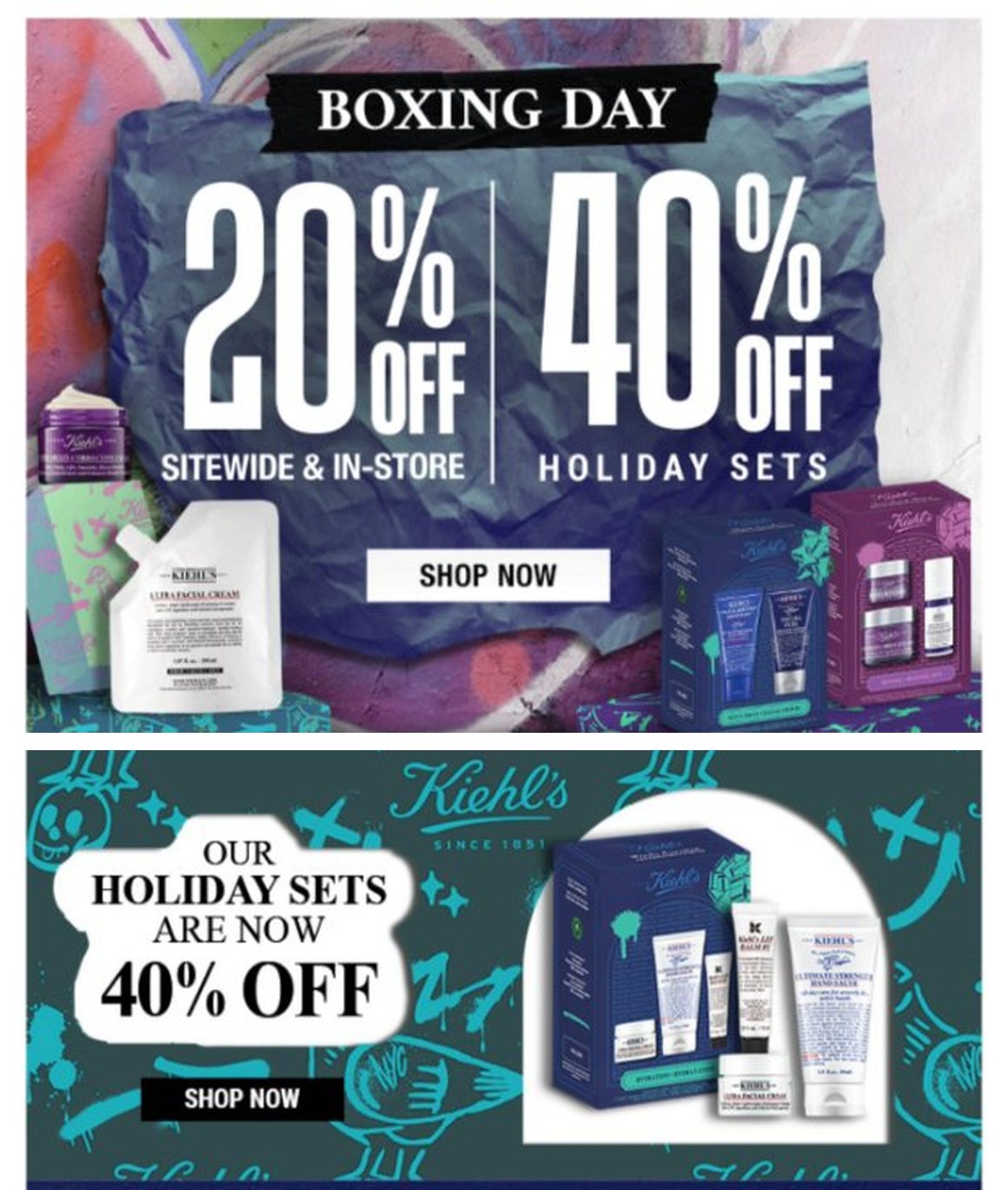
This Kiehl’s email splits the offer three ways: 20% off sitewide and in-store, 40% off holiday sets, and 40% off selected products. For beauty, the verification step is the contents. Add up the regular prices of the exact sizes in the set, then compare cost per millilitre with the full-size product you would normally buy.
A 40% set can still be the worse purchase if half of it is the wrong shade, a mini you will not finish, or a product you would never have bought alone. A smaller discount on the one full-size staple you use every day may be the real deal. I work through the same method in my dedicated Kiehl’s Black Friday Canada guide.
Adidas: Extra Percentage, Same Arithmetic

The Adidas examples show a Boxing Week sale of up to 60% off with no code, and a Cyber Monday offer of an extra 40% off full-price and sale items with code CYBER (exclusions applied). “Extra” percentages multiply; they do not simply add. If an eligible shoe was already 30% off and then took another 40% off, you would pay 70% × 60% = 42% of the reference price — a 58% total reduction, not 70%.
Then run the normal test on the exact shoe model, colour and size: what was that combination selling for before the event? A headline rate on a different colourway is not evidence for the pair in your cart.
Walmart: “Up To” Is a Ceiling, Not a Promise
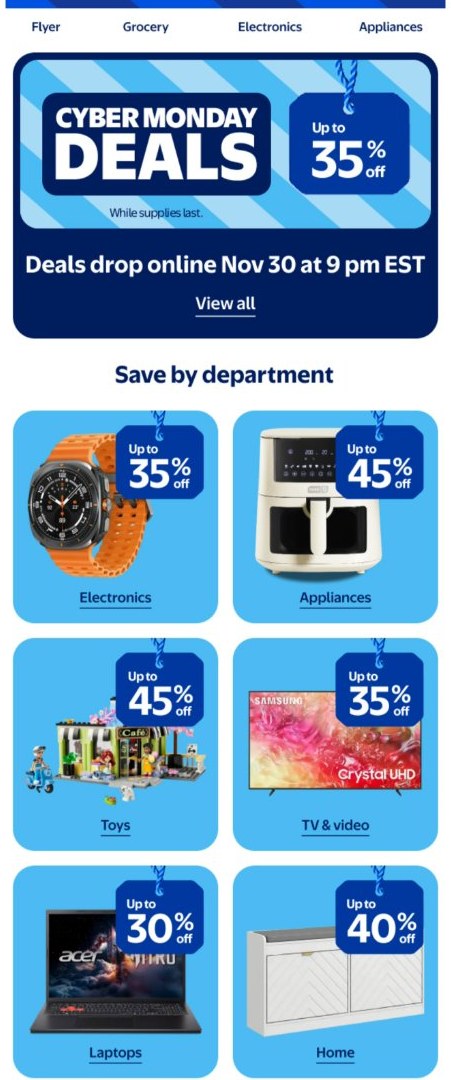
The Walmart email’s headline says up to 35% off, while its department ceilings vary: electronics 35%, appliances 45%, toys 45%, TV & video 35%, laptops 30%, and home 40%. Inside the same email, a 55-inch TV shown at $498 → $348 works out to about 30% off, and a 13-inch iPad Pro at $1,799 → $1,479 is about 18% off. Neither fact makes the email “fake” by itself — it proves why you calculate the exact product instead of shopping from the banner.
Crocs: “Extra” Is a Second Layer, Not the Whole Discount
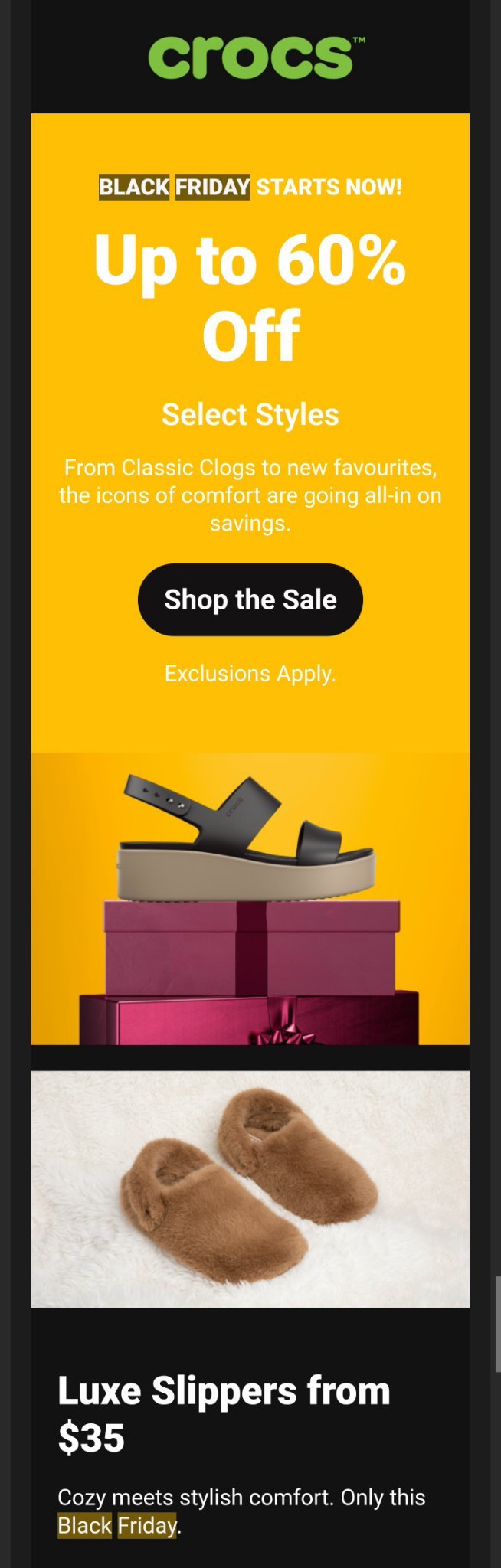
Crocs, the main event: a Crocs email I received — the Black Friday main event — leads with “up to 60% off” on select styles, exclusions apply, with luxe slippers from $35. Put the two Crocs emails side by side and the pattern is the lesson: “extra 50%” and “up to 60%” are both ceilings on styles the brand picked. The only number that matters is the final price of the exact style you want, compared with its price before the event.
The rule that covers all of them: a percentage is advertising; a price history is evidence.
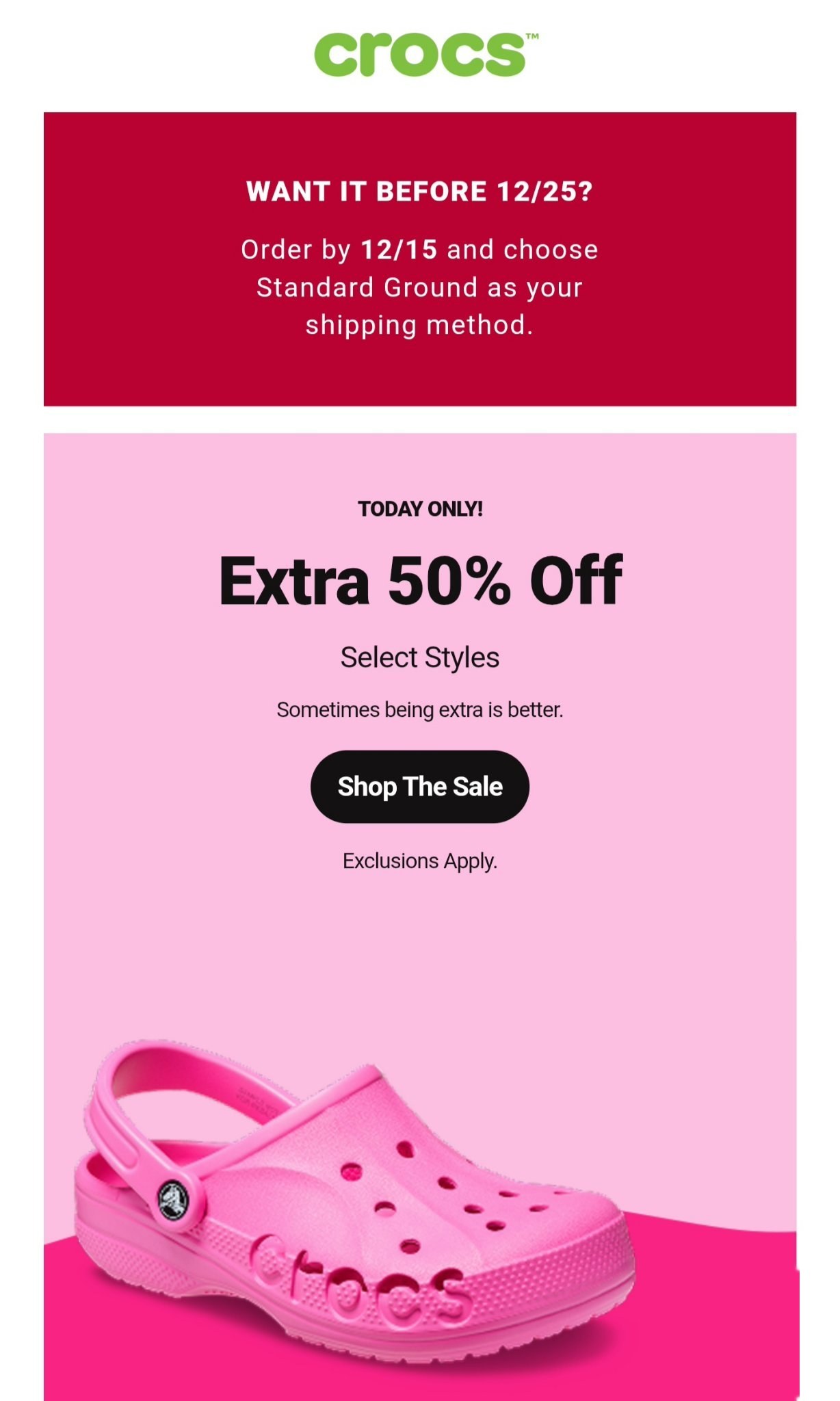
The Crocs email leads with “Extra 50% Off” on select styles, today only — and the small print right under the button says exclusions apply. “Extra” is the word to slow down on: it stacks on top of whatever sale price the style already had, and only on the styles Crocs chose. So run the whole chain before judging it — regular price → sale price → extra 50% — and compare the final number with what that exact style, colour and size actually sold for before the event. The same email shows the other catch of a one-day deal: to receive the order before December 25, it had to be placed by December 15 with standard ground shipping.
Fashion Posters: “Up to 60% Off — Including Clearance”
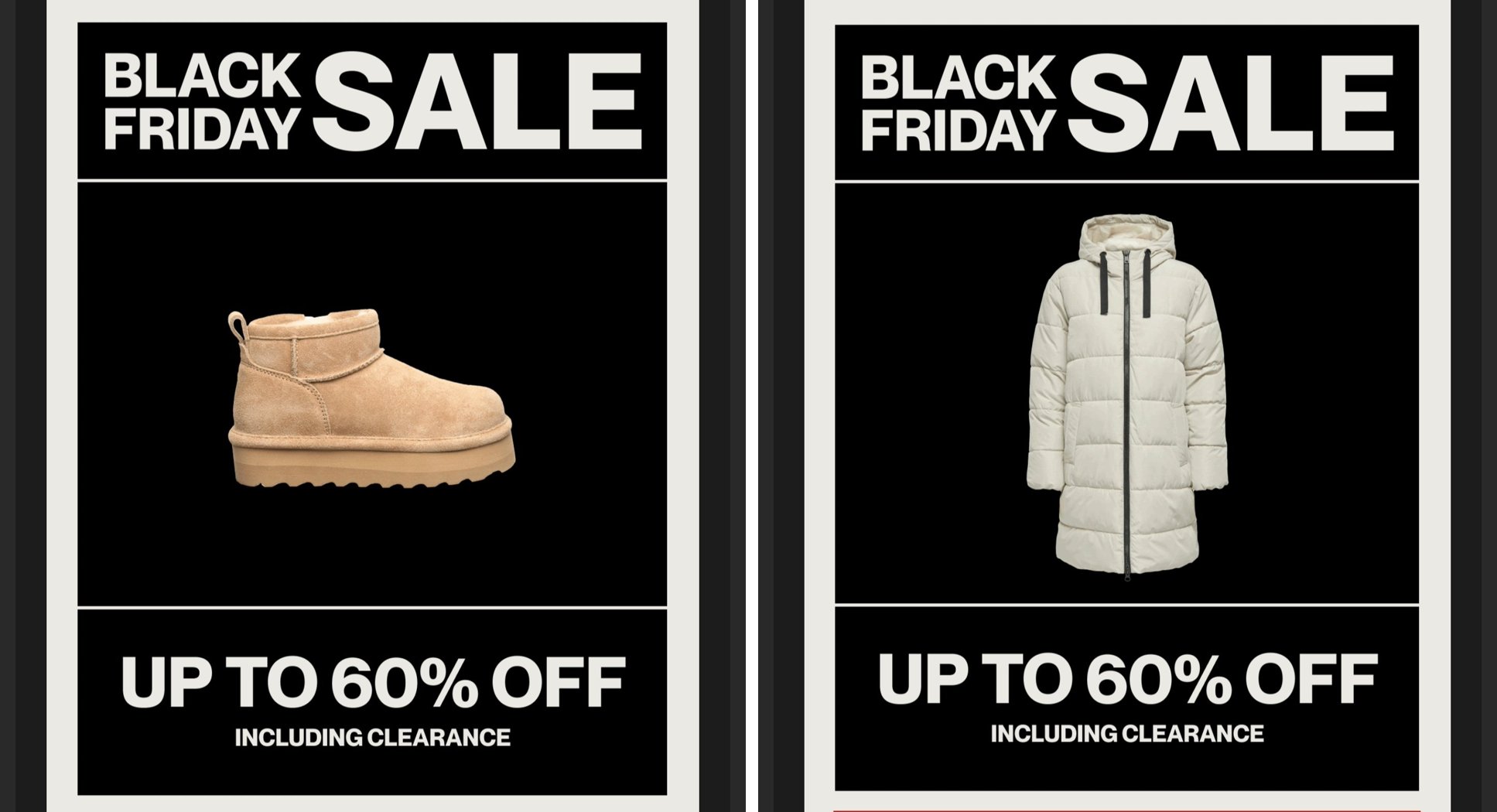
The same wording shows up beyond shoes. Black Friday sale posters I received by email — a winter boot, a long puffer coat — advertise up to 60% off, including clearance. That last phrase is the tell: the headline number is only reachable when clearance stock is counted in. On this season’s regular lines the discount is usually far shallower, so compare the final price of the exact coat or boot, not the poster percentage. (The posters name no store, so treat them as a wording example, not a shopping tip.)
Coach Outlet: “Extra 25% Off” — Plus a Pay-Later Button
Coach Outlet’s Black Friday email offers an extra 25% off select styles — the same “extra” layer as Crocs and Adidas, stacked on outlet prices that are already discounted from boutique prices. Two checks follow. First, the base: an extra 25% off an outlet price is only a deal if the outlet price itself was fair for that bag. Second, the email’s top banner pushes “gift now, pay later” with Klarna or Afterpay — splitting the payment doesn’t change the price math; it just makes the number feel smaller. Judge the bag’s final price against its price history, and treat the payment plan as a budgeting choice, never as part of the “discount.”

Hunter: “30% Off Selected Lines” — Then an Extra 20% at Cyber
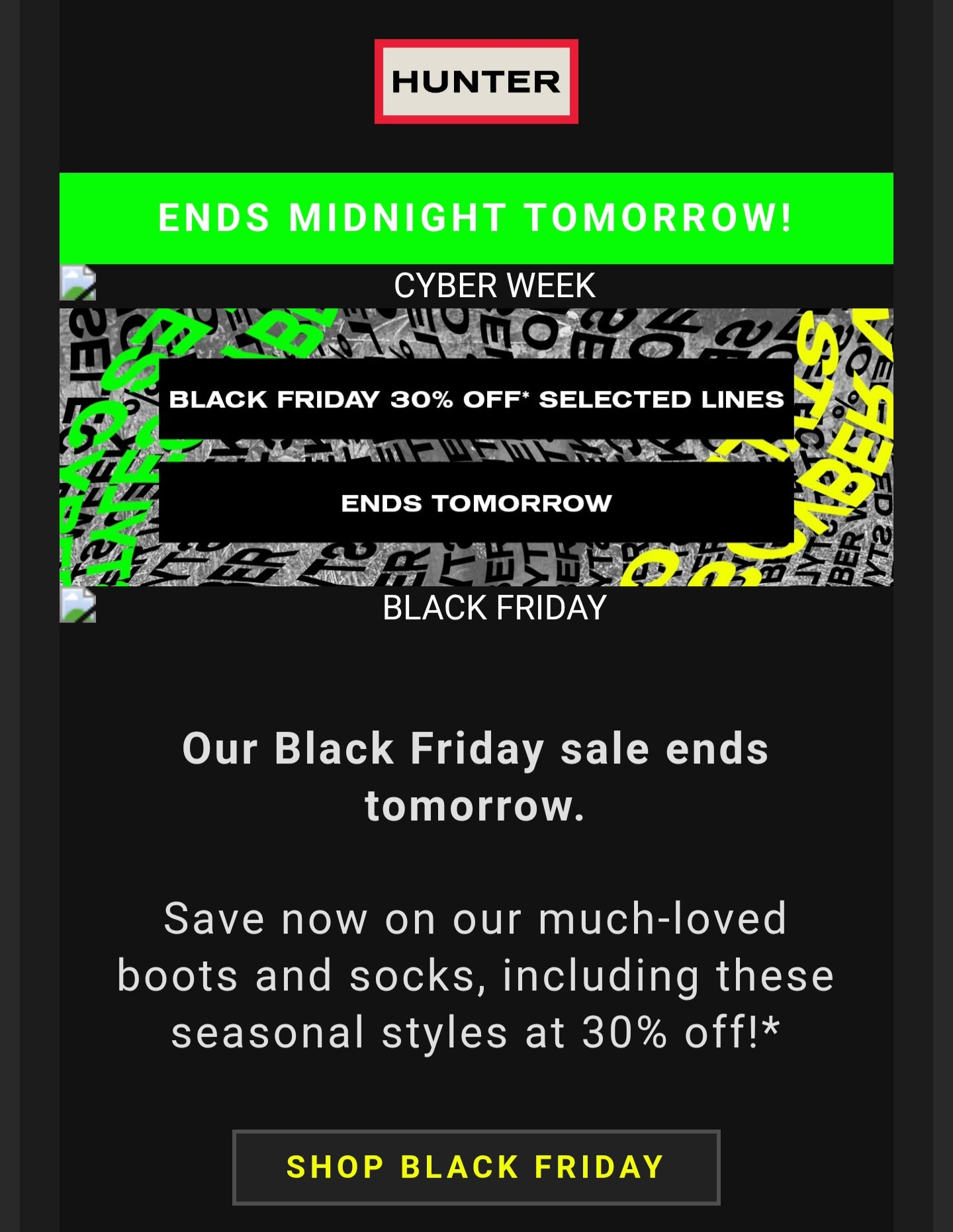
A boot brand’s two emails show the stacking pattern inside a single brand. Hunter’s Black Friday email: 30% off selected lines — its boots and socks, seasonal styles included — wrapped in “ends midnight tomorrow” urgency. The Cyber sale email that followed kept the sale going with plus 20% off, winter’s insulated boots and puffer coats as the face of it. Read both qualifiers before the numbers: “selected lines” means the 30% never covered the whole range, and the Cyber “plus 20%” comes off the already-reduced price. Where both layers stack on the same item, the math is multiplicative, not additive — 30% then a further 20% off lands at 44% off in total, not 50% (the same arithmetic as the Adidas case).
Coach Outlet, the Cyber Monday follow-up: the “extra” layer grew. Black Friday’s email offered an extra 25% off select styles; the Cyber Monday email — stamped “today only” — raised it to up to an extra 30% off select styles. It is the Pandora pattern again: the extra percentage tends to grow as the event moves from Black Friday toward Cyber Monday. If the bag is not urgent, the wait can pay — and “today only” pressure still has to pass the same final-price test.

💰 Don’t Just Take the Discount — Stack Extra Cashback on Top
A Black Friday price is only the start — click through a cashback portal first, and portal cashback + a store coupon + credit-card rewards stack into one extra discount on top of the sale price. I compared the portals I actually use (Rakuten Canada & US, Great Canadian Rebates, BeFrugal, RebatesMe) — signup bonuses, payout terms and all — in one guide: 6 Best Cashback Sites 2026: Get Paid Twice on Every Purchase. My referral codes, if you sign up: Rakuten (US) P08915 · BeFrugal ZFXWPEC · Great Canadian Rebates 342532 · RebatesMe XEWYYH — enter the code when you join.
My Rakuten links: if you are joining anyway, use Rakuten Canada or Rakuten US. Start from the portal or app immediately before checkout, and check the store’s cashback terms first — a bigger headline discount is worth more than cashback that does not track.
Wishing you a beautiful day.
🛍️ Shopping other categories too? I gathered every one of my Black Friday guides on a single page: Black Friday Canada 2026: Every Deal Guide in One Place.
📅 Want the full calendar? My Black Friday 2026 Canada: The Complete Guide (Honest Edition) covers retailer sale patterns and the price-tracking tools I use.
Happy saving 💛
— J.
Educational information only — not financial advice. Figures checked November 2026.
❓ Black Friday 2026 Canada: Quick Answers
When is Black Friday 2026 in Canada?
Friday, November 27, 2026 — the day after US Thanksgiving. Cyber Monday follows on Monday, November 30.
When do Black Friday sales actually start in Canada?
Weeks before the day itself. Early and member-only sales open in early November — Best Buy Canada ran member early access on November 2–5 this year — and the heaviest concentration lands in deal week, November 23–30.
How can I tell whether a Black Friday deal is real?
Compare the sale price with the item’s own autumn price history, not with the “was” price on the tag. Price trackers like ca.camelcamelcamel.com and Keepa show the history in seconds; if the Black Friday price is not below the autumn low, it is not a deal.
Is Black Friday or Cyber Monday better in Canada?
It depends on the category. Big-ticket electronics peak on Black Friday itself, while phones, gift-card bundles and online-only offers often do better on Cyber Monday — and Boxing Day (December 26) is Canada’s second chance for anything that sold out.
🌐 This post is also available in Korean: 2026 캐나다 블랙프라이데이: 가짜 세일에 속지 않는 법 · et en français : Black Friday 2026 au Canada : ne vous faites pas avoir par les fausses bonnes affaires
📚 You May Also Like
- Christmas 2026: A Stress-Free Holiday Prep Guide
- The Gratitude Money Habit: How Thankfulness Changes Spending
- Black Friday 2026 Dyson Deals Canada: What to Watch For
Get the Free Canada Savings Checklist
Join the newsletter — get the free PDF checklist and weekly Canada savings tips in your inbox.
Read Next


Some links in this post are referral or affiliate links. If you sign up or buy through them, I may receive a bonus or commission at no extra cost to you. It helps keep this blog running — thank you!