
How to Spot Fake Black Friday Deals (2026 Edition)
Last updated: November 5, 2026
Bonjour! It’s J. —
These are my honest notes, from deals I check — and buy — with my own money.
One in three “sales” is fake. Visualping’s 2025 analysis of 1,500 products proves it. Stop paying full price for discounts that don’t exist — here’s how to tell the real deals from the theatre.
One truth I’ve learned from nine years of shopping in Canada: a “sale price” is often just the everyday price wearing a costume. When Visualping tracked more than 1,500 products in 2025, one in three “deals” was a discount in name only. The price had already been lower in October or early November. This post is my field guide to not getting played.
Let me be upfront first. As of October 12, 2026, no major retailer has announced its Black Friday 2026 sale yet. This guide is built on real 2025 data.
🌿 Quick Take
- One in three Black Friday “deals” in 2025 wasn’t real — Visualping analysed 1,500+ products and found October or early November was cheaper
- Worst categories for fake deals: luggage (61%) and microwaves (50%)
- Verify before you buy: check the price history on ca.camelcamelcamel.com or Keepa, and cross-check the RedFlagDeals forum
- The rule is simple: if the Black Friday price isn’t below your October screenshot low, it’s not a deal — whatever the “regular price” claims
- Safety net: Best Buy’s Lowest Price Guarantee matches a lower Canadian retail price within 30 days
1. 📊 What the 2025 data actually says
Numbers don’t lie. A third of Black Friday “deals” were cheaper earlier in the season. The worst offenders were luggage (61%) and microwaves (50%) — more than half were fake.
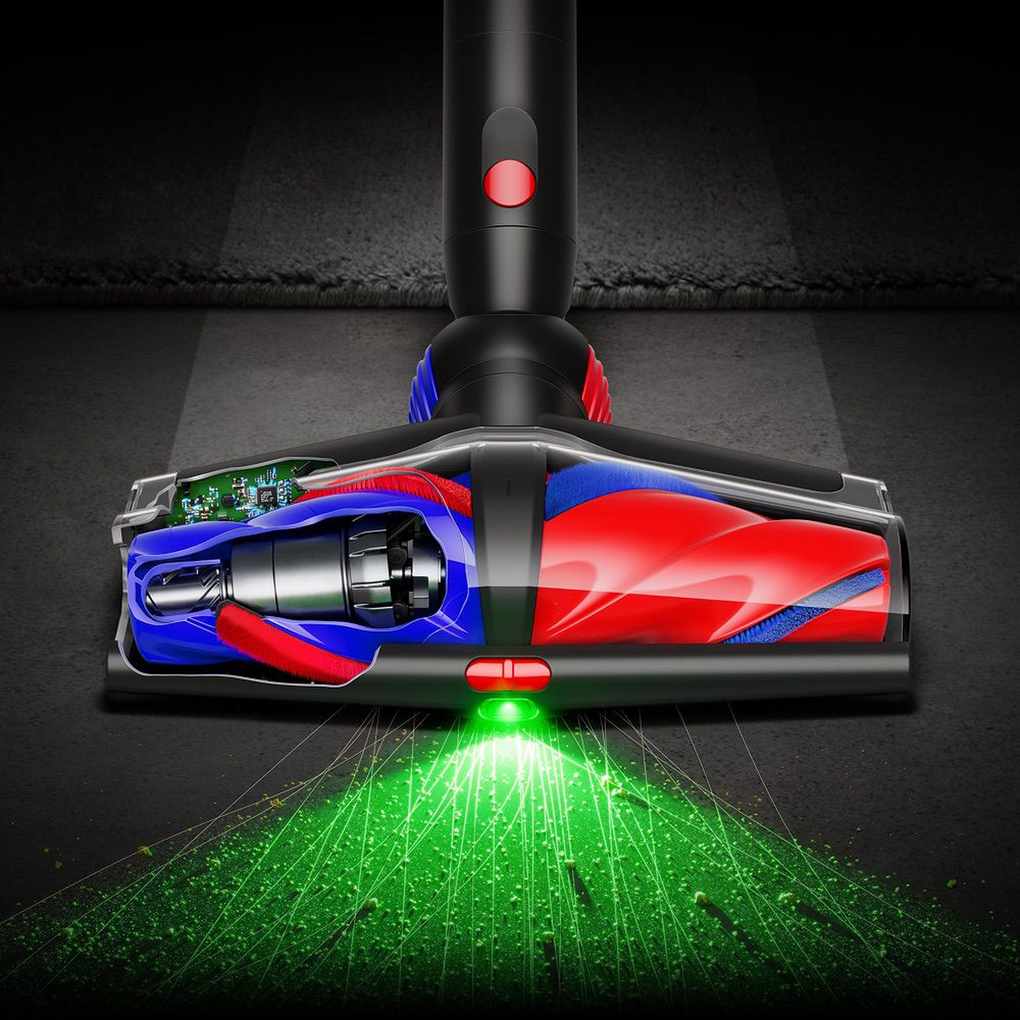
Take the Dyson V15. Its lowest price wasn’t on Black Friday at all. It was in mid-October, at $949.93.
Retailers aren’t always breaking the law. More often, they inflate the “original price” or repackage a discount that was already running. Either way, the effect on your wallet is identical.
2. 🚩 Red flags of a “fake deal”
① An inflated “original price.” “Was $899, now $499” — but was it ever really $899? If it has been selling at $549 for months, the “$899” is theatre.
② The same price for weeks before Black Friday. If a “doorcrasher” price has been sitting there since early November, it’s just the regular price. Real Black Friday prices are short, sharp, and often sell out.
③ Everything is “on sale,” every single day. When the whole catalogue wears a red sale tag, the tag means nothing.
④ A “model number” you can’t compare anywhere. Some variants are made only for Black Friday, with a different model name so you can’t price-match them. If no reviews or price history exist for that model, be suspicious.
3. 🔍 How to verify a deal (tools that work in Canada)
ca.camelcamelcamel.com — tracks Amazon Canada price history. (The address is easy to get wrong: for Canada it’s ca.camelcamelcamel.com, not camelcamelcamel.ca.) Paste an Amazon product URL and check whether that “Black Friday price” was already beaten this fall.
Keepa — a browser extension that draws the price history right on the product page, and can alert you when a price drops to your target.
RedFlagDeals.com — the forum where Canadians verify deals in real time. Search the deal thread or “price error” threads: chances are someone has already worked out whether it’s a genuine low or a fake.
Honey — more for stacking than history. It checks coupon codes at checkout so you can layer them on top of a sale price.
My free DIY method — screenshot prices in October. An October price photo on your phone beats any ad copy. If the Black Friday price isn’t lower than your October low, it isn’t a deal. I do this every year and it has filtered out more than a dozen fake discounts for me. I also buy this way myself: on Prime Day I picked up a Sennheiser ACCENTUM, regular price CA$299, for CA$119 — the verification process and my review are in my Sennheiser ACCENTUM review.
For Canadian deal news and price fact-checks, I also follow smartcanucks.ca and mobilesyrup.com.
⚖️ How Canadian law treats the “original price”
Inflating an “original price” isn’t a grey area in Canada, either. The Competition Act prohibits false or misleading price representations. To advertise a discount off a “regular price,” a seller must meet the Competition Bureau’s tests: either the price was genuinely in effect for a reasonable period (the time test), or a substantial volume was actually sold at that price (the volume test). The Bureau lays it all out on its official ordinary selling price page.
So a baseless “was $899” isn’t ad copy — it’s a red flag in itself. If a store can’t explain when, and how much, it actually sold at that regular price, there’s no reason to trust the discount percentage either. Before the checklist below, remember just this one line: a real deal can prove its regular price.
4. ✅ The pre-purchase checklist
- □ Did you screenshot this product’s price in October or early November?
- □ Is the Black Friday price lower than your October low — not just lower than the “original price”?
- □ Does ca.camelcamelcamel.com (Amazon) or RedFlagDeals show a lower past price?
- □ Has this “deal” price been sitting unchanged for weeks?
- □ Can you compare the exact same model name at other retailers?
- □ Do you actually need it — or is a countdown timer pushing you?
If even one of the first five snags, pass. Deals come back on Cyber Monday and Boxing Day. Missing a fake deal is a hundred times better than “catching” one.
🧭 Still not sure? The final test
Overlap just three things: your October screenshot low, the price tracker’s history, and a safety net like post-purchase price protection. If two or more of the three point to “no,” pass on the deal. Missing Black Friday is not a loss — catching a fake deal is. The deals always return on Cyber Monday and Boxing Day.
🛡️ Use price protection as a safety net, too
Best Buy’s Lowest Price Guarantee is a backup weapon against fake sales. If you find a lower price at another Canadian retailer within 30 days of buying, they’ll adjust your price to match. One catch: by policy, Black Friday, Cyber Monday and Boxing Day sale prices are excluded from that adjustment. It can’t replace your October screenshots, but it means one mistake won’t cost you money.
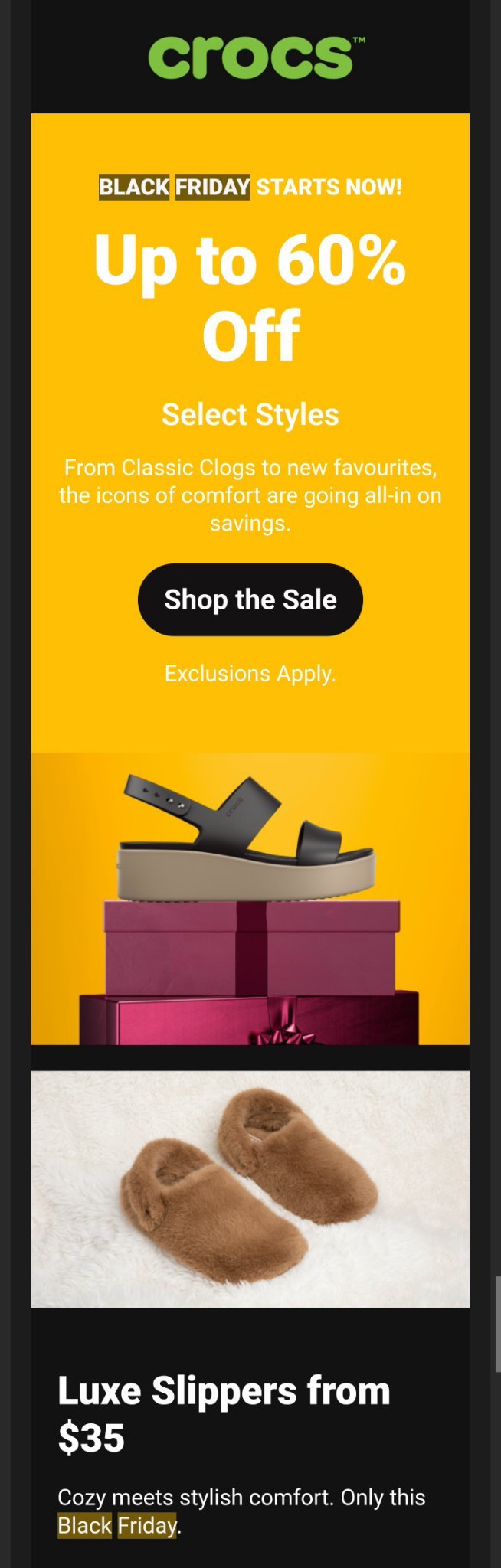
Crocs, the main-event version: another Crocs email I received — the Black Friday main-event announcement — leads with up to 60% off select styles (exclusions apply) and Lux slippers from $35. Put the two Crocs emails side by side and the pattern shows itself. Whether it’s “extra 50%” or “up to 60%,” both are ceilings that apply only to styles the brand chose. What matters is one thing: compare the final price of the exact style you want against its pre-event price.
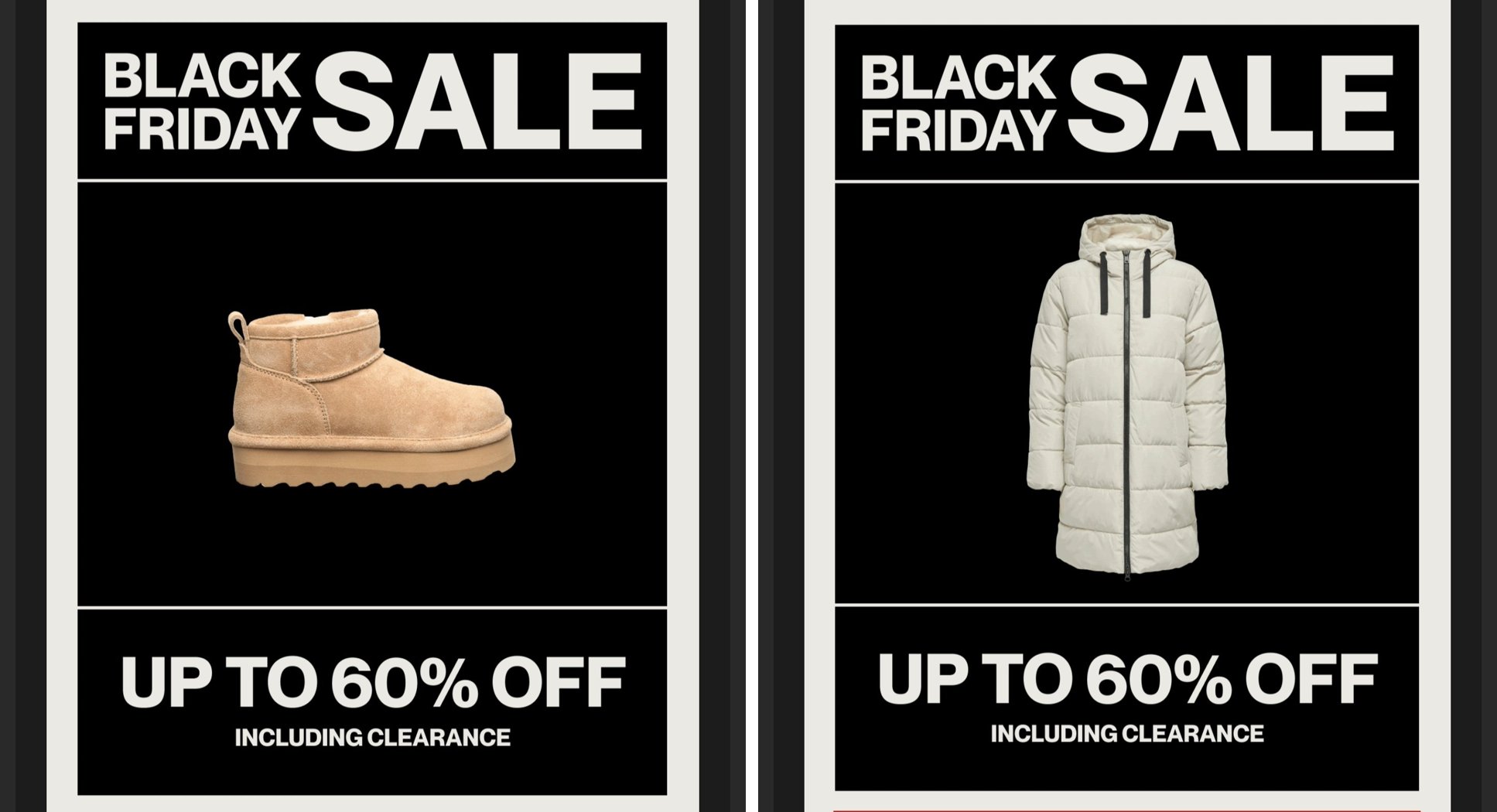
Fashion poster: “Up to 60% off — clearance included.” The same wording shows up beyond shoes. A Black Friday sale poster I got by email — winter boots and a long puffer coat — reads up to 60% off, clearance included. The key is the last phrase: that maximum number is only reachable once clearance stock is counted. On this season’s regular lines the discount is often much shallower, so for coats and boots, compare the final price of the item itself — not the poster’s percentage. (The poster had no store name, so I’m showing it as a wording example, not shopping information.)
Coach Outlet: “Extra 25% off” — and the pay-later button. Coach Outlet’s Black Friday email offers an extra 25% off select styles. It’s the same “extra” stacking as Crocs and Adidas, and the base price is the outlet price, already discounted from boutique pricing. Two things to check. First, the base price: was the outlet price itself fair value for that bag? Second, the banner at the top pushes Klarna and Afterpay “gift now, pay later” — splitting a payment doesn’t change the price math. It only makes the number look smaller. Judge the bag by its final price against its price history, and treat pay-later as a budget choice, never as part of the discount.

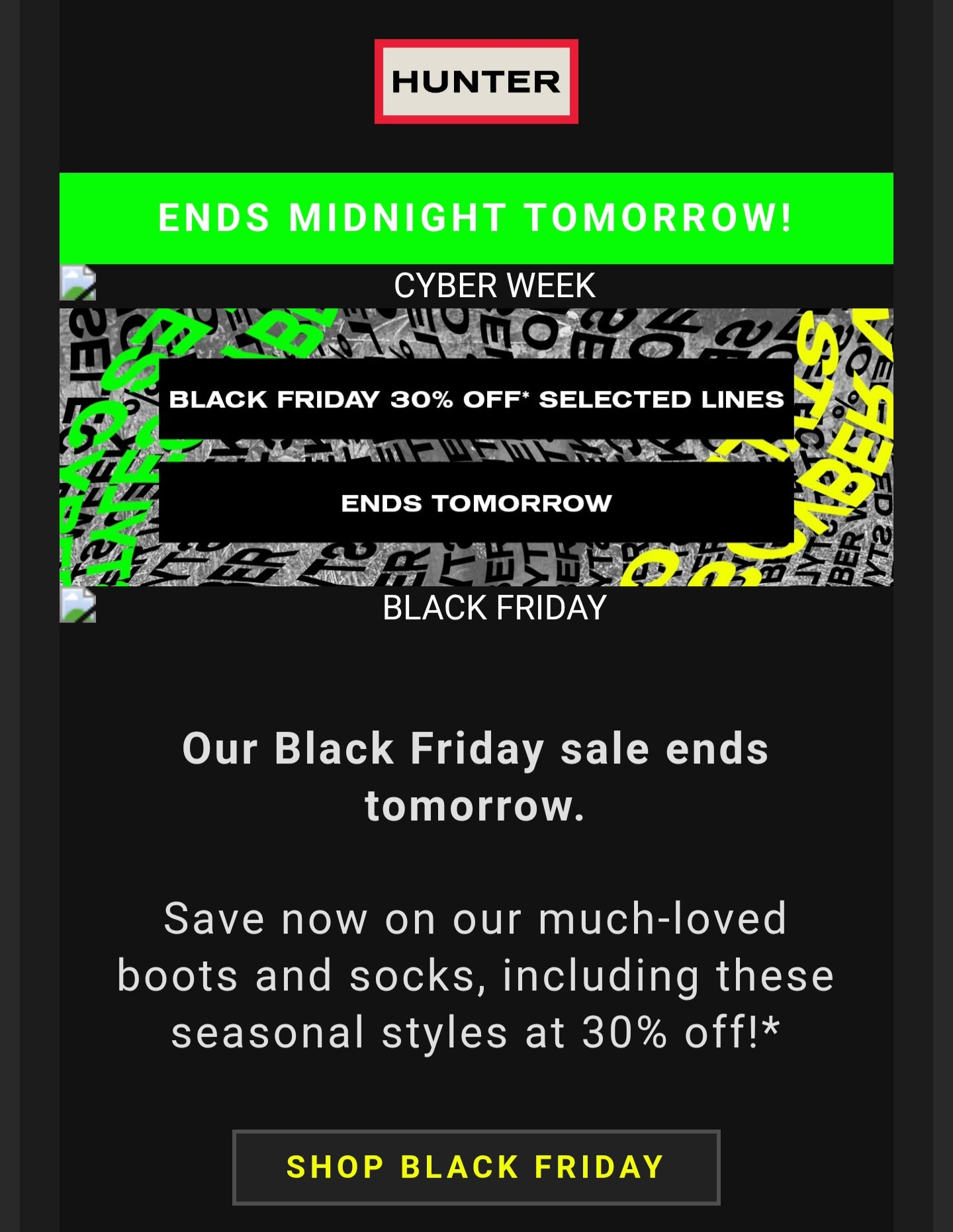
Hunter: “30% off selected lines” — then an extra 20% for Cyber. Two emails from one boot brand show stacking inside a single brand. Hunter’s Black Friday email offered 30% off selected lines (boots and socks, seasonal styles included) with a “ends tomorrow at midnight” nudge. The Cyber sale email that followed kept an extra 20% off running, with winter boots and padded coats as the face. Read the conditions before the numbers. “Selected lines” means the 30% doesn’t apply to everything, and Cyber’s “extra 20%” comes off an already-discounted price. When two layers stack on one item, the math multiplies, not adds: 20% off after 30% off totals 44%, not 50% (the same math as the Adidas example below).
Coach Outlet, the Cyber Monday follow-up: the “extra” layer grew. The Black Friday email was an extra 25% off select styles; the Cyber Monday email, stamped “today only,” raised it to up to an extra 30% off select styles. It’s the same pattern as Pandora — extra discount rates tend to grow as the event rolls from Black Friday into Cyber Monday. For a bag you don’t urgently need, waiting can pay; and even the “today only” pressure still has to pass the final-price test.

🧪 Brand by brand, the standard is the same: Pandora · beauty · Adidas · Walmart · Crocs · Coach · Hunter
The examples below come from store emails I actually received, including some from the 2025 season. Treat them as case studies, not live offers. The store changes; the math doesn’t. Find what the product actually sold for before the event, compare the exact same model, set, colour and size — then judge whether the discount rate means anything.
Pandora: when you buy is part of the price strategy.

Pandora emails never put one rate on everything. Member double points on all purchases ran November 19–27, Disney and Marvel styles were 40%, some online styles were up to 50%, and gift sets and the limited 2025 ornament and charm sets were 30%. Which is why the price of the exact charm you want matters more than the headline.
My own Pandora buying rules:
Members may get an early chance to buy before Black Friday. The sale starts before the day itself, rates grow as it goes, it continues through Cyber Monday, and it comes back again on Boxing Day.
The problem is stock. If the charm, ring size or set you want sells out, a bigger discount rate is useless — and popular pieces may not restock until January, after the holiday sales end.
For a gift you must have, or a piece you’d regret missing, buy early in the sale once it hits the target price you noted in advance. Don’t lose the item itself chasing a few extra percent later.
For nice-to-have pieces, waiting for Black Friday or the later sales can work in your favour. Just accept the sell-out risk.
Before paying, if the store participates, route through a cashback site or app like Rakuten. Portal earnings stack on top of Pandora’s own discount, and rates and conditions vary.
Count double points as money only if you already plan another Pandora purchase. Points you’ll never use are not a discount.
Pandora now has its own dedicated guide: my Pandora Black Friday Canada guide unpacks last year’s official emails offer by offer — double points, Disney 40%, gift sets 30% — plus the early-buy and wait-it-out strategies I actually use.
Beauty and Kiehl’s: a 40% set isn’t automatically a win.
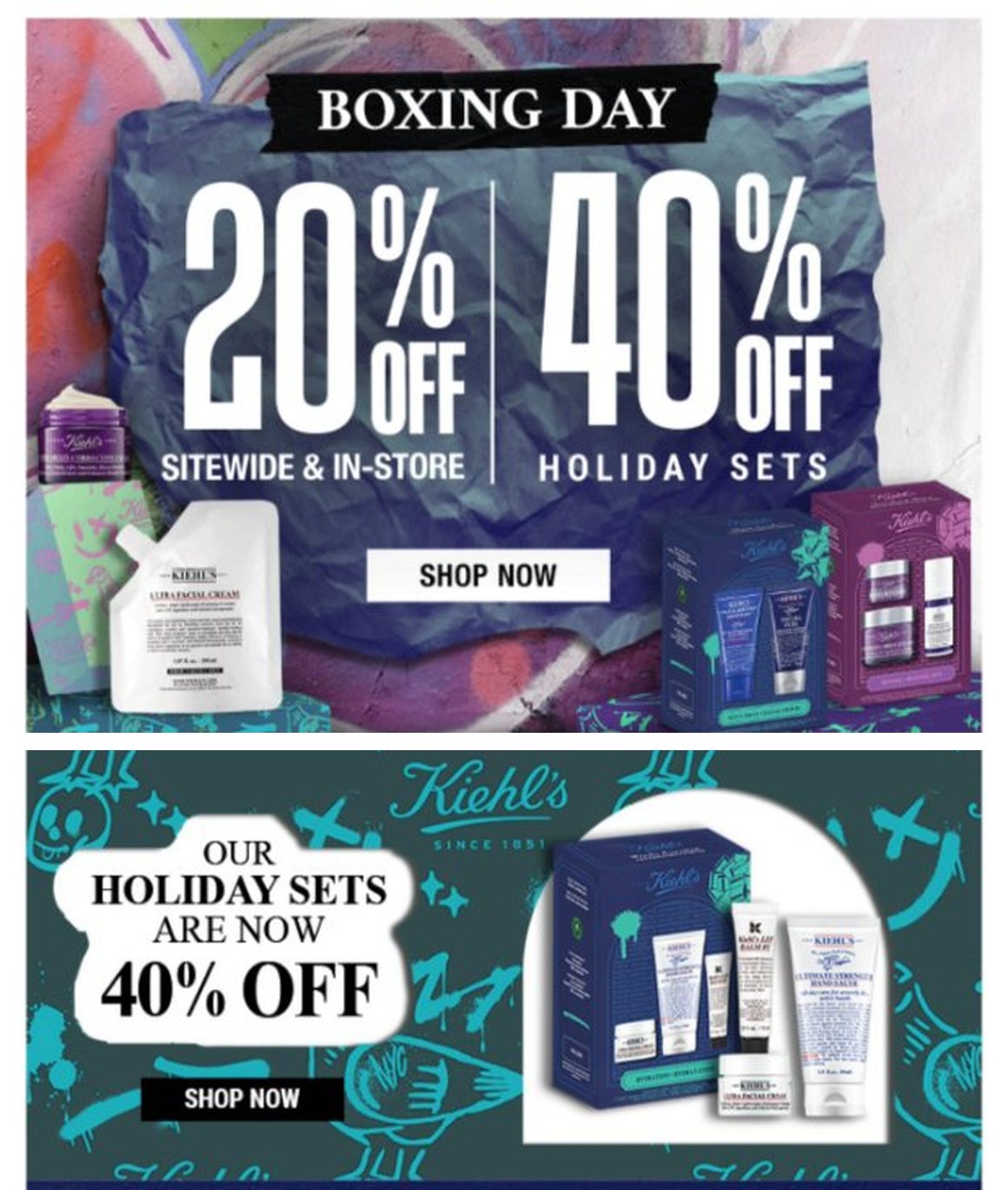
This Kiehl’s email splits its offer three ways: 20% off everything, including in store, holiday sets 40% off, and select products 40% off. Beauty has to be verified by what’s inside. Add up the regular prices of the exact sizes in the set, and compare the per-ml price against the full-size product you normally buy.
If half the set is shades that don’t suit you, minis you’ll never finish, or products you wouldn’t have bought alone, a 40% set can actually cost you. One everyday full-size staple at a smaller discount is often the real deal. I’ve laid out the same standard in my Kiehl’s Black Friday guide — worth reading alongside this.
Adidas: “extra” percentages follow the same math.

The Adidas case pairs a no-code Boxing Week up to 60% off with a Cyber Monday offer of an extra 40% with code CYBER on regular and sale items (some exclusions). “Extra” percentages multiply; they don’t add. If shoes already 30% off get another 40%, you pay 70% × 60% = 42% of the regular price — a total discount of 58%, not 70%.
Then, as always, verify the pre-event selling price for the exact model, colour and size. A big rate on a different colour doesn’t make the pair in your cart cheaper.
Walmart: “up to” is a ceiling, not a promise.
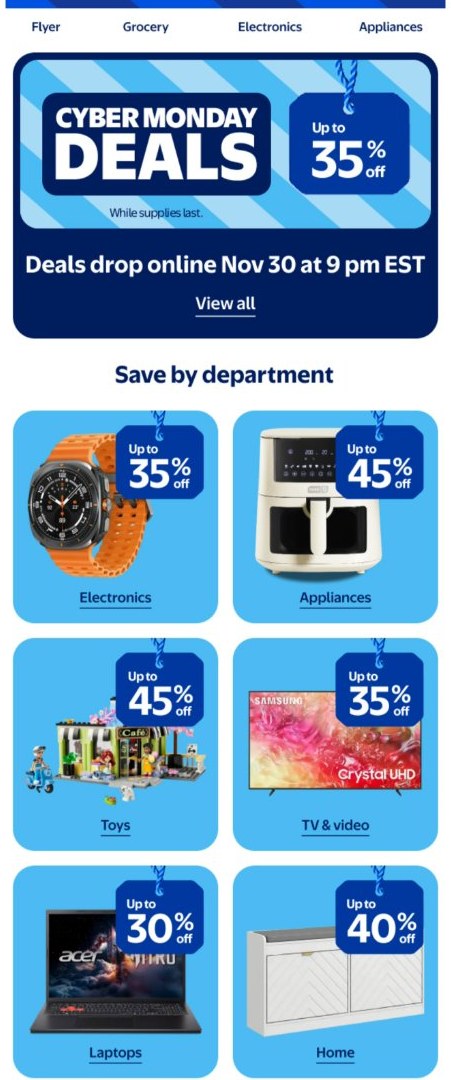
The Walmart email’s headline says up to 35%, but the department ceilings differ: electronics 35%, appliances 45%, toys 45%, TVs and video 35%, laptops 30%, home 40%. Inside the same email, a 55-inch TV at $498 → $348 works out to about 30%, and a 13-inch iPad Pro at $1,799 → $1,479 to about 18%. That alone doesn’t make the email fake. It’s proof you have to do the math product by product, not banner by banner.
Crocs: “extra” is a second discount stacked on top.
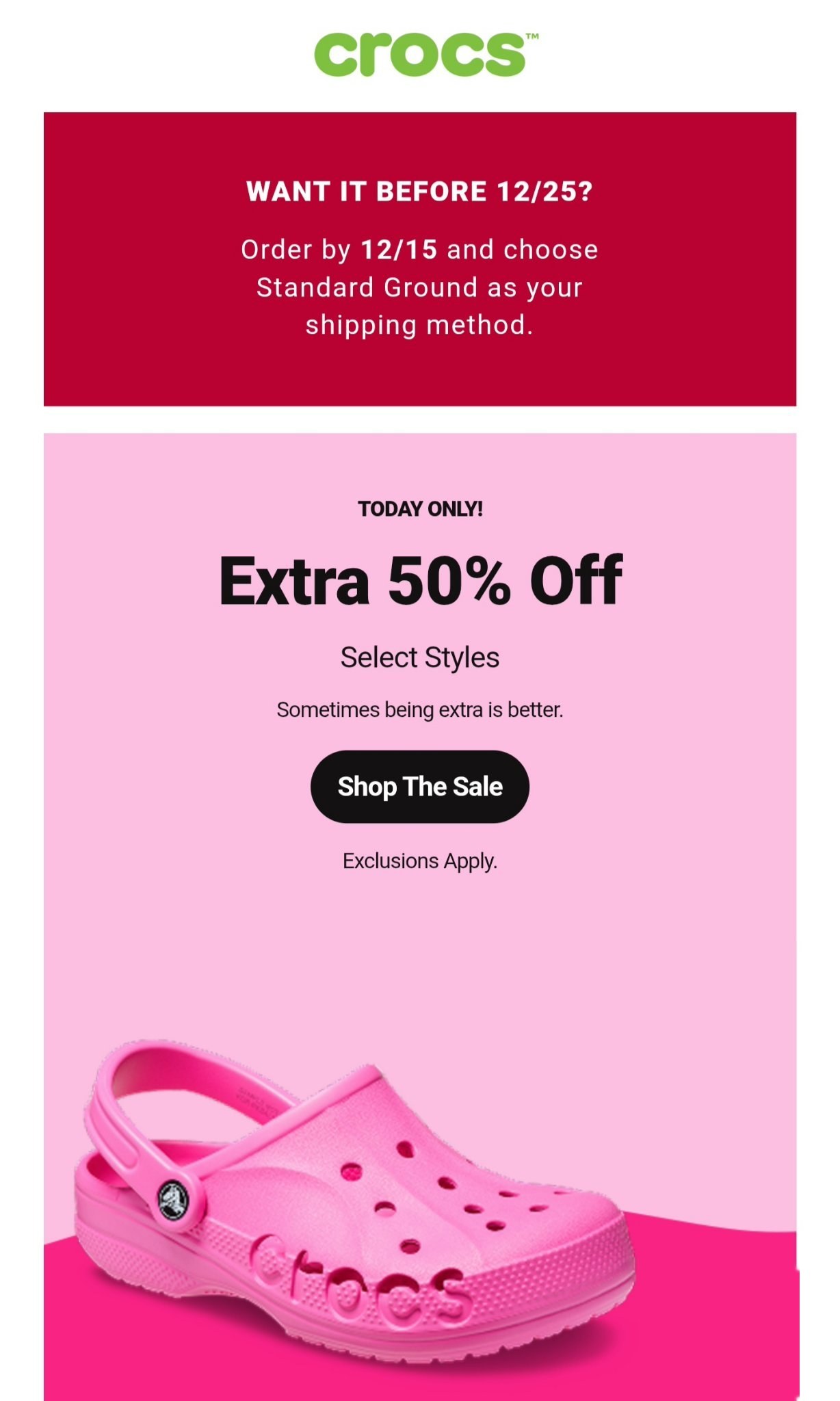
The Crocs email leads with “today only, an extra 50% off select styles,” and right under the button, in small print, notes that exclusions apply. The word to slow down on is “extra.” It’s a second discount layered onto a sale price already in place, and only on styles Crocs picked. So run the whole chain — regular price → sale price → extra 50% — then compare the final number with what that style, colour and size actually sold for before the event. The same email carries another one-day-deal condition: to receive it by December 25, you had to order by December 15 with standard ground shipping.
One line that runs through every brand: the discount rate is advertising; the price record is evidence.
💰 One more layer on top of the sale price — stacking cashback
The Black Friday sale price is only the starting point. Route your purchase through a cashback portal before you buy, and portal cashback + store coupons + credit-card rewards stack into an extra discount on top of the sale price. The portals I actually use (Rakuten Canada and US, Great Canadian Rebates, BeFrugal, RebatesMe), with their sign-up bonuses and payout conditions compared, are all in one post: 6 Best Cashback Sites 2026 | Get Paid Twice on Every Purchase.
Here are my referral codes if you’d like to use them when you sign up: Rakuten (US) P08915 · BeFrugal ZFXWPEC · Great Canadian Rebates 342532 · RebatesMe XEWYYH — enter them when you join.
My Rakuten links: if you’re signing up, go through Rakuten Canada or Rakuten US. Start from the portal or app right before you pay, and check each store’s earning conditions first. A real price discount beats cashback that never tracks.
📌 The short version
- A third of 2025 Black Friday deals were fake. Luggage (61%) and microwaves (50%) were the worst.
- The Dyson V15 was cheapest in mid-October ($949.93) — timing beats hype.
- Red flags: an inflated “original price,” a deal price unchanged for weeks, a model name you can’t compare.
- Verify with ca.camelcamelcamel.com, Keepa, RedFlagDeals and your October price screenshots.
- When in doubt, pass: Cyber Monday and Boxing Day bring a second chance.
Before you go, meet this post’s partner piece. The planning side — wish lists, budgets, timing — and the scam-prevention rules are in my Black Friday 2026 Canada: Don’t Get Scammed — How to Spot Fake Deals.
🛍️ Shopping other categories too? I’ve gathered all of my Black Friday guides on one page: 2026 Canada Black Friday Deals: Every Guide in One Place.
🇰🇷 Korean version: 블랙프라이데이 가짜 세일 구별법 (2026년판)
This post is for information only and does not constitute financial advice.
🧮 The fake discount, in numbers
Let’s run this post’s headline example all the way through. An ad that says “was $899, now $499” claims $400 off — about 44% in discount-rate terms. But if that product had actually been selling at $549 for months, the story changes completely. The real saving is $549 minus $499: $50, a discount of only about 9%. Same price tag — a 44% “deal” or a plain 9% price, depending on which base price you use. That’s why you ask for the track record behind the base price, not the discount rate.
Read the study numbers the same way. Visualping tracked more than 1,500 products, and a third were fake — meaning roughly 500 products carried “deals” that were deals in name only. By category it gets sharper: luggage at 61% is six out of ten; microwaves at 50% is exactly half. Flip it around, and it also means one verification pass filters out that many traps.
And keep the Dyson V15 as a number, not a slogan: its lowest price, $949.93, was recorded in mid-October, not on Black Friday. The loudest day is not the cheapest day. That one line is this whole post in summary.
📚 You May Also Like
- Black Friday 2026 Canada: Don’t Get Scammed — How to Spot Fake Deals
- Black Friday 2026 Dyson Deals Canada: What to Watch For
- Black Friday 2026 Laptop Deals Canada: A Practical Guide
Have a savvy day 💛
— J.
Get the Free Canada Savings Checklist
Join the newsletter — get the free PDF checklist and weekly Canada savings tips in your inbox.
Read Next


Some links in this post are referral or affiliate links. If you sign up or buy through them, I may receive a bonus or commission at no extra cost to you. It helps keep this blog running — thank you!