Quebec Car Registration Renewal 2026: My Real $350.86 SAAQ Bill, Line by Line
Last updated: November 12, 2026
Bonjour! It’s J. — and the most expensive envelope in my mailbox this fall wasn’t a shopping bill. It was my car registration renewal from the SAAQ: $350.86 for one car, for one year.
My renewal notice is dated September 8, 2026, and the payment is due October 31. When I sat down to read it properly — really read it, line by line — one number stopped me: $183.45 of my $350.86 bill is public transit charges. More than half. I own a car, I pay for parking, I pay for insurance… and the biggest single line on my registration bill is the bus and métro network.
I’ve lived in Montreal for nine years, and this envelope arrives every fall like clockwork. But this year I wanted to understand where the money actually goes — and why the transit line more than doubled compared with two years ago. Here’s the full breakdown of my real bill, what changed, and what happens next. All figures below are as of October 2026, checked against the SAAQ’s official pages.
🌿 Quick Take
- My 2026 registration renewal total is $350.86 — and $183.45 of it (over half) is public transit charges.
- The transit amount has two layers: a $30 provincial contribution, frozen since 1992, plus the CMM registration tax (TIV).
- The CMM tax jumped from $59 to $150 in 2025 — a 154 percent one-time increase — then rose to $153.45 in 2026 with inflation indexation.
- My registration fee shows $90 only because of a temporary $50 government rebate. The regular Montreal fee is $140.
- Your driver’s licence is billed separately: no transit charge on it, and its insurance contribution got a 75 percent rebate in 2026.
🧾 My Actual 2026 Bill, Line by Line
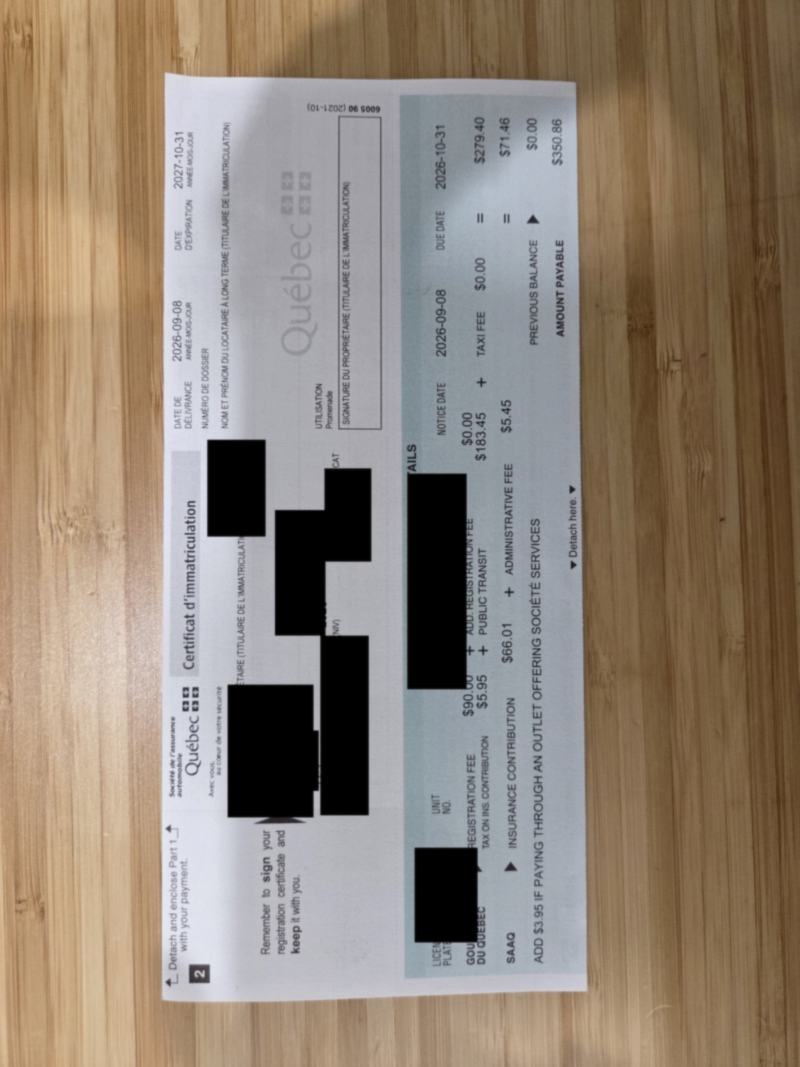
Here is my renewal notice exactly as it arrived — personal details covered, every amount untouched. My car is a minivan, registered at a Montreal address.
| Line on the notice | What it actually is | Amount |
|---|---|---|
| Registration fee | The base fee for keeping a vehicle registered. It goes to the Ministère des Finances, and the amount depends on your region — Montreal is in the top bracket at $140 (more on my $90 below). | $90.00* |
| Tax on the insurance contribution | Quebec’s 9 percent insurance premium tax, applied to the SAAQ insurance contribution. It goes to Revenu Québec. | $5.95 |
| Additional registration fee | Extra fees for luxury vehicles (value over $40,000) and large-engine vehicles. My van doesn’t trigger either one. | $0.00 |
| Public transit | The big one. Two charges combined into a single line: the $30 provincial contribution + the $153.45 CMM registration tax. | $183.45 |
| Taxi fee | Only applies to taxi permits. | $0.00 |
| Subtotal — Government of Québec | The sum of the five lines above that go to the Government of Québec — registration fee, insurance contribution tax, additional registration fee, public transit and taxi fee. | $279.40 |
| Insurance contribution | My share of Quebec’s public automobile insurance plan — the fund that compensates bodily injuries in road accidents, whoever is at fault. | $66.01 |
| Administrative fee | The SAAQ’s processing charge for the transaction. | $5.45 |
| Subtotal — SAAQ | The insurance contribution plus the administrative fee — the part the SAAQ itself receives. | $71.46 |
| Total payable | The two subtotals added together — the full amount actually paid for this renewal. | $350.86 |
*That $90 registration fee needs an explanation, because the official Montreal rate for 2026 is $140. The difference is a temporary government rebate of up to $50, applied automatically to registration renewals expiring between September 1, 2026 and August 31, 2027 — a measure meant to soften fuel prices. It covers gasoline, hybrid and plug-in hybrid vehicles, but not pure EVs, motorhomes or commercial vehicles. My van qualifies, so my $140 fee became $90. The SAAQ’s own worked example for a Montreal driver in 2026 is $400.86 — subtract the $50 rebate and you land exactly on my $350.86.
Two details worth knowing before you pay: the insurance contribution of $66.01 is up slightly from $64.78 in 2025, and the administrative fee went from $5.35 to $5.45 — small moves, nothing like the transit line. And 💡 Tip: pay online or through your bank — paying in person at a service outlet adds $3.95 to the bill. The full official fee table is on the SAAQ registration renewal cost page, and the 2025 vs 2026 comparative table shows every line side by side.
🚇 The Transit Charge: Two Layers, One Shock
That $183.45 “Public Transit” line is really two separate charges wearing one coat.
The first layer is the provincial public transit contribution: a flat $30 a year. It was introduced in 1992 and — this surprised me — it has never been raised or indexed since 1992. If you register a vehicle in a municipality served by a transit authority, you pay it, and the money flows to your regional transit agency (in Montreal, the ARTM).
The second layer is where the shock lives: the passenger vehicle registration tax (TIV), set by the Communauté métropolitaine de Montréal (CMM). For years it sat at $45 in the Montreal area. Then it started moving:
| Year | Provincial contribution | CMM registration tax (TIV) | Total on the notice |
|---|---|---|---|
| 2024 | $30 | $59 | $89 |
| 2025 | $30 | $150 | $180 |
| 2026 | $30 | $153.45 | $183.45 |
What happened in 2025? The CMM board voted in May 2024 to raise the tax from $59 to $150 — a one-time jump of 154 percent — to help cover a $361 million shortfall in the ARTM’s 2025 budget framework, after provincial support came in lower than the year before. In 2024 the tax had also been extended to all 82 CMM municipalities plus Saint-Jérôme, so more drivers were paying it just as the amount spiked. Drivers pushed back — a CAA-Québec member survey found 59 percent opposed the increase — but the increase stayed.
And here’s the part that matters for your wallet: the transit charge is flat. Everyone who registers a passenger vehicle at a CMM address pays the same $183.45 — the same for a ten-year-old compact as for a brand-new luxury SUV, and the same whether you drive 30,000 km a year or your car barely leaves the condo garage. It follows your residential address, not your driving. (Where does the money actually go? Into the regional network — the same one I break down in my STM Montreal guide to OPUS cards and fares.)
📈 What Happens Next: Smaller Rises, a Higher Floor
So will it jump another 154 percent next year? Based on what’s officially in place, no — but don’t expect it to go back down either.
The CMM tax is now indexed to the consumer price index once a year. That’s exactly how $150 became $153.45 in 2026: a 2.3 percent inflation adjustment, confirmed on the ARTM’s own financing page. There is no officially announced fixed amount for 2027 — anyone quoting you an exact 2027 figure is guessing. The structure, though, is clear: small inflation-sized increases each year, on top of a base that already more than doubled. The $180-plus level is the new floor, and it’s now just another fixed cost of owning a car here.
The bigger near-term change for many of us is the rebate ending. Remember, my registration fee was $90 instead of $140 thanks to that temporary $50 rebate. The rebate only covers renewals expiring up to August 31, 2027. When your first post-rebate renewal arrives, the same bill quietly climbs back by $50 — toward the SAAQ’s $400.86 example total for Montreal, before any new indexation. Nothing about your car changed; the discount simply expires.
💡 Tip: when your notice arrives, check the registration fee line first. If it shows $90 this year, budget for roughly $140 next year so the increase doesn’t ambush you. The rebate conditions are spelled out on the SAAQ temporary rebate page.
🪪 Registration Is Not Your Licence
One thing my bill made me check: does my driver’s licence carry the same transit charge? It doesn’t. The transit charges — both the $30 and the CMM tax — are collected only on vehicle registration, never on the licence itself. Registration and licence are two separate SAAQ bills, with different ingredients.
In fact, the licence went the other direction this year. For 2026, the insurance contribution on a Class 5 licence was cut by a 75 percent rebate for the fifth year of the SAAQ’s give-back program, thanks to the insurance fund’s healthy balance and fewer claims since 2020. With no demerit points, the contribution drops from $93.92 to $23.48; add the $5.45 administrative fee and $21.30 in Ministère des Finances fees, and a clean-record Montreal driver’s licence costs $50.23 for 2026 (plus $10.40 in photo years). Demerit points change the story fast — the same licence runs to $608.96 at 15 points or more, per the SAAQ’s 2026 licence cost table.
So the two envelopes tell opposite stories this year: the licence got cheaper by government decision, while the registration got more expensive by regional decision. If you’re new to Quebec and sorting out the paperwork, my guide to exchanging a foreign licence for a Quebec licence walks through the SAAQ process step by step.
🗺️ Where You Live Changes the Bill
Montreal’s $183.45 is the highest transit total in Quebec, but it’s far from the only one. The charge follows your municipality, and several cities have introduced or raised their own registration taxes in the last two years (amounts for 2026, from the SAAQ’s official collection table):
| Where the vehicle is registered | Transit total (2026) |
|---|---|
| Montreal, Laval, Longueuil and all CMM municipalities + Saint-Jérôme | $183.45 |
| Gatineau | $120 |
| Québec City | $90 (per the SAAQ table; the city’s own page lists its tax at $61.10, so the two official pages don’t quite match) |
| Sherbrooke | $64.75 |
| Municipalities with a transit authority but no local registration tax | $30 |
| No transit authority | $0 |
The registration fee itself also varies by zone: $140 in the standard (Montreal) zone, $114 in designated areas and $88 in outlying regions for 2026. And two surcharges sit outside my bill entirely — an additional fee for luxury vehicles valued over $40,000 and another for large-engine vehicles. My van doesn’t trigger them, and the rates depend on your vehicle, so check the SAAQ renewal cost page rather than trusting anyone’s summary — including mine. The CMM’s transit financing page and the ARTM financing page explain where the metropolitan money goes, and the Ministère des Finances explainer traces the whole history of driver contributions to transit.
💸 The Real Fixed Cost of One Car
Here’s why a $350.86 envelope gets under my skin. It’s never just the envelope.
Stack the year honestly: the registration at $350.86 (heading back toward $400 once the rebate expires), the licence at about $50 in a good year, private insurance on top of the SAAQ’s public plan, and — in my case — indoor parking. My parking is bundled into my condo contract, which works out cheaper than renting a spot separately, and I’m grateful for that every February. But bundled or not, it’s still a real monthly line in the budget, sitting right next to fuel, maintenance and winter tires.
None of these costs asks how much you actually drove. They renew whether the car moves or not — that’s what makes car ownership feel so heavy lately, and it’s exactly why the transit line stings: a charge that doubled in a year, attached to a bill you can’t skip if you want to keep your car legal. I’m not anti-transit — I ride the métro too, and after nine years here I know this city runs on it. But when more than half of a car owner’s registration bill funds a network we also pay fares to use, it’s fair to ask for the math to be visible. Now at least you can see it.
If the fixed-cost math has you wondering whether you even need a car in Montreal, you’re not alone — I ran the numbers on going car-free in my Communauto Montreal guide, having been a member for years. For many Montreal households, the honest answer is a mix: transit for the week, a shared car for the weekend.
❓ Questions I Had Too
Why is public transit on my car registration bill at all?
Because Quebec has charged drivers a transit contribution since 1992 — a flat $30 that funds regional transit agencies. Since 2024, metropolitan Montreal adds its own registration tax (the TIV) on top, collected by the SAAQ and sent to the ARTM. Both are collected at registration renewal only, never on your driver’s licence.
Will the transit tax jump another 154 percent next year?
There’s no announced repeat of the 2025 jump. The CMM tax is now indexed to inflation once a year — that’s how $150 became $153.45 in 2026 — and no official fixed amount for 2027 has been published. Expect small yearly increases, not another doubling, unless the CMM votes a new increase.
Why does my registration fee say $90 when the official table says $140?
The temporary rebate. Renewals expiring between September 1, 2026 and August 31, 2027 get up to $50 off automatically — gasoline, hybrid and plug-in hybrid vehicles only. When the rebate window closes, the fee returns to the full zone rate ($140 for Montreal).
Can I dodge the transit charge by driving less, or not using transit?
No. It’s a flat charge based on the municipality where you live, applied to every passenger vehicle registration — how much you drive, and whether you ever take the bus, doesn’t change it. Amounts differ by city (see the table above), and there’s no refund if you move mid-year.
Quick question before you go: did the public transit line on your renewal surprise you this year — or had you already stopped reading the bill? Tell me below — I read every answer.
Educational information only — not financial advice. Figures checked October 2026.
Happy renewing 💛
— J.
📚 You May Also Like
- Korean Licence → Canada (Quebec) Licence: Exchange Guide (2026)
- STM Montreal Guide: OPUS Cards, Fares & Free Rides (2026)
- Communauto Montreal Guide: Plans, Prices & Tips (2026)
Why is public transit on my car registration bill at all?
Because Quebec has charged drivers a transit contribution since 1992 — a flat $30 that funds regional transit agencies. Since 2024, metropolitan Montreal adds its own registration tax (the TIV) on top, collected by the SAAQ and sent to the ARTM. Both are collected at registration renewal only, never on your driver’s licence.
Will the transit tax jump another 154 percent next year?
There’s no announced repeat of the 2025 jump. The CMM tax is now indexed to inflation once a year — that’s how $150 became $153.45 in 2026 — and no official fixed amount for 2027 has been published. Expect small yearly increases, not another doubling, unless the CMM votes a new increase.
Why does my registration fee say $90 when the official table says $140?
The temporary rebate. Renewals expiring between September 1, 2026 and August 31, 2027 get up to $50 off automatically — gasoline, hybrid and plug-in hybrid vehicles only. When the rebate window closes, the fee returns to the full zone rate ($140 for Montreal).
Can I dodge the transit charge by driving less, or not using transit?
No. It’s a flat charge based on the municipality where you live, applied to every passenger vehicle registration — how much you drive, and whether you ever take the bus, doesn’t change it. Amounts differ by city (see the table above), and there’s no refund if you move mid-year.
Get the Free Canada Savings Checklist
Join the newsletter — get the free PDF checklist and weekly Canada savings tips in your inbox.
Read Next


Some links in this post are referral or affiliate links. If you sign up or buy through them, I may receive a bonus or commission at no extra cost to you. It helps keep this blog running — thank you!