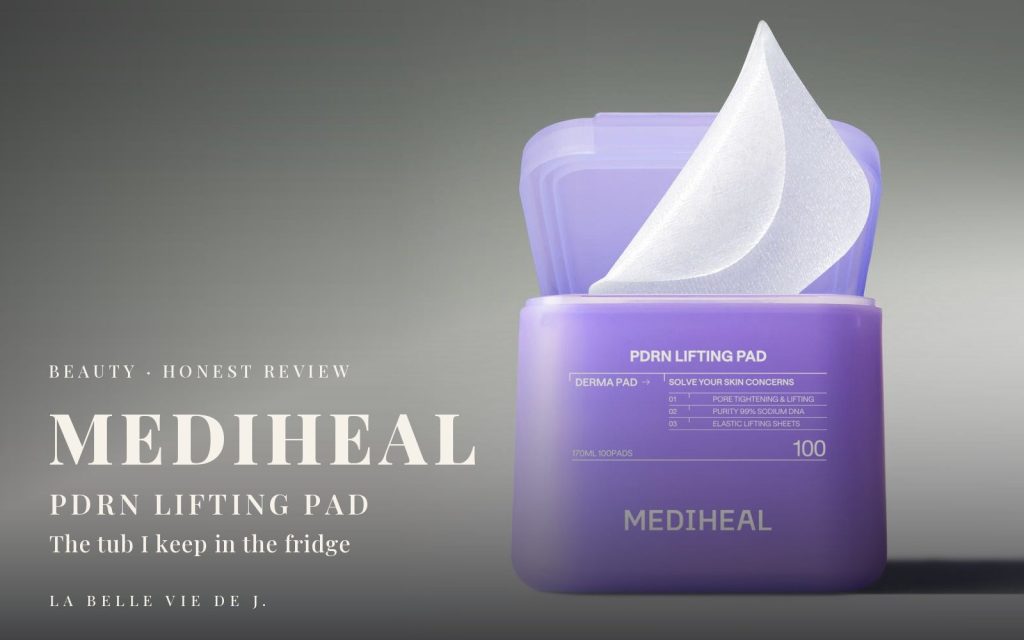
MEDIHEAL PDRN Lifting Pad Review: The Tub I Keep in the Fridge
Last updated: November 14, 2026
Today we’re talking about the purple tub that has quietly taken over my bathroom shelf: the MEDIHEAL PDRN Lifting Pad. Before this tub landed on my shelf, I went deep on what this ingredient can and can’t do — and I’ve folded that homework into this page, further down. This post is not that lecture. This time I bought the pad version, I’ve been using it in real life — mornings, housework and all — and it turns out the most interesting thing about it isn’t the ingredient. It’s the lid.
I ordered it on Amazon.ca from the Mediheal Cos storefront. The list price is $36, but between a sale and Subscribe & Save it came to $21.60 before tax, delivered on October 9. Nine years of living in Canada have taught me that the list price is only ever the opening offer, and skincare is no exception.
So here’s my honest, hands-on review: what this tub actually is, the scent situation (spoiler: there isn’t one), the clever-but-fiddly lid bar, my very unscientific housework test, the fridge trick I now swear by on puffy mornings, and the full price math — because a pad you use every day has to make sense per pad, not just per tub.
🌿 Quick Take
- 100 pads and 170 ml in one tub — big, square, elastic “lifting” sheets
- Completely fragrance-free — no scent at all in my tub
- No loose tweezers: a plastic bar is built into the lid — nothing to lose, but lifting exactly one pad takes patience
- Stays on through vacuuming and dish-washing; a workout would be another story
- I paid $21.60 before tax against a $36 list price (sale + Subscribe & Save, October 2026)
🧴 What’s Actually in the Tub
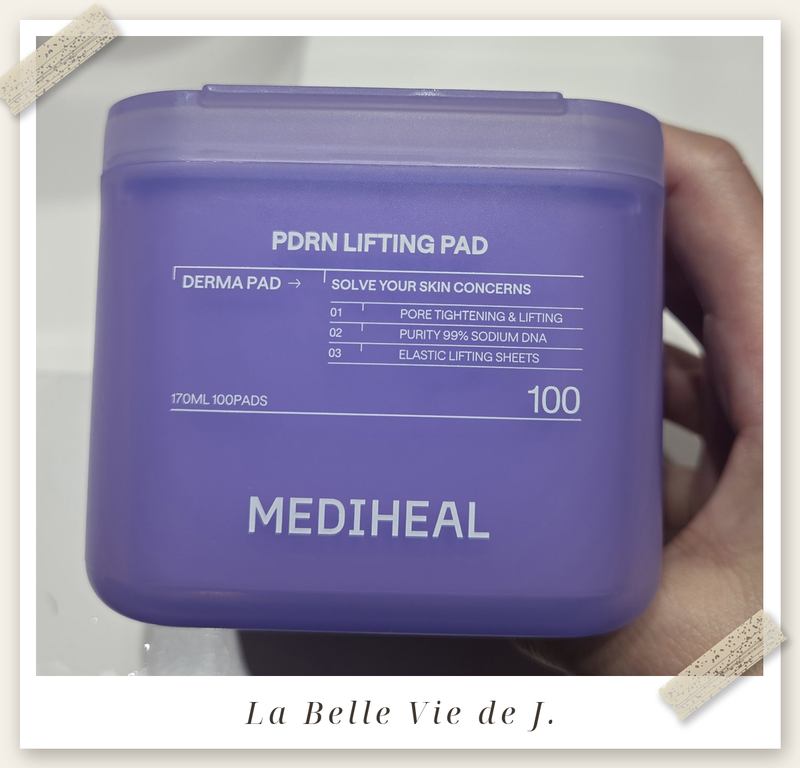
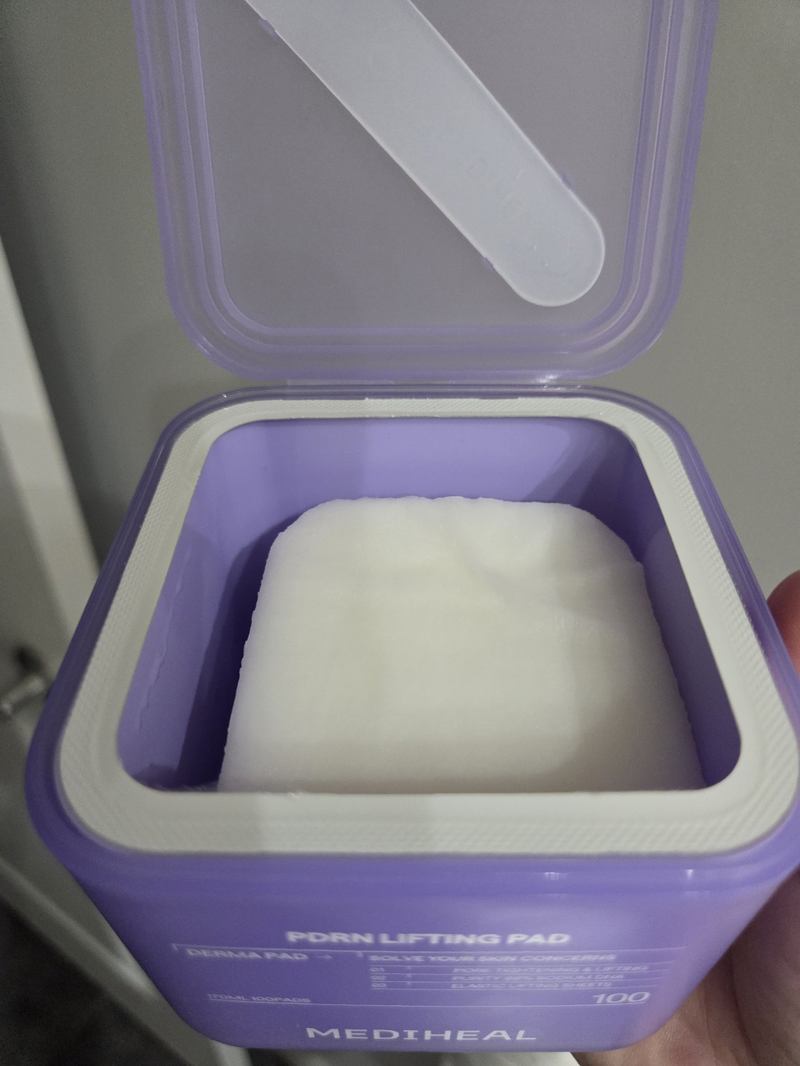
This is MEDIHEAL’s Derma Pad line — the purple one. The tub itself prints three promises on the front: pore tightening and lifting, 99% purity sodium DNA (that’s the PDRN), and elastic lifting sheets. I’m repeating the label, not endorsing it — what a cosmetic pad can realistically do is more modest than what a tub can print, and I laid out the evidence, including what the studies actually support, in the background notes further down this page. My short version: I treat these pads as a hydration-and-habit step in my routine, not as a treatment.
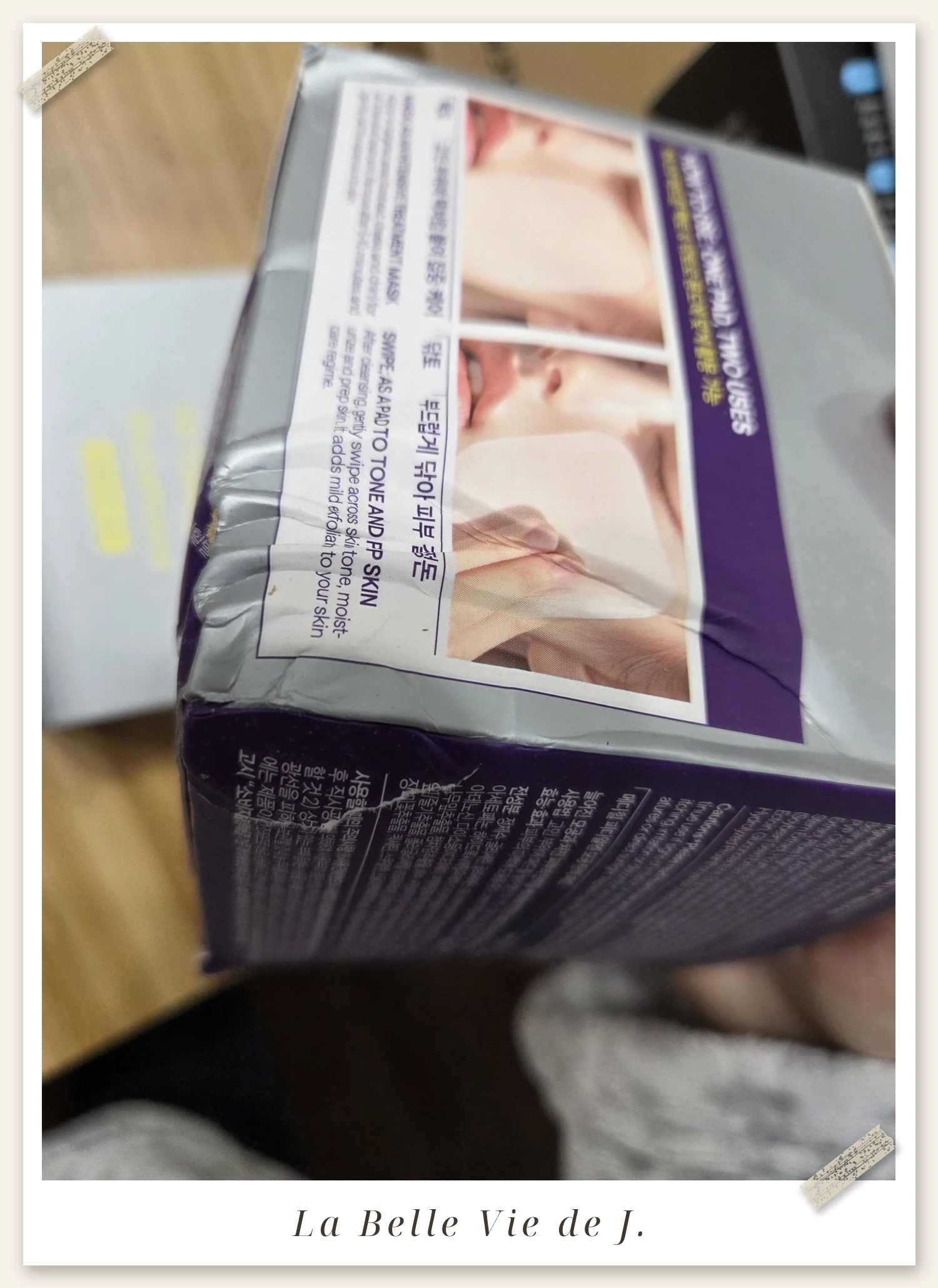
In practice, my main use is as a mini mask: two pads parked on my cheeks after cleansing while the morning gets going. The sheets are the stretchy kind, so they hug the cheek instead of sliding down it — and that detail, as you’ll see in the housework section below, is what makes or breaks a pad in my house. The essence is generous without dripping everywhere, and 100 pads is a properly sized tub, not a two-week teaser.
👃 The Scent Report: There Isn’t One
Short section, because there’s almost nothing to report: these pads have no fragrance. No floral cloud, no “fresh” perfume, nothing lingering on the skin afterwards. If scented toner pads have ever made your eyes water or your skin complain, that’s genuinely good news. And if you’re someone who loves a spa-like scent as part of the ritual, be warned that this one will feel very plain-Jane. For me, especially first thing in the morning, plain is a feature.
🔓 The Lid Bar: Clever, With One Catch
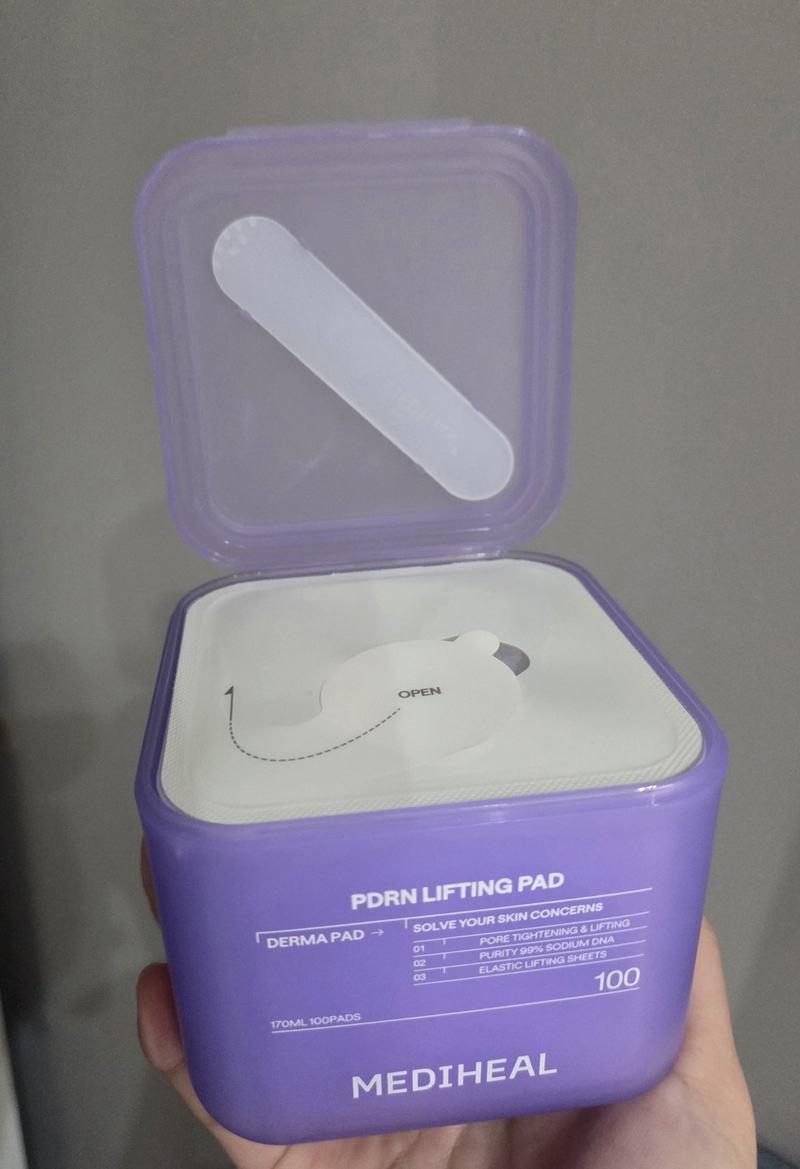
Here’s the design detail I keep coming back to. The other pad brands I’ve used include a little pair of tweezers — a separate piece you fish out, use, and eventually lose somewhere behind the sink. This tub does it differently: a plastic bar is built right into the underside of the lid, so it lives with the tub, every single time. There’s a sealed inner cover under the flip lid when you first open it, and once that’s off, the bar is just… there. Nothing to hunt for with wet hands at 7 a.m.
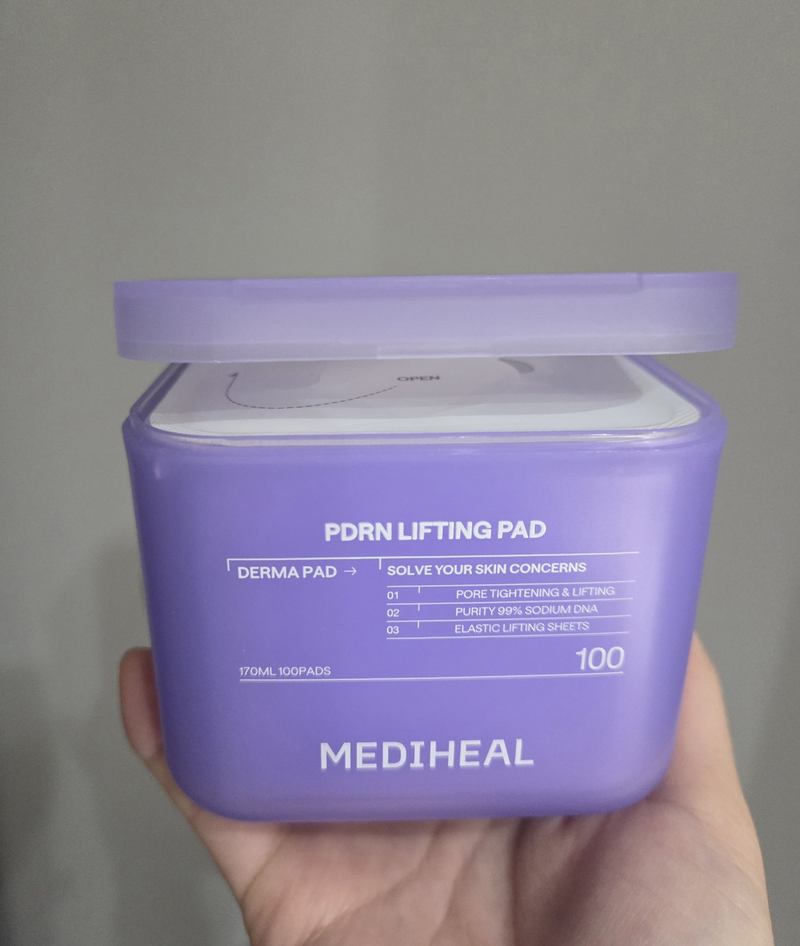
The catch: a bar is not tweezers. It presses and lifts rather than pinches, so separating exactly one pad is genuinely fiddly — the pads are thin and cling to each other, and about half the time the second pad tries to come along for the ride. It takes an extra second of patience. After a few weeks I’ve decided the trade is worth it: I’d rather spend one extra second per morning than play hide-and-seek with a loose tweezer ever again. But if pad separation already annoys you on other tubs, know that this design won’t fix that particular irritation.
🧹 The Housework Test
My real test of any “wear it for 5–10 minutes” product is whether it survives my actual morning. These do. I stick the pads on after cleansing and then get on with things — vacuuming, dishes, tidying up — and they stay where I put them through all of that normal movement. The elastic sheet really does cling rather than perch. The limit is exactly where you’d expect: anything exercise-like, with real bouncing and bending, would end the experiment. For everything short of a workout, though, they stay put — and that’s the difference between a product I use daily and one that slowly migrates to the back of the cabinet.
🧊 Cold From the Fridge, First Thing in the Morning
My tub lives in the fridge. On mornings when I wake up looking like I slept face-first — you know the ones — a cold pad on each cheek is my first move, before coffee, before anything. And here’s my honest, carefully-worded verdict: it feels like the puffiness settles noticeably faster than on mornings when I skip it. That’s a feeling, not a measurement — I own no puffiness-measuring equipment, and cold anything tends to feel de-puffing. But the ritual works for me, the cold pad on warm morning skin is genuinely pleasant, and it’s become the step I actually look forward to.
💡 Tip: keep the tub in the fridge door, not the back of a shelf — if the cold pad is the first thing your hand finds, the habit sticks.
💰 What I Paid, Per Pad
Because a daily product lives or dies on its per-use math, here is exactly what this tub cost me on Amazon.ca (seller: Mediheal Cos), checked in October 2026:
| What | The number |
|---|---|
| List price | CA$36.00 |
| What I paid (sale + Subscribe & Save) | CA$21.60 before tax |
| Cost per pad | about CA$0.22 |
| Subscribe & Save rhythm | Every 2 months |
| Tax | Extra, as always in Canada |
At roughly twenty-two cents a pad, this sits comfortably in “daily habit” territory for me — I’ve paid more per use for pads I liked less. Two honest caveats: Subscribe & Save pricing moves, and you have to actually want the two-month rhythm (you can skip or cancel a delivery in your account, but only if you remember to). Timing skincare purchases around the big sale events is the other half of my strategy — I wrote up how I do that in my Prime Big Deal Days skincare notes. You can also check the official product page for Mediheal’s own description of the pads.
🌟 My Verdict
After a few weeks of mornings, my honest summary is the one I gave a friend: it’s just… convenient. The fragrance-free formula doesn’t fight with the rest of my routine, the lid bar is always where it should be, the pads stay on while life happens around them, and the per-pad price doesn’t make me ration them. The fiddly one-pad-at-a-time thing is real, but it’s a two-second annoyance in a product that otherwise removes friction from my mornings. If you want the ingredient deep-dive before deciding, the background section further down this page is the place — and if you prefer your pads perfumed or your tweezers separate, this tub will not convert you.
Quick question before you go: do you swipe your toner pads and move on, or park them like a mini mask the way I do? Tell me below — I read every answer.
Prices in this post were checked on Amazon.ca in October 2026, before tax, and can change at any time — please check the listing before you buy.
Happy glowing 💛
— J.
🤔 What I Wondered Before I Bought It
I didn’t buy this tub on a whim. Before it landed in my fridge, I spent an evening on the ingredient itself — what PDRN is, what it can’t do, and how to read a label. Here is the short version, because it shapes everything I’ve said above.
Can a pad do what the clinic injections do? No — and keeping that gap in mind is the whole game. The PDRN that Korean clinics talk about is an injectable treatment: a medical procedure, performed by health professionals, at concentrations and depths of action that a cosmetic never reaches. A topical product sits on the skin’s surface, so the honest expectation is gradual and modest — texture and resilience improving over 4 to 8 weeks of once- or twice-daily use. That is exactly why I file these pads under hydration and habit, not treatment.
What is PDRN, in plain terms? It stands for polydeoxyribonucleotide — fragments of DNA, traditionally extracted from salmon milt, then purified. It is a repair-supporting ingredient, not a resurfacing one: it does not exfoliate like acids or speed turnover like retinol. If you are label-shopping, it usually appears in the INCI list as “Sodium DNA” (sometimes simply “DNA”) — and position matters, because ingredients are listed in descending order of concentration for the significant part of the formula. A box that shouts PDRN while burying it at the very end of the list deserves a raised eyebrow.
Can I use it every day? What about side effects? The rhythm the research points to is once or twice daily, with a first honest look at week 4 and a verdict at week 8 — one new product at a time, and a patch test first. The patch test matters doubly if you have a fish allergy, and that caution applies even to the vegan fermented versions (The Ordinary’s Lacto-PDRN is one). Pairing notes from my homework: PDRN plays well with hyaluronic acid, niacinamide, peptides, ceramides and vitamin C — with vitamin C, apply it first, wait 1 to 2 minutes, then layer PDRN. Retinol needs care: PDRN first on slightly damp skin, then retinol on dry skin 10 to 15 minutes later; strong AHA/BHA acids and benzoyl peroxide belong on different days entirely. And if you are pregnant, skip PDRN for now — there is not enough clinical data to call it safe.
Is the MEDIHEAL PDRN Lifting Pad scented?
No. In my tub there is no fragrance at all — nothing floral, nothing lingering — which makes it an easy pick if scented toner pads bother you.
Does it come with tweezers?
Not a separate pair. A plastic bar is built into the inside of the lid, so it’s always there and can’t be lost. The trade-off: separating exactly one thin pad takes a little patience.
How much does the MEDIHEAL PDRN Lifting Pad cost in Canada?
The list price on Amazon.ca was CA$36 when I bought it in October 2026. I paid CA$21.60 before tax with a sale plus Subscribe & Save (every 2 months) — about CA$0.22 per pad. Prices change, so check the listing.
Can you wear the pads while doing other things?
In my experience, yes for everyday movement — I vacuum and do dishes with them on, and they stay put. I wouldn’t wear them for a workout.
And while the pads do their thing, the kettle goes on — Twinings Pure Peppermint is my winter throat ritual.
Two more of my own-money shelf tests, read the same way: my La Roche-Posay Lipikar Baume AP+M review and my Lancôme Rénergie H.C.F. Triple Serum review.
📚 You May Also Like
- Lancôme Rénergie H.C.F. Triple Serum — My Honest Review (Bought With My Own Money)
- I Replaced My CA$80 Moisturizer With This CA$24 One (Honest Review)
- Layer Lab Barrier Moist Cream Review: The 3:1:1 Ceramide Science
Get the Free Canada Savings Checklist
Join the newsletter — get the free PDF checklist and weekly Canada savings tips in your inbox.
Read Next
Some links in this post are referral or affiliate links. If you sign up or buy through them, I may receive a bonus or commission at no extra cost to you. It helps keep this blog running — thank you!