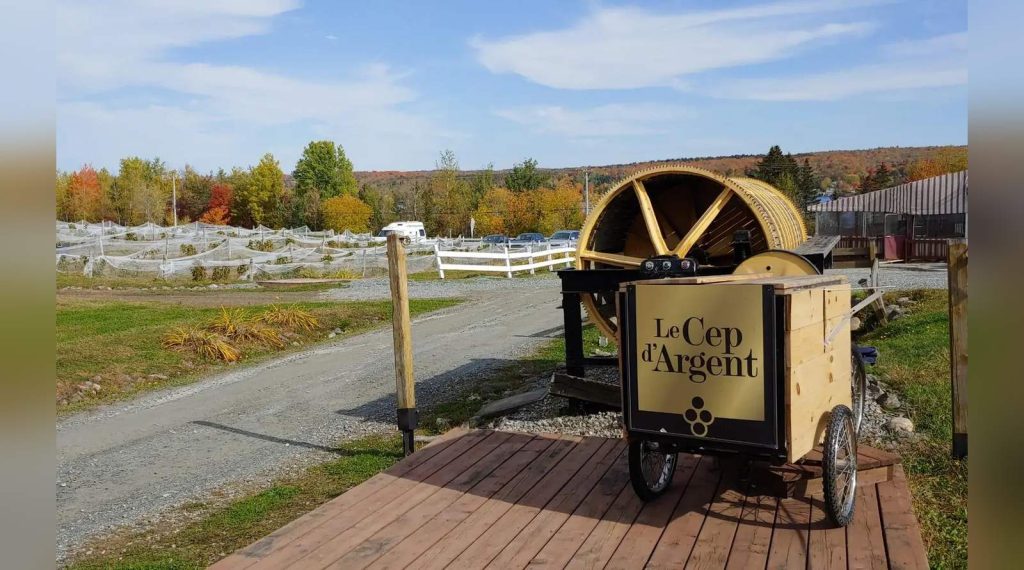
Le Cep d’Argent Winery: Champagne Method & Icewine in Magog
Last updated: November 5, 2026
Some places you visit once. Others quietly move into your suitcase forever. Le Cep d’Argent is the second kind for me: this Magog winery is where I stop before a flight to Korea, because its bottles are the gift that has never once missed. Let me take you through the vineyard, the press, and the tasting room — and tell you exactly which bottle to bring home.
The estate sits on a hillside above Lake Magog, in the gentle Appalachian foothills of the Eastern Townships. The name means “the silver vine stock,” after the silvery shimmer of the lake below. It is a working farm, a Champagne classroom, and a tasting boutique in one — and on a clear day, the view alone is worth the drive.
🌿 Quick Take
- Founded by the Scieur brothers from Champagne, France, with four Québec partners — first vines planted in 1985
- Québec’s sparkling specialist: wines made by the traditional champagne method
- 114 acres, about 60,000 vines, roughly 125,000 bottles a year
- Tastings run through several wines — and several icewines
- My verdict on the icewine: it slides down like honey water. It is the bottle I always gift in Korea
🍇 A Champagne Family Takes Root in Québec
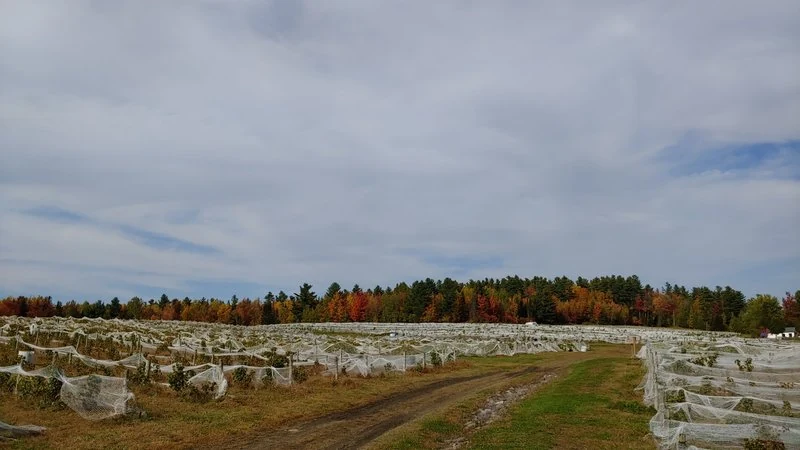
The story starts in Étoges, a village in Champagne-Ardenne, where the Scieur family had made wine for generations. Brothers François and Jean-Paul Scieur crossed the Atlantic with four Québec partners and saw something in this hillside that reminded them of home: elevation around 200 metres, a lake moderating the air, and slopes that catch the light. They planted their first vines in 1985, began production in 1987, and opened to the public in 1988.
Today the vineyard runs to 114 acres and some 60,000 vines. The varieties are the hardy hybrids that survive a Québec winter — Seyval Blanc, Vidal, the Frontenac family, Maréchal Foch, Sainte-Croix — and the estate turns out around 125,000 bottles a year: sparkling, still whites and reds, a port-style fortified wine called L’Archer, and the icewine I will get to in a moment.
🚶 Walking the Vineyard
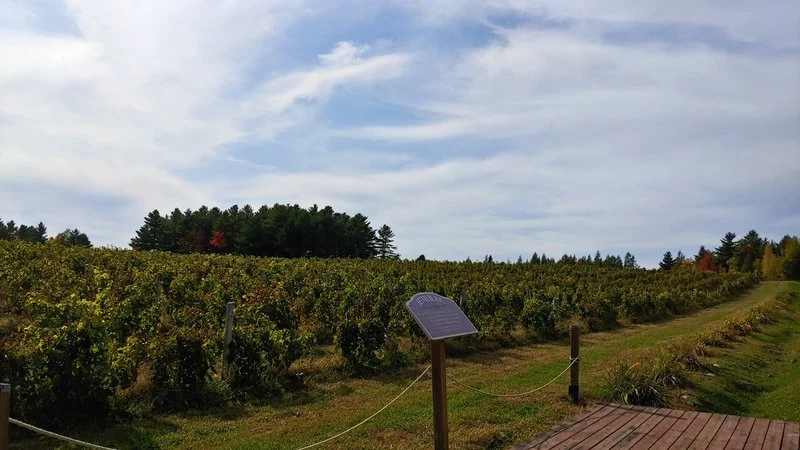
What I love here is that you are allowed to simply wander. A wooden deck threads between the rows, variety signs name what is growing beside you, and white nets ripple over the vines — protection for the ripening fruit, and strangely beautiful, like the whole hillside is tucked in for the season.
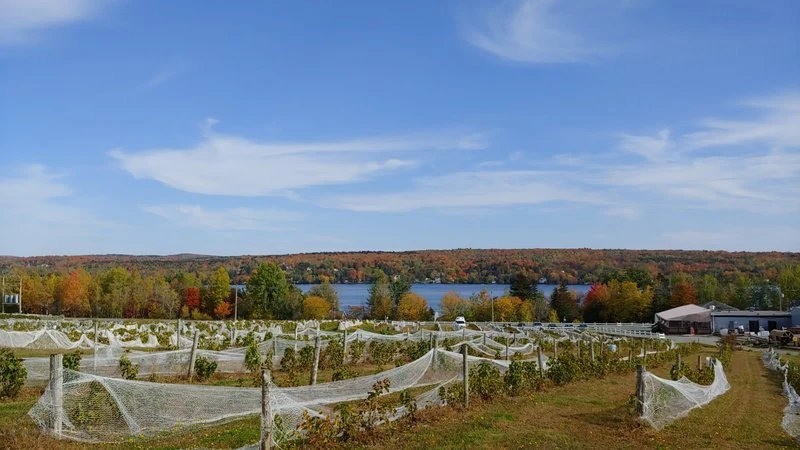
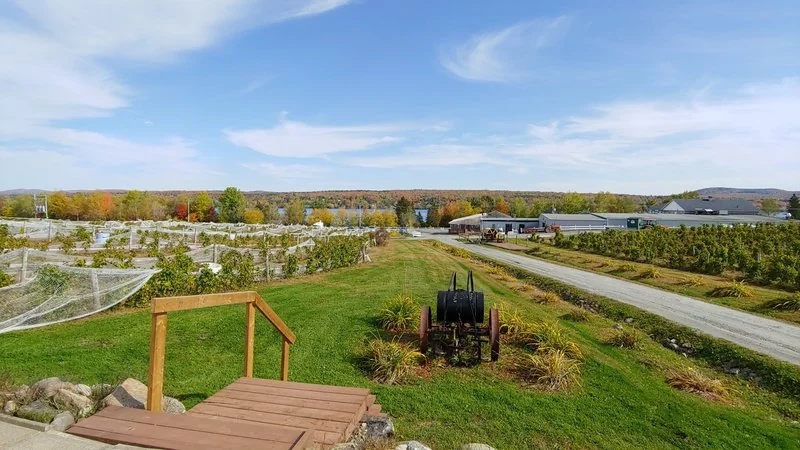
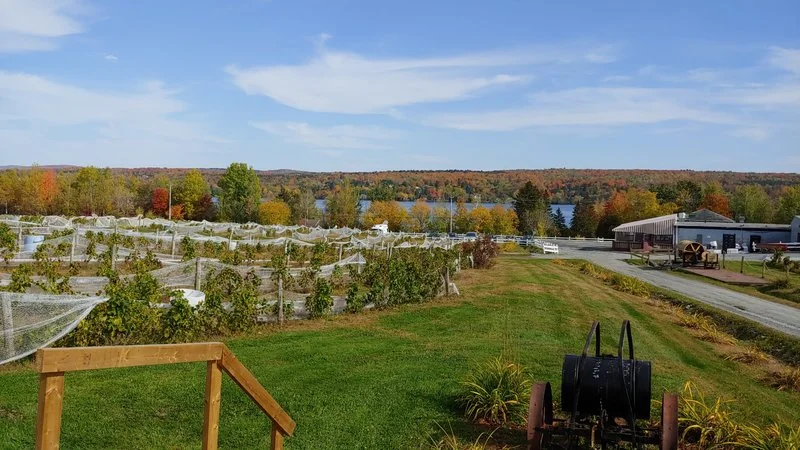
Climb a little and the estate opens up: rows below you, the boutique at the edge of the vines, and beyond it the lake and the hills turning colour. It is an easy, unhurried walk — twenty minutes if you rush it, an hour if you do it properly.
🥂 Sparkling, the Champagne Way
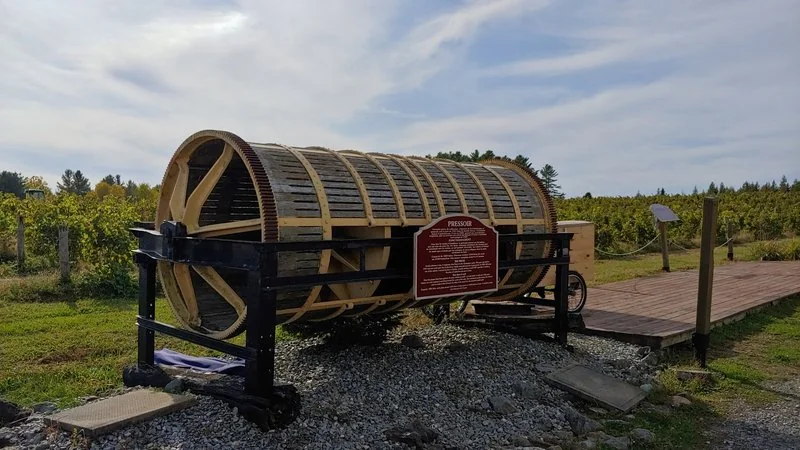
The giant wooden press standing by the deck is not decoration — it is the estate’s thesis statement. Le Cep d’Argent built its reputation on sparkling wine made the slow way, by the traditional method: second fermentation in the bottle, exactly as in Champagne. Its Sélection line — Blanc de Blancs, Brut Nature, Rosée — is the flagship, and the estate is often described as Québec’s only winery making sparkling wine this way. There is even a small interpretation centre on site dedicated to the méthode champenoise, and in 2009 the family helped found a provincial celebration of Québec sparkling.
💡 J.’s tip — Two experiences are worth planning around: the self-guided sparkling tour, which walks you through each step of the method, and the sabrage — opening a bottle with a sabre. If the sommelier-led cave tasting is running on your day, book it; it ends in the medieval-style hall below.
🍷 The Tastings: Several Wines, Several Icewines
This is not a one-sip-and-done tasting room. You work through several wines — sparkling, still, fortified — and then arrive at the part I wait for: the icewines, plural. There are several icewines to compare, which is rare; most Québec wineries pour one and move on.
My honest tasting note, recorded right there: the icewine slides down like honey water. Deeply, almost impossibly sweet, but so smooth that the glass empties before you have decided whether to buy a bottle. You will buy the bottle. Everyone does.
🎁 The Bottle I Always Gift in Korea
Here is the personal part. Every trip home to Korea, I have carried this winery’s bottles in my luggage — several times now — and they have been a complete hit, every single time. Icewine is still a novelty gift in Korea: Canadian, wintry, luxurious, and just small enough to travel well. The sparkling is the other suitcase candidate — a Québec bottle with a genuine Champagne pedigree makes a wonderful story at the table.
The boutique sells the full range on site, and the wines also appear in SAQ stores and public markets, so a restock never requires the drive. But go for the drive anyway.
🏰 A Medieval-Style Finishing Touch
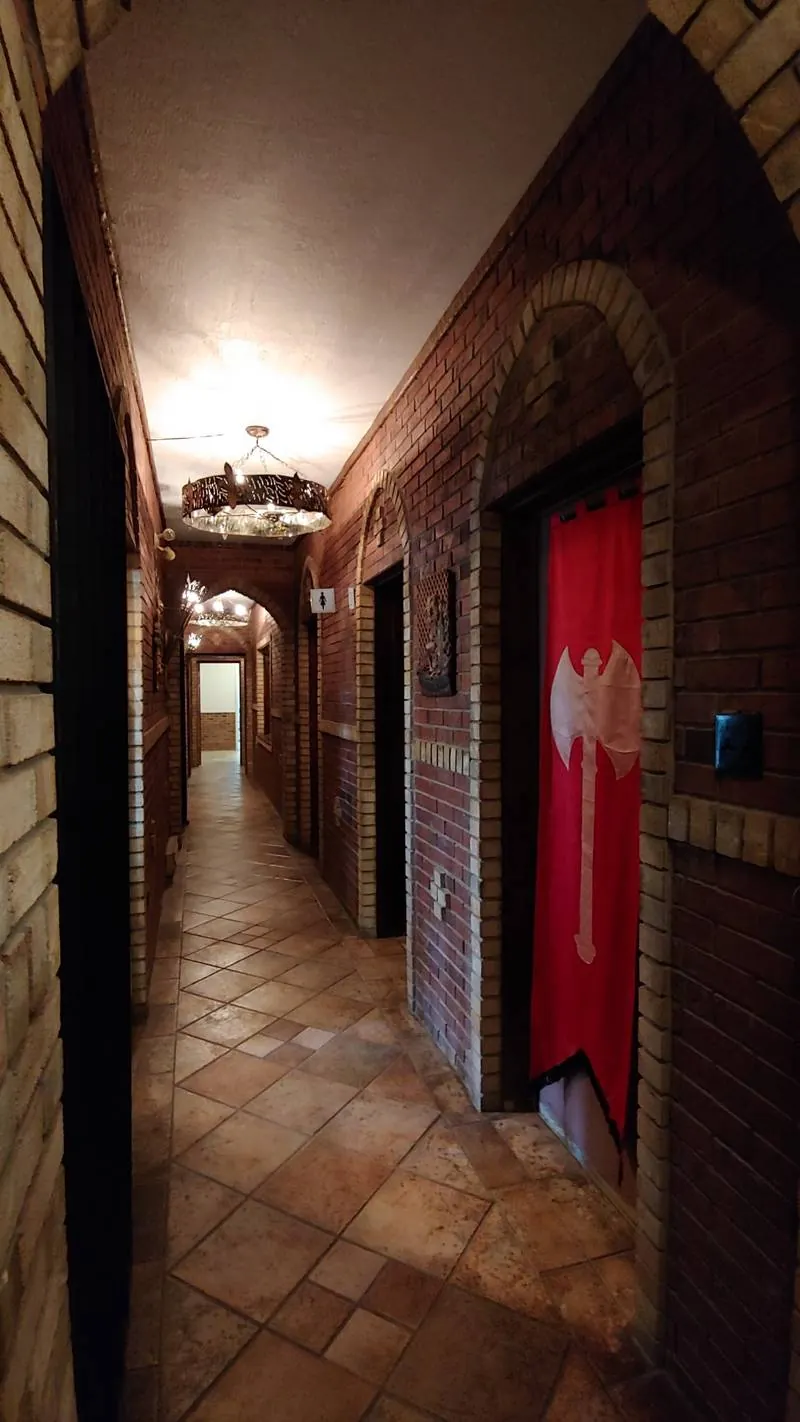
One detail charms me every visit: the sommelier-led cave tasting finishes in a salle médiévale, a medieval-style hall — brick arches, stone and tile underfoot. It sounds like a gimmick until you are sitting in it with a glass in hand; then it feels exactly right for a family that has been making wine since long before Canada existed. Between the interpretation centre, the press on the deck and this hall, the estate teaches as much as it pours.
✅ The Visit, in Order
- Walk the vineyard slowly — twenty minutes if you rush it, an hour if you do it properly.
- Two experiences are worth planning around: the self-guided sparkling tour, and the sabrage.
- If the sommelier-led cave tasting is running on your day, book it — it ends in the medieval-style hall below.
- The tasting finishes with several icewines to compare — don’t rush the finale.
- The wines also appear in SAQ stores and public markets, so a restock never requires the drive.
- Open year-round, with shorter hours outside the warm season — check the current schedule on the official site before you set out.
🧭 Before You Go
Le Cep d’Argent is at 1257 chemin de la Rivière, Magog, about an hour and a half from Montréal. It opens year-round with shorter hours outside the warm season, and tour formats vary by day — check the current schedule on the official site before you set out. A last piece of trivia to carry with you: Québec’s first grape-harvest festival, the Fête des Vendanges, began as a harvest party at this very winery in 1991. Raise a glass to that. View on Google Maps
What is Le Cep d’Argent known for?
Sparkling wine made by the traditional champagne method — it is often described as Québec’s only winery working this way — plus a well-loved icewine. The estate was founded by the Scieur brothers from Champagne with four Québec partners.
Can you taste several wines at the winery?
Yes. The tasting runs through several wines — sparkling, still and fortified — and finishes with several icewines you can compare side by side, which is rare in Québec.
How sweet is the icewine, really?
Very — but smoothly so. My note from the tasting: it slides down like honey water. That sweetness is exactly why it works as a gift: a small glass feels like dessert and celebration at once.
Where is Le Cep d’Argent, and when is it open?
At 1257 chemin de la Rivière in Magog, about 1.5 hours from Montréal. It opens year-round with shorter hours outside the warm season, and tours vary by day, so check the official site before you go.
One question before you go: if a bottle from this hillside were travelling home in your suitcase, would you choose the sparkling or the icewine? Tell me below — I read every answer.
While you’re in Magog, the slow day on Lake Memphrémagog’s shore and the fall colours of Mont Orford complete the same Eastern Townships trip.
📚 You May Also Like
- Magog, Québec: A Slow Day on Lake Memphrémagog’s Shore
- Mont Orford in Fall: Gondola Rides Over Québec Colours
- Isle-aux-Coudres: Free Ferry & the 23 km Island Loop
Happy wandering 💛
— J.
Take care, and see you on the next beautiful road.
Get the Free Canada Savings Checklist
Join the newsletter — get the free PDF checklist and weekly Canada savings tips in your inbox.
Read Next


Some links in this post are referral or affiliate links. If you sign up or buy through them, I may receive a bonus or commission at no extra cost to you. It helps keep this blog running — thank you!