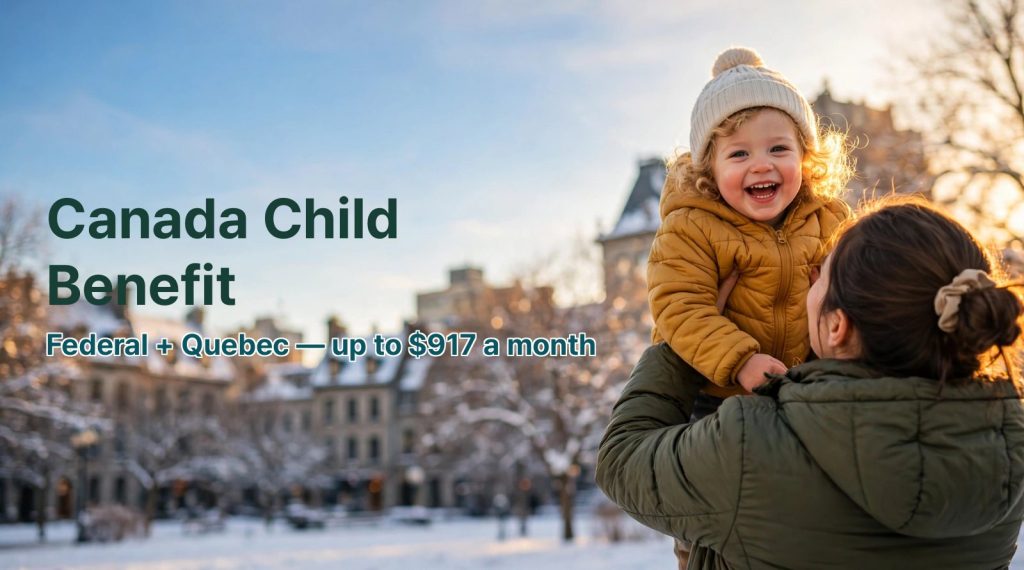
Canada Child Benefit, Explained — Amounts, the 11-Month Window, How to Apply, and What Quebec Adds
If you are raising a child in Canada, two governments may be sending you money every month — Ottawa and, if you live in Quebec, Quebec City too. This guide lays out exactly how much each one pays, how the two stack, how far back you can claim, and how to apply, all with real numbers for the 2025–26 benefit year.
THE SHORT VERSION
· The federal Canada Child Benefit pays up to $666 a month for a child under 6 — tax-free.
· Quebec’s Family Allowance adds up to $251 a month per child, for a combined $917 a month.
· Late claims are only paid back 11 months. Every month you wait past that is money you do not get back.
1. The federal Canada Child Benefit (CCB)
The CCB is a tax-free monthly payment from the federal government for children under 18. Every July, the amount is recalculated from your household’s adjusted family net income (AFNI) on the previous year’s tax return.
- Under age 6: up to $7,997 a year ($666 a month)
- Ages 6 to 17: up to $6,748 a year ($562 a month)
- The phase-out: full amounts up to $37,487 of family net income. Above that, the benefit shrinks by a set percentage of the excess (7% for one child). Past $81,222 the reduction slows, and for one child it does not fully disappear until income approaches roughly $235,000.
In other words, even high earners usually receive something. The catch is that both parents have to file taxes every year to keep it coming — more on that below.
2. Quebec’s Family Allowance (Allocation famille)
Quebec pays its own child benefit on top of the federal one. It works like a refundable tax credit, in two layers: a base amount every family keeps, plus an income-tested top-up. It is tax-free, paid quarterly (January, April, July, October) by default, or monthly if you ask.
- Up to $3,006 a year per child
- A minimum of $1,196 a year is guaranteed, no matter how high your income
- School supplies supplement: $124 a year per child aged 4 to 16, paid each July
When a child is born in Quebec, registration is automatic through the birth declaration, and the first payment usually lands within about 40 days.
3. So what does a Quebec family actually get?
The two benefits stack. Here is the real monthly total for a couple with one child under 6, by household net income:
| Household net income | Federal CCB (monthly) | Quebec Family Allowance (monthly) | Combined (monthly) |
|---|---|---|---|
| $30,000 | $666 | $251 | $917 |
| $50,000 | $593 | $251 | $844 |
| $70,000 | $477 | $215 | $692 |
| $100,000 | $361 | $115 | $476 |
| $150,000 | $228 | $100 | $328 |
Even at $100,000 of net income, one child under 6 brings in $476 a month. With two children under 6, the same income yields about $1,118 a month — and at lower incomes, up to $1,834. Note that the phase-out also stacks: as income rises, both governments trim at once, so the combined total falls faster than most people expect.
4. Single parents receive more

The federal CCB has no separate single-parent top-up — but because it is calculated on one income instead of two, a single parent’s benefit naturally stretches further before phasing out.
Quebec goes further, with an explicit single-parent supplement:
- Up to $1,055 more per year, with a guaranteed minimum of $421
- Quebec’s phase-out for single parents starts at its own threshold ($43,280), separate from the couples’ line
Run the two together and a single parent’s combined total can exceed what a couple with the same child receives at the same total income. If you parent alone, file as a single-parent household from the start — that status is what switches the supplement on.
5. A child with a disability brings a second layer of benefits
- Child Disability Benefit (federal): if your child qualifies for the Disability Tax Credit, up to $3,411 a year is added to the CCB. It phases out only above $81,222 of family income.
- Supplement for handicapped children (Quebec): $2,832 a year, paid regardless of family income. For the most severe situations, a second tier (additional complexity of care) adds more on top.
Stacked, the disability layer alone can reach $6,243 a year, on top of the regular CCB and Family Allowance. The gateway is medical certification — the federal Disability Tax Credit approval, and a separate assessment by Retraite Québec. Start the paperwork early; approval dates drive payment dates.
6. Claiming late — the 11-month window
If you apply late, the CCB is paid retroactively for up to 11 months. Anything older than that is, in principle, gone. (In rare cases the CRA can accept a later claim for a documented reason you could not apply — illness, for example — but never plan on it.)
New to Canada on a work or study permit? Temporary residents become eligible only after 18 months of living in Canada, with a valid permit in the 19th month. Mark that date: the 11-month clock means applying at month 19 still captures most of the eligible period.
7. How to apply — automatic at birth, manual if you arrived with children
Federal (CCB):
- Born in Canada: consent to the Automated Benefits Application when you register the birth, and the CRA is notified automatically
- Arrived with children, or missed the automatic route: file form RC66 (plus RC66SCH for status and income if you are a newcomer), by mail or through CRA My Account
- You will need proof of each child’s birth and proof of your status in Canada
Quebec (Family Allowance):
- Born in Quebec: automatic with the birth declaration — nothing to file
- Moved to Quebec with children: apply to Retraite Québec with its own form — the federal application does not carry over
8. There is no “reapplying” — there is filing your taxes
You never re-apply for the CCB or the Family Allowance. What keeps them alive is an annual tax return from both spouses or partners, every year — even in a year with no income at all. Miss the filing and the July recalculation stops the payments; file, notify the CRA, and the amounts are reconciled and restarted.
One warning for families with income abroad: the CCB is calculated on worldwide income. Income earned outside Canada must still be reported on the income statement — leaving it out does not raise your benefit; it creates an overpayment the CRA will later reclaim, with interest.
When one parent lives in another country
Split-household families — one parent in Canada with the children, the other working abroad — ask about this constantly. The parent in Canada who is the child’s primary caregiver can receive the CCB and the Family Allowance. Two obligations come with it: the spouse abroad, even as a non-resident, must still declare worldwide income for the benefit calculation, and Quebec also measures the Family Allowance against household net income. Keep both parents’ income documented from day one and the split arrangement itself is no obstacle.
The government also saves into your child’s education account — the RESP

Separate from the monthly cash, opening a Registered Education Savings Plan (RESP) triggers government money into your child’s account:
- CESG (federal grant): the government matches 20% of what you contribute — up to $500 a year and $7,200 over the child’s lifetime
- Canada Learning Bond (CLB): for lower-income families, the government deposits $500 in the first year and $100 a year after that — up to $2,000 — even if you contribute nothing at all. Eligibility years run to age 15
- QESI (Quebec): Quebec adds 10% of your contributions, up to $250 a year ($500 for lower-income families) and $3,600 lifetime, on top of the federal grants
None of this is automatic. You have to actually open the RESP, and the Learning Bond in particular only starts when you apply for it at account opening. Families who qualify but never open the account simply never receive it. All you need is your child’s Social Insurance Number, at any bank or financial institution.
9. How Korea compares — front-loaded vs. the long haul
South Korea pays new parents dramatically more at the start: a first-meet voucher of ₩2 million (₩3 million from the second child), then ₩1 million a month for a baby under 1 and ₩500,000 a month in the second year, plus a flat ₩100,000 monthly child allowance to age 8. Add it up over six years at lower incomes and Canada still comes out ahead — roughly ₩63.5 million of Canadian benefits versus about ₩32 million in Korea — simply because Canada keeps paying, every month, until 18. The two systems are built on opposite instincts: Korea concentrates everything in the first two years; Canada spreads a thinner layer across the whole of childhood, with subsidized Quebec childcare (about $9.35 a day in 2025) filling part of the early-years gap.
Frequently asked questions
Q. How much is the Canada Child Benefit, exactly?
For 2025–26, up to $7,997 a year ($666 a month) per child under 6, and $6,748 a year ($562 a month) per child aged 6 to 17. Your actual amount depends on your adjusted family net income, calculated every July.
Q. How far back can I claim?
Up to 11 months retroactively. Months older than that are not paid, so the application date matters more than almost anything else in this guide.
Q. How do I apply?
For a Canadian-born child, consent to the Automated Benefits Application at birth registration. Otherwise, file form RC66 (plus RC66SCH for newcomers) by mail or in CRA My Account. In Quebec, births are registered automatically with Retraite Québec; families who move to Quebec apply to Retraite Québec separately.
Q. Can I apply online?
Yes — through CRA My Account you can apply and submit documents online. Keep the child’s birth proof and both parents’ status documents ready as files.
Q. Do I need to reapply every year?
No — but both spouses must file a tax return every year, even with zero income. The July payment stoppages people panic about are almost always a missed filing; file, tell the CRA, and payments resume with reconciliation.
Q. I am here on a work permit. Can I receive it?
Yes, once you have lived in Canada for 18 months and hold a valid permit in the 19th month. If your spouse is a citizen or permanent resident, an application through them may also be possible.
YOU MAY ALSO LIKE
ISIC, IYTC or ITIC? The International Student Card Guide
VIA Rail Canada, Route by Route: Every Train, Fare and Discount
— J.
Get the Free Canada Savings Checklist
Join the newsletter — get the free PDF checklist and weekly Canada savings tips in your inbox.
Read Next


Some links in this post are referral or affiliate links. If you sign up or buy through them, I may receive a bonus or commission at no extra cost to you. It helps keep this blog running — thank you!