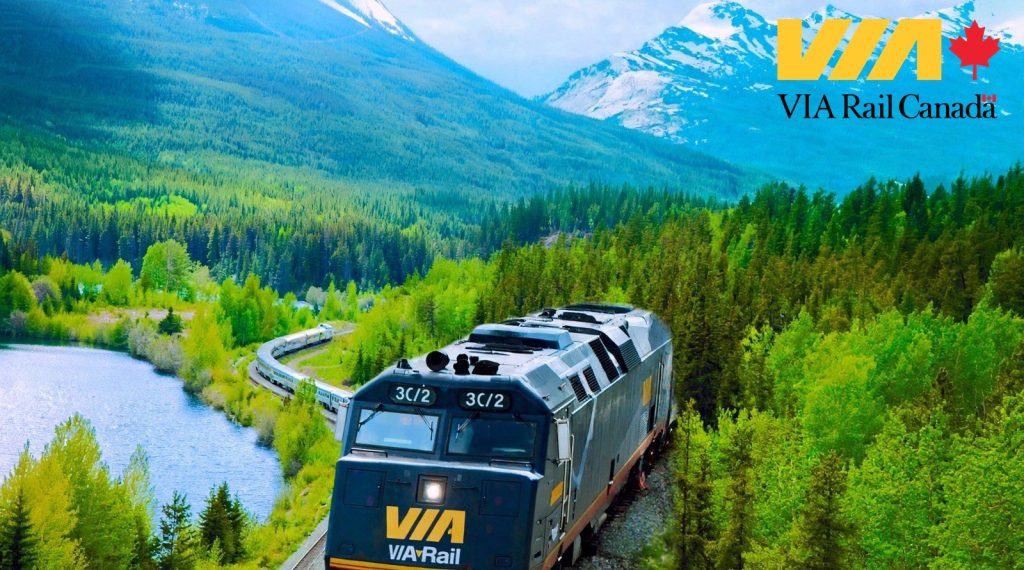
VIA Rail Canada, Route by Route: Every Train, Fare and Discount — Planned from Montreal
Seeing Canada by Train
A plane is the fastest way across Canada, but a train is the most beautiful one. From Montreal, VIA Rail strings together routes where the window is the destination — from the stone lanes of Québec City to the snow peaks of the Rockies and the fishing villages of the Atlantic. This guide gathers everything you need in one place: every route, fare and discount, which side of the train to sit on for the best views, and how to claim a seat under the glass dome.
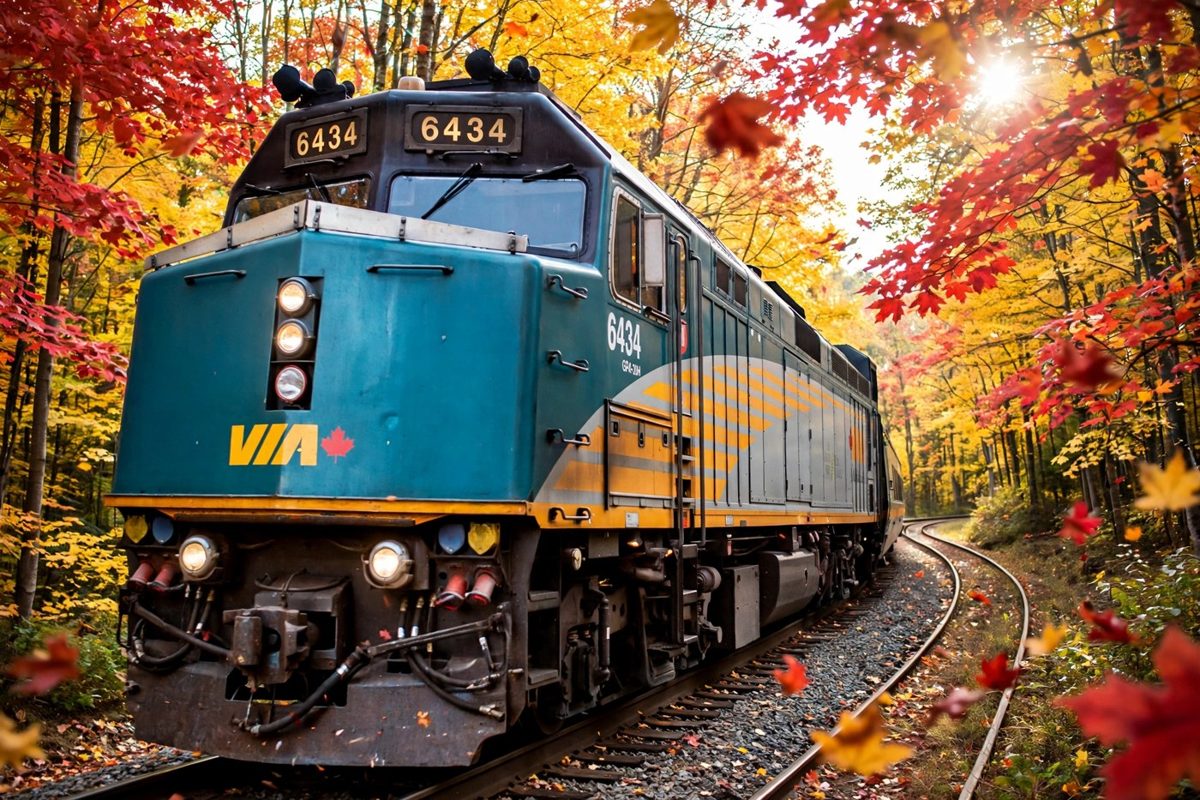
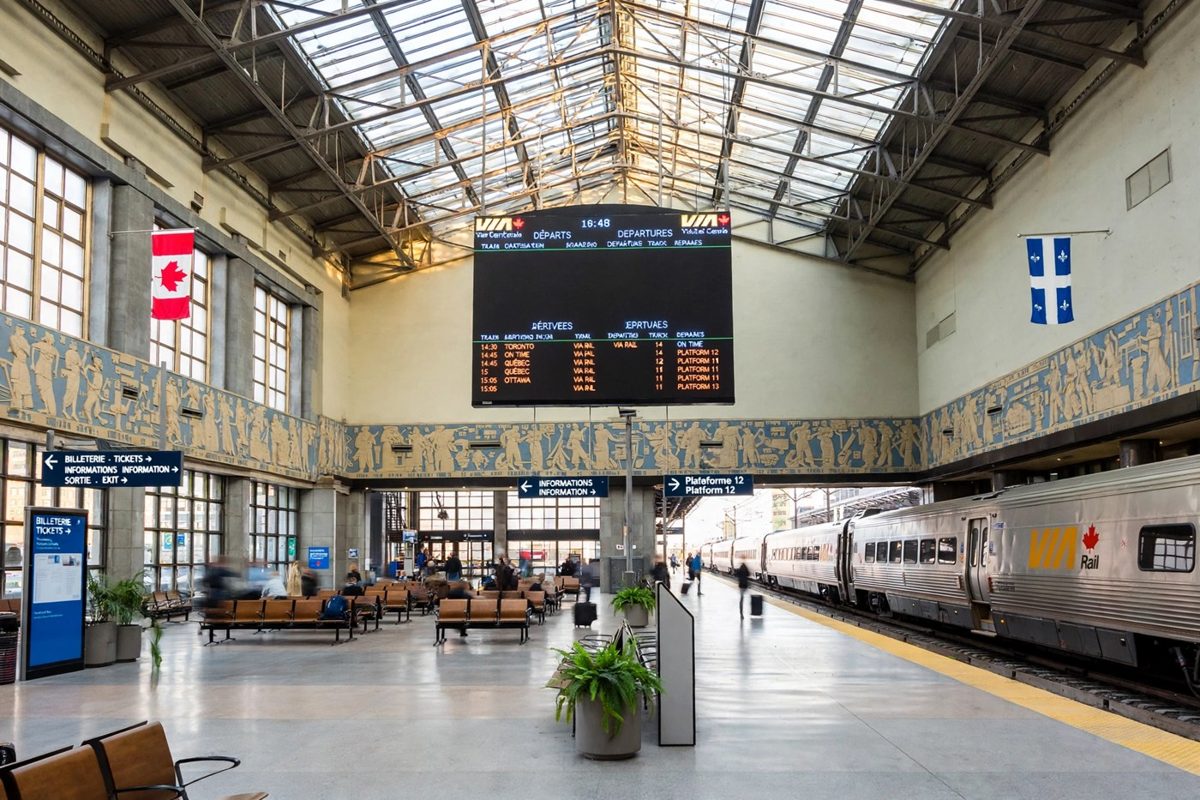
The short answer: yes — but every route plays by completely different rules. One line is a commuter workhorse that runs several times a day; another runs twice a week and takes four nights. This guide maps out every VIA Rail route from a Montreal starting point, then gets into the part everyone actually cares about: how to pay less for the same seat.
🚆 Every VIA Rail Route at a Glance
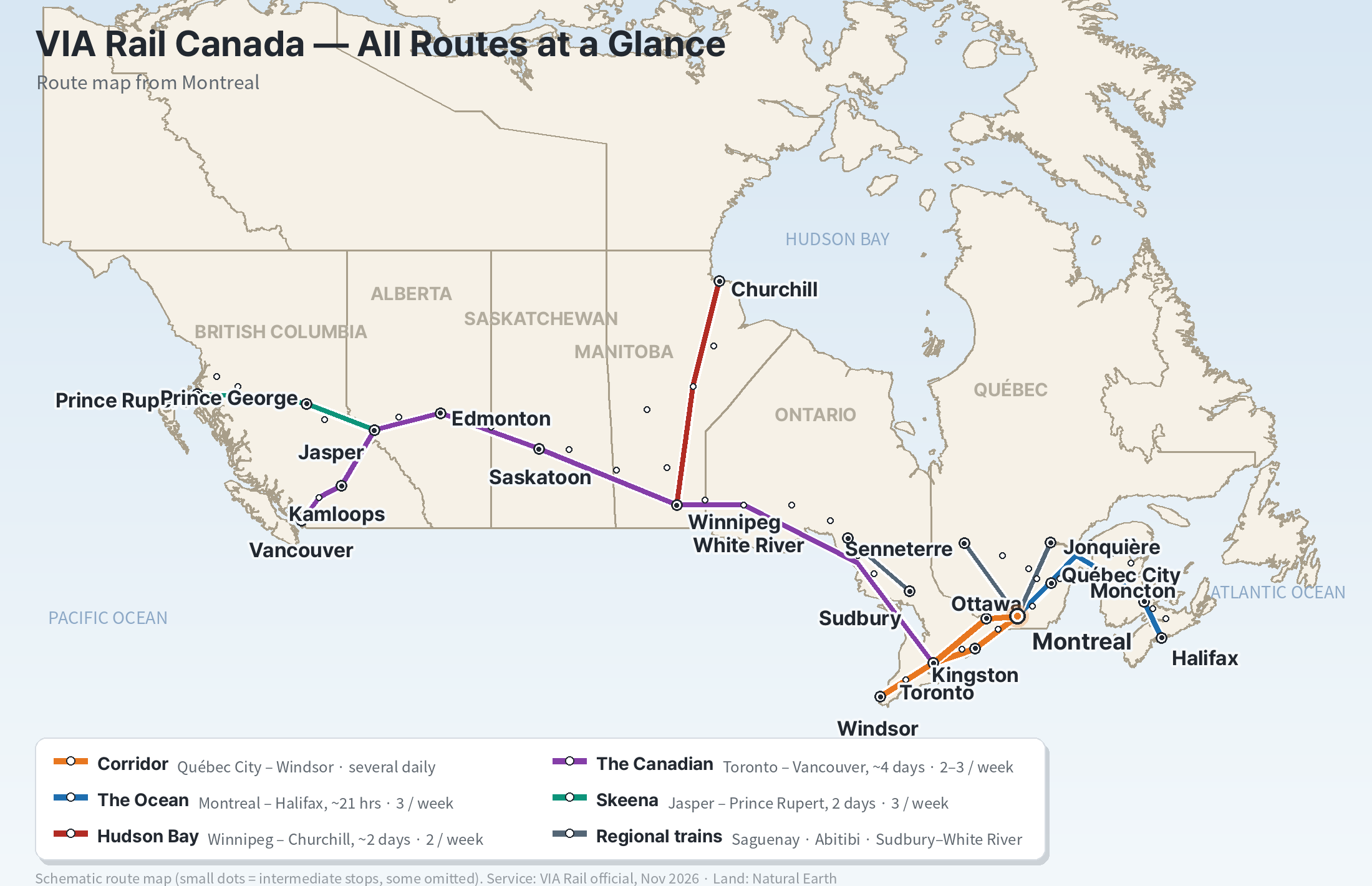
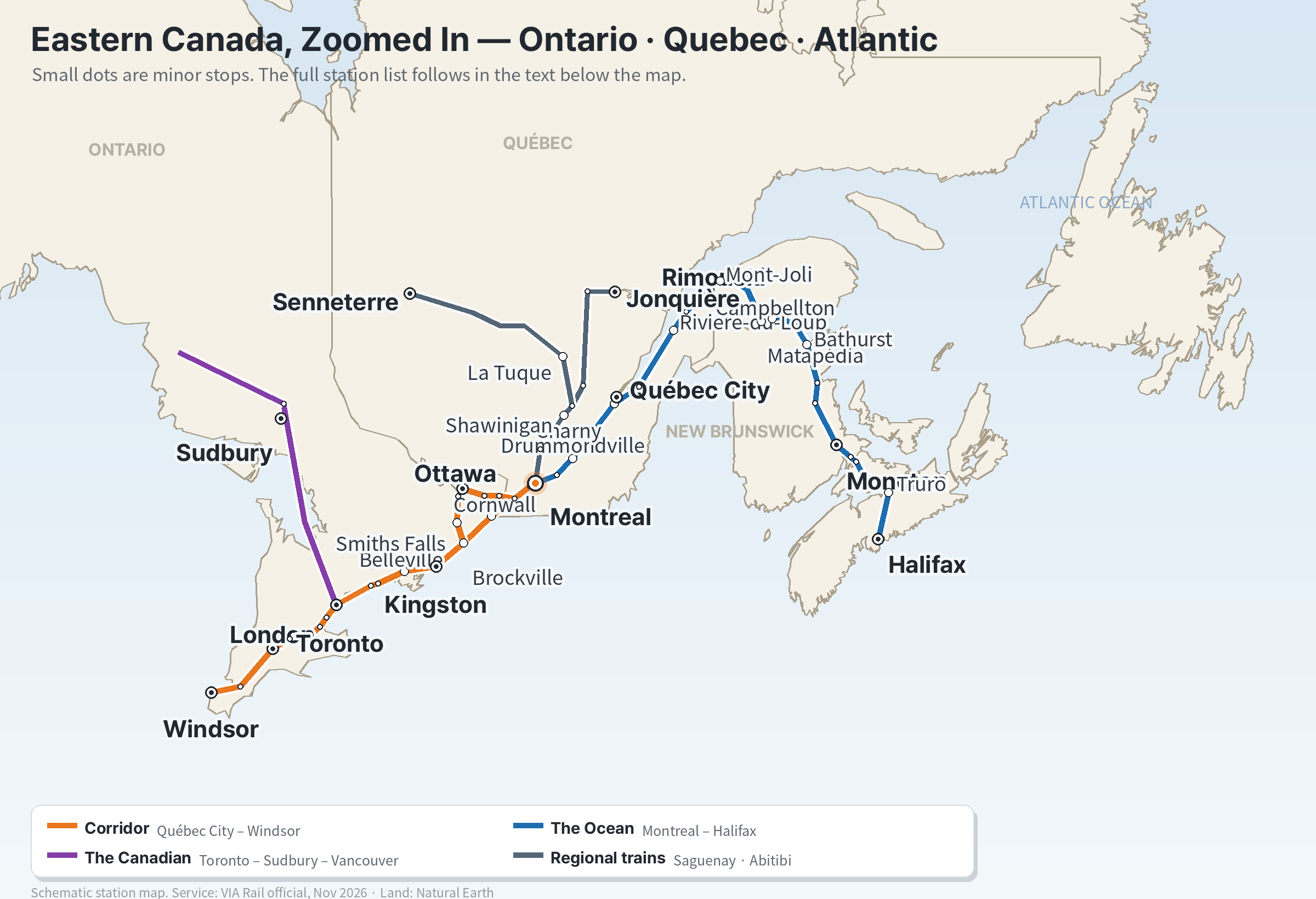
🚉 Every station in the east, west to east
· Corridor: Windsor → Chatham → London → Woodstock → Brantford → Aldershot → Oakville → Toronto → Port Hope → Cobourg → Belleville → Kingston → Brockville → Cornwall → Dorval → Montreal → Saint-Hyacinthe → Drummondville → Charny → Québec City
· Ottawa trains: Brockville → Smiths Falls → Fallowfield → Ottawa → Casselman → Alexandria → Coteau → Dorval → Montreal
· The Ocean: Montreal → Saint-Hyacinthe → Drummondville → Charny → Montmagny → Rivière-du-Loup → Trois-Pistoles → Rimouski → Mont-Joli → Matapédia → Campbellton → Bathurst → Miramichi → Moncton → Sackville → Amherst → Truro → Halifax
· Saguenay: Montreal → Joliette → Shawinigan → Rivière-à-Pierre → Jonquière / Abitibi: Shawinigan → La Tuque → Senneterre (some small flag stops omitted)
| Route | Segment | Travel time | Frequency | What it’s like |
|---|---|---|---|---|
| The Corridor | Quebec City–Montreal–Ottawa–Toronto–Windsor | Varies by segment | Several to dozens of departures a day | Canada’s busiest everyday rail line |
| The Ocean | Montreal–Halifax | About 23 hours | 3x a week (Wed · Fri · Sun) | An overnight sleeper train to the Atlantic |
| The Canadian | Toronto–Vancouver | About 4 nights | 2–3x a week | The legendary cross-country train |
| Skeena | Jasper–Prince Rupert | 2 days (with an overnight stop) | 3x a week | A sightseeing train that runs through the Rockies by daylight only |
| Hudson Bay | Winnipeg–Churchill | About 45 hours | 2x a week | The only land route to polar bear country |
| Saguenay | Montreal–Jonquière | About 11 hours | 3x a week | North into Quebec’s deep forest |
| Abitibi | Montreal–Senneterre | About 13 hours 30 min | 3x a week | Remote northwestern Quebec |
| — | Sudbury–White River | About 8 hours | 3x a week | A regional train in Northern Ontario |
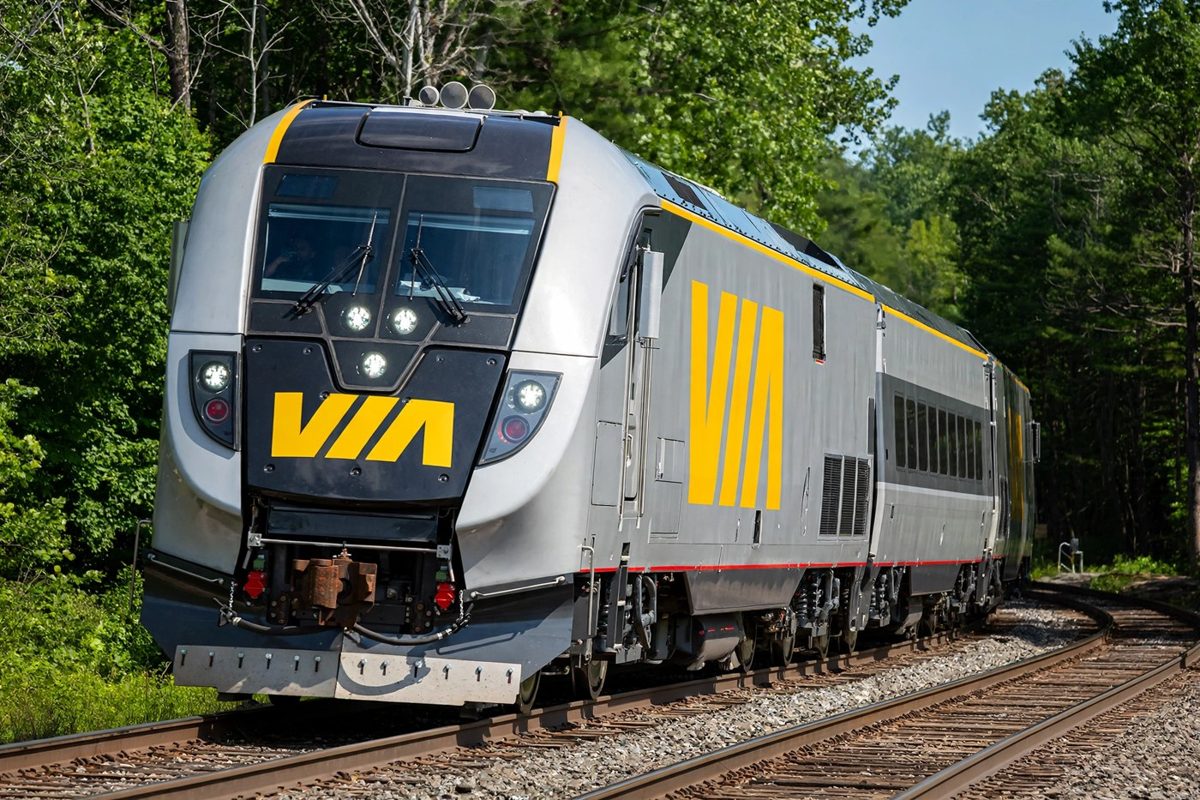
The one you’ll actually use day to day is the first row: the Corridor. Montreal–Quebec City takes about 3 hours 15 minutes (5–7 trains a day, from $43), and Montreal–Toronto about 5 hours 10 minutes (around 6 trains a day, from $55). Because it’s downtown station to downtown station, once you subtract airport transfers and security lines, the train’s real door-to-door time is much closer to flying than most people expect.
🍂 Can You Take the Train to Tadoussac for Fall Colours?
First, the misconception almost everyone starts with: Tadoussac has no train station. There is no “train to Tadoussac” — the trip that works looks like this.
① The train leg: Montreal → Quebec City (VIA Rail, about 3 hours 15 minutes)
This is as far as VIA Rail takes you.
② The transfer — two choices
- Train de Charlevoix (the Charlevoix sightseeing train): Leaves from Chute-Montmorency in Quebec City and follows the St. Lawrence River through Baie-Saint-Paul to La Malbaie — about 3 hours 45 minutes of river-and-cliff scenery. Peak fall colour (late September to mid-October) falls inside its season, but the season ends November 1 (2026 schedule), so check before planning a late-fall trip. Fares start at $268 round trip, Quebec City–La Malbaie, before tax. One catch: its last stop is La Malbaie — from there you still need a bus or car to reach Tadoussac.
- Intercar bus, direct: One bus ride from Quebec City straight to Tadoussac, every day — downtown Quebec City 10:00 departure, Tadoussac 14:00 arrival (the return bus leaves Tadoussac at 14:20). It follows Route 138 through La Malbaie, and the ferry crossing at the end is included.
③ The last leg: the ferry (Baie-Sainte-Catherine ↔ Tadoussac)
The ferry across the river is free and takes about 10 minutes. It runs year-round.
So the fall Tadoussac route is a three-part combo: train (Montreal–Quebec City) + sightseeing train or bus + free ferry. If you want to linger in the Charlevoix coastal villages, take the sightseeing train; if whales in Tadoussac are the point, the direct bus saves you hours.
🏛️ Montreal → Ottawa: A Day Trip That Actually Works by Train
- Gare Centrale → Ottawa Station, about 2 hours (the fastest runs are in the 1-hour-50s)
- Around 5–6 direct trains a day, plus connecting options via Fallowfield station west of downtown
- Escape fares from around $30 — the earlier you book, the cheaper it gets
Parliament in the morning, home by dinner train: Ottawa is an easy day trip at this distance. Driving means downtown parking headaches; the train drops you in the middle of the city. For Ottawa specifically, the train honestly wins.
🌎 Montreal to Vancouver: Can You Really Cross Canada by Train?
Yes — with one change of trains in Toronto.
- Montreal → Toronto (the Corridor, about 5 hours 10 minutes)
- At Toronto’s Union Station, transfer to The Canadian → about 4 nights to Vancouver
The Canadian covers 4,466 km, rolling through Winnipeg and Edmonton and climbing through Jasper and the Rockies. There are three classes:
- Economy: A seat for four nights. From $514 one way. The young-and-tough-it-out option.
- Sleeper Plus: A real bed, meals included, access to the dome car. From about $2,500 in winter / $4,500 in summer — the same berth costs nearly twice as much depending on the season.
- Prestige: The top tier, with meals and service all included. $5,500 and up.
One warning that matters: this train is famous for delays, so build an overnight buffer in Toronto into the connection. Count on 4.5–5 days of pure travel, and plan the trip as 5–6 days with breathing room.
💺 Which side is the good side? A window-seat guide by route
Half of a train trip is decided by the window. Scenery clusters on one side of each route, so knowing your direction before you book genuinely changes the trip. (Sides below are relative to the direction of travel.)
- The Canadian (Toronto ↔ Vancouver) — The prize is Mount Robson (3,954 m), the highest peak in the Canadian Rockies. Heading west, sit on the right after Jasper; heading east, watch the left side as you approach Jasper. If you can choose, the eastbound run from Vancouver tends to meet Robson in morning light.
- The Corridor (Toronto ↔ Montreal) — Lake Ontario unrolls to the south. Toronto to Montreal, the lake is on your right; the other way, on your left.
- The Skeena (Jasper ↔ Prince Rupert) — Leaving Prince Rupert, the Skeena River runs along the south side. Take a river-side window early on, then watch the north side as Mount Robson appears near Jasper.
- The Ocean (Montreal ↔ Halifax) — Once you cross into Nova Scotia, coastal stretches begin. The closer you get to Halifax, the more a sea-side window pays off.
And if your seat faces the “wrong” way, the dome car fixes it — up there, both sides belong to everyone.
🌌 Under the glass ceiling — the dome cars, explained
The emblem of VIA’s long-distance trains is the dome car, wrapped in glass right up to the ceiling. Peaks and sky slide past overhead — an experience no other way of travelling gives you. There are three kinds:
- Skyline Car — The classic dome: 24 dome seats up top, a dining room and snack bar below. Found on The Canadian, The Ocean and the Skeena.
- Panorama Car — A viewing car whose glass wraps down to seat level. It joins The Canadian west of Edmonton.
- Park Car — The rounded tail car at the very end of the train, with dome seats and a cocktail lounge — the car in all the photographs.
Access depends on your class. On The Canadian, each class gets its own Skyline car, so Economy passengers have a dome of their own; the Panorama and Park cars belong to Sleeper Plus and Prestige. On the Skeena, the Panorama dome is reserved for Touring class, offered on select summer dates with three meals included. Operating patterns change by season, so double-check on the booking screen.
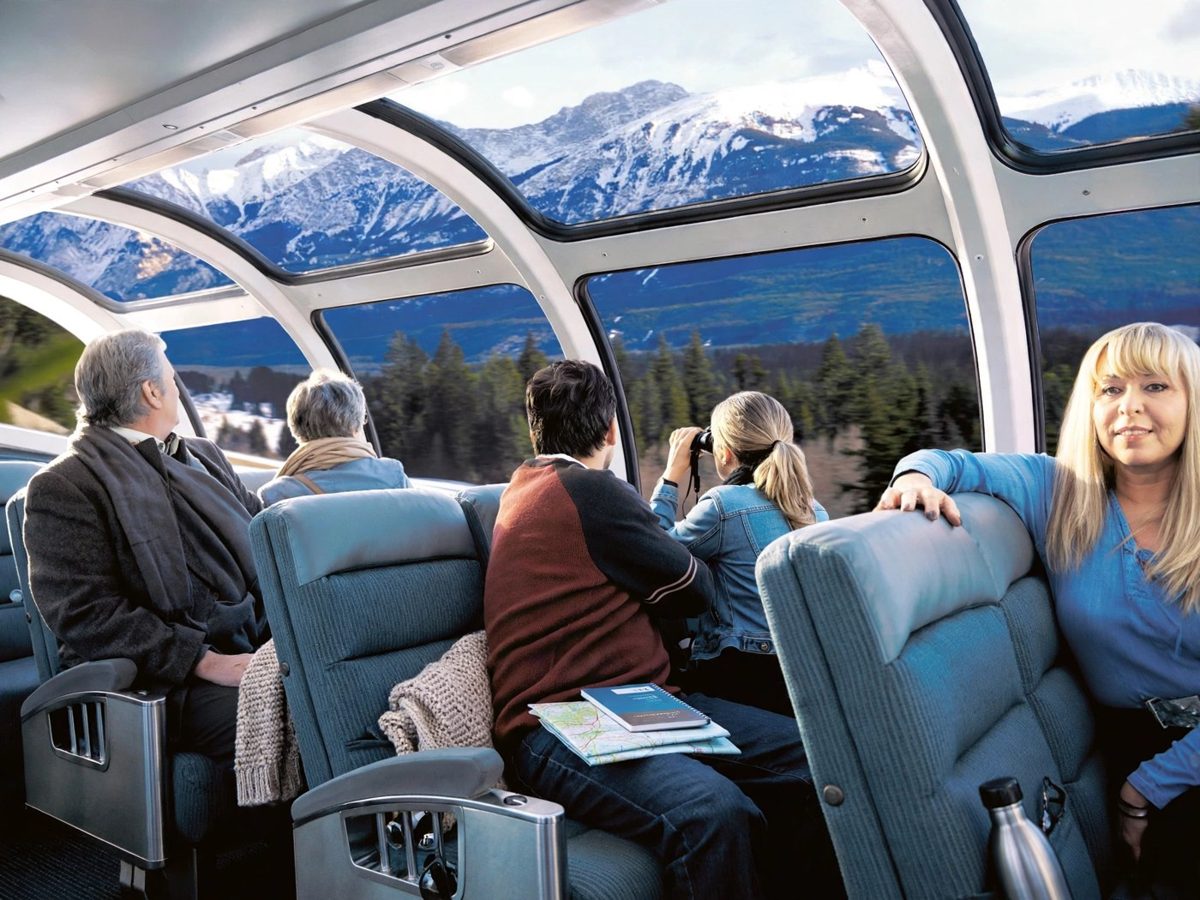
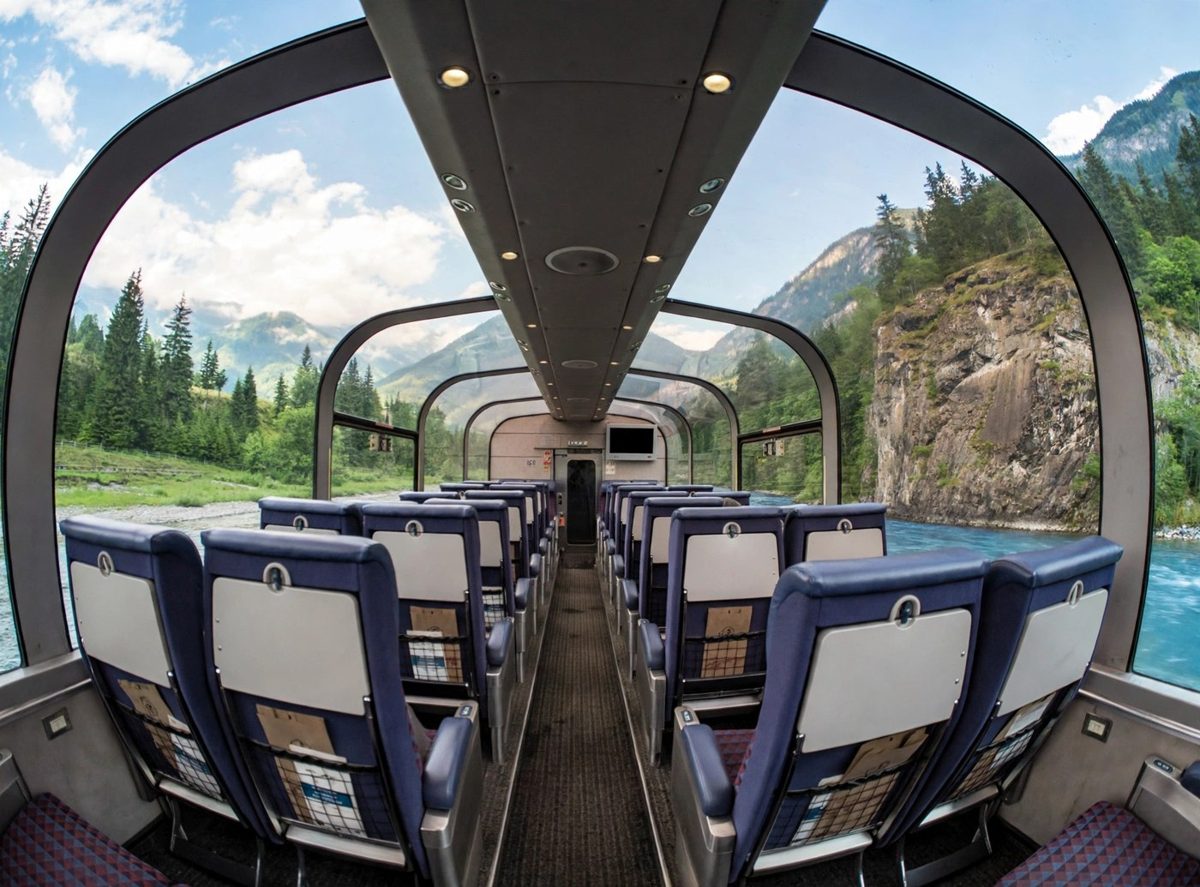
The dome’s real finale comes at night. Far from any city, out in the middle of the continent, the moon and the stars pour straight through the glass above your head. Before turning in, climb up to the dome and look up — VIA travellers name it, again and again, as the single best moment of the trip.
💰 Every Discount, in One Place — Who Saves What
- Youth (ages 12–25): VIA’s youth deal isn’t a percentage off — it’s set discounted fares on each segment. You don’t need to be a student; age alone qualifies. Compare against the regular fare on the booking screen.
- Children (ages 2–11): 50% off Economy. Under 24 months rides free on a parent’s lap.
- Seniors (60+): 10% off Economy.
- CAA members: Up to 20% depending on route and class (Corridor 10%, Ocean Economy 15%, Canadian sleeper classes up to 20%). You enter your membership number when you book.
- Military (CFOne): 25% off for active members, reservists and their families (advance booking required).
- VIA Préférence points: Free to join. The base rate is 1 point per $1 spent, and the earn rate climbs to 2x and 3x as your annual spending grows. When you pay with points, the points needed track the cash fare — so a cheap ticket costs fewer points too.
Canada Strong Pass: A federal summer-season program. In summer 2026 it meant free travel for ages 17 and under (travelling with an adult) and 25% off for ages 18–24. It’s seasonal and currently ended, and whether it returns next season hasn’t been announced. If you’re planning summer train travel, check for a new-season announcement.
💡 How to Ride for Less
No discount eligibility? The fare structure alone can save you a lot — if you know how it works.
1. Know what makes Escape cheap before you buy it
VIA fares climb from Escape → Economy → Economy Plus, and Escape is cheapest for one simple reason: no changes, no refunds. Buy Escape only when your plans are set in stone. If there’s any chance they’ll move, Economy (changes and refunds carry a 25% fee) or Economy Plus (fully refundable) ends up cheaper in the end. A bargain ticket you have to throw away is the most expensive ticket of all.
2. Earlier is cheaper — dynamic pricing basics
There’s no fixed “book X days ahead, save Y%” chart. Like airfares, VIA prices move with demand, and the cheap fare classes sell out first. Bookings open 331 days before departure, so once your dates are set, not waiting is the discount.
3. Watch for Tuesdays — Discount Tuesday
Every Tuesday, a standing sale opens with the code TUESDAY. What gets discounted, and by how much, changes week to week — recent editions have looked like 20% off the Corridor and 10% off long-distance routes. The booking just has to happen on Tuesday; the trip itself can be for later dates. If you know which ticket you want, waiting for Tuesday is a legitimate strategy.
4. Ride often? Get the discount card. Ride rarely? Just buy Escape
The old multi-ride pass (the Canrailpass) is gone, replaced by seasonal discount cards. The one on sale now, the Corridor Card ($79 + tax), takes 25% off Economy fares between Quebec City and Windsor for up to 16 segments (valid Mon · Tue · Wed · Thu · Sat only — no Fridays or Sundays). It’s on sale until November 30, 2026, for travel until December 15. The math is simple: on a $100 one-way trip you save $25 a ride, so the card pays for itself on the fourth trip — and if you use all 16 segments, you’ve saved $400. (The separate Southwestern Ontario card — $69 for 30% off — is a different product; don’t mix them up.) Flip side: if you’ll ride two or three times at most within the window, skip the card and buy Escape. Before buying, check two things: ① do your travel days fall on the card’s valid days (Fridays and Sundays are often excluded)? ② have you compared against the lowest Escape fare?
5. Spend points when fares are low
Because Préférence points are fare-linked, booking an off-season, weekday ticket with points costs fewer points for the same trip. And join before you book — points only start accumulating on bookings made with your member number attached.
6. Discounts don’t stack
You can’t layer the youth fare and the Tuesday code. The system applies whichever works out better, so a quick glance at which discount got applied on the booking screen is all the checking you need.
7. The day and the season are the price
The same sleeper berth is $2,500 in winter and $4,500 in summer on VIA. Corridor fares swing by day of week and departure time, too. If your schedule is flexible, weekday + off-season + Escape is the cheapest combination there is — and budget for weekend and peak-season departures to cost more.
🚂 Life on board
- Dining car — On The Canadian and The Ocean, Sleeper Plus and above include dining-car meals. Economy passengers buy sandwiches and drinks at the Skyline snack bar and café car.
- Wi-Fi and outlets — Corridor trains (Québec City–Windsor) offer free Wi-Fi and an outlet at every seat, enough for a working day. Long-distance trains have no Wi-Fi — leave that time to the scenery.
- Baggage — Checked baggage service runs at staffed stations (availability varies by route and station — confirm when booking). Boxed bicycles can travel too.
- Showers — Sleeper passengers share shower rooms, which is how a four-day crossing still starts fresh every morning.
- Lounges — Long-distance trains carry a lounge car with drinks, where the trip picks up its social side.
🎓 Students: Is an ISIC Card Worth Getting?
The ISIC (International Student Identity Card) is the globally recognized student ID. In Canada, the virtual card costs $20, and students at Canadian Federation of Students (CFS) member schools may be able to get one for free. It’s valid for one year from the issue date.
For VIA Rail specifically, though, the story has changed. VIA used to court ISIC holders with a 35% discount, but today’s VIA youth fares are based on age (12–25) — so if you’re 25 or under, you get the youth fare with or without an ISIC. Whether an ISIC-specific VIA discount still exists couldn’t be confirmed on VIA’s official pages, so if you’d be buying the card for VIA alone, check with VIA before you pay for it.
Where ISIC really earns its keep is elsewhere: transit systems that recognize it, like Greyhound Canada’s student fares (up to 45% off), and rail and museum discounts across Europe. The honest summary: a student who stays in Canada is fine with a school ID; a student who travels a lot gets a $20 passport to discounts.
❓ FAQ
Can I take one train all the way to Tadoussac?
No — Tadoussac has no train station. Ride VIA Rail to Quebec City, transfer to the Charlevoix sightseeing train or an Intercar bus, and finish with the free ferry.
How many days does Montreal to Vancouver take by train?
Changing to The Canadian in Toronto, it’s about 4.5–5 days of pure travel. Long-distance delays are common, so plan 5–6 days including an overnight buffer in Toronto.
What’s the single cheapest way to book?
If your dates are fixed, buy the Escape fare early; if you know which ticket you want, wait for the Tuesday sale (Discount Tuesday); and pick weekdays and off-season dates. But skip Escape if your plans might change — it can’t be changed or refunded.
Do I need an ISIC card to get a student discount on VIA?
No. Ages 12–25 get VIA’s youth fares whether or not they’re students. ISIC only matters if you’ll also use it for other transit and travel discounts.
Can I still buy the old Canrailpass?
No — it was discontinued during the pandemic, and seasonal discount cards have taken its place. Each card has its own routes, valid days and travel window, so read the conditions before buying.
How far have you travelled by train in Canada? If you’ve ridden the Charlevoix train at peak fall colour or day-tripped to Ottawa by rail, tell me in the comments — I read every one.
May your long roads feel light, and your Eastern Canada trips a little easier 💛
— J.
Can anyone use the dome car?
It depends on the train and your class. On The Canadian, each class has its own Skyline dome car, so Economy passengers get dome access too, while the Panorama and Park cars are for Sleeper Plus and Prestige passengers. On the Skeena, the Panorama dome runs as Touring class on select summer dates. At night, the dome is also where the moon and stars come out — a highlight of the long-distance routes.
📚 You May Also Like
- Megabus Canada: The Complete Guide — Routes, Fares, Discounts & Booking Tips (compare bus vs. train, segment by segment)
- Saint-Irénée: Charlevoix’s Next Station & a Free Art Garden — a stop along the Tadoussac route
- Pointe-au-Pic, La Malbaie: A Riverside Village Walk in Charlevoix
- The Golden Virgin of Les Éboulements: The Hilltop Church With Charlevoix’s Best View
Get the Free Canada Savings Checklist
Join the newsletter — get the free PDF checklist and weekly Canada savings tips in your inbox.
Read Next
Some links in this post are referral or affiliate links. If you sign up or buy through them, I may receive a bonus or commission at no extra cost to you. It helps keep this blog running — thank you!