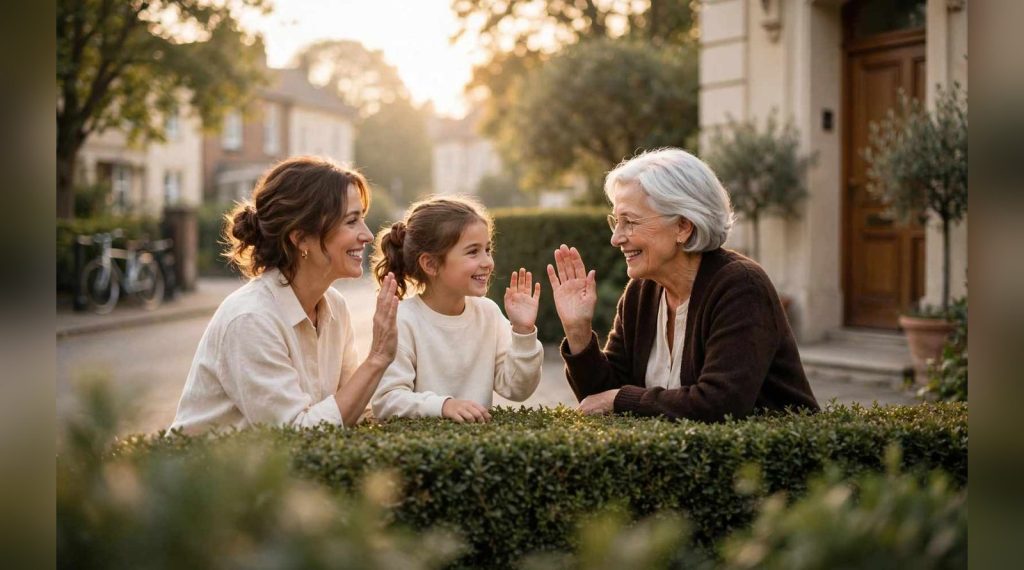
The Energy of Words: How Your Tone Shapes Your Life
Last updated: November 5, 2026
Bonjour! It’s J. — and today, no products, no prices. Just something I’ve been thinking about over coffee: the way we speak.
Give me one minute of listening to someone talk, and I can usually guess what kind of person they are. Not from what they say — from how they say it. Because speech carries something most of us never think about: energy.
🌿 Quick Take
- Your voice is a literal wave — and its tone spreads to everyone who hears it
- Like a fingerprint, your voice and speech habits are unmistakably yours
- Kind words fill the space around you with good energy; harsh words pile up the opposite
- Children copy not just your words, but your tone — I hear it in my own home
- And the greatest power of all: life tends to happen the way we say it will
- Woven into this post: the two books I pull back off the shelf whenever my heart feels shaky
🎙️ Your Voice Is a Wave — and It Carries a Fingerprint

Let’s start with the simple physics of it. Sound is a vibration travelling through the air — a wave, carrying real energy from my mouth to your ear. The bigger the wave (its amplitude), the louder the sound and the harder it lands. The faster it vibrates (its frequency), the higher the pitch.
But words are only half the message. The other half is prosody — the pitch, pace, volume and melody of your voice. Two people can say “I’m fine” and mean opposite things. We read each other’s feelings from tone long before we process the words.
And that voice is yours alone. The size of your vocal cords and the shape of your vocal tract give your voice an acoustic pattern so distinctive that speaker-recognition technology can pick you out of a crowd by sound alone. Add your favourite words, your pace, your tone — and your speech becomes a fingerprint no one else has.
Here is why that matters. Psychologists call it emotional contagion: we unconsciously catch the emotions of the people around us, through their faces, their posture — and their voices. Laboratory research has documented it for decades, and a large-scale study published in PNAS showed that emotional expressions measurably shift the emotions of everyone exposed to them.
So an irritated tone doesn’t stay inside the speaker. An annoyed voice doesn’t just express annoyance — it hands it to the listener. And a raised, angry voice makes the other person angry right back. The wave goes out, and it grows as it travels.
🪙 Honey, Not Vinegar: Every Culture Knows the Power of Words
In Korea, we say two things about words. “가는 말이 고와야 오는 말이 곱다” — “Only if the words that go out are lovely will the words that come back be lovely”: words make a round trip. And “말 한마디로 천 냥 빚을 갚는다” — “With one kind sentence, you can repay a debt of a thousand nyang” (an old Korean coin — a thousand of them was a fortune). Put simply: a single kind sentence can be worth a fortune.
If you grew up in North America, though, your own sayings have taught you exactly the same two lessons for just as long.
For the round trip, there is the American saying “What goes around comes around” (United States). What you send out — in words as in deeds — travels in a circle and knocks on your own door again.
You can watch it happen at the grocery store: one sharp word to the cashier and the whole line goes tense; one warm word, and the good mood travels down the line behind you.
And when the words coming back at you are angry ones, the English-speaking world’s oldest advice book answers: “A soft answer turneth away wrath” (from the Book of Proverbs, 15:1, in the King James wording North Americans still quote). A gentle reply doesn’t just keep the peace — it lowers the temperature of the whole exchange.
For the fortune hidden in one kind sentence, Benjamin Franklin printed America’s version in his Poor Richard’s Almanack in 1744: “Tart words make no friends: a spoonful of honey will catch more flies than a gallon of vinegar.” It survives today as “You can catch more flies with honey than with vinegar” — a proverb Franklin popularized in America (its earliest printed record is actually a 1666 collection of Italian proverbs).
Ask a neighbour for a favour in a honeyed voice, and help arrives with a smile. Lead with a complaint, and the very same door somehow stays closed. Honey works. Vinegar doesn’t.
Honey, not vinegar. A kind word, not a sharp one. A different country, a different century — and exactly the same wisdom the Korean proverbs carried into my childhood.
Of all the words that make that round trip, the ones that save me, day after day, are words of gratitude. I’ll follow that thread below, in the practice section, with a book I’ve kept close for years — and, for the moments when words turn sharp, with a second book of techniques for speaking without making an enemy of the person across from you.
🌊 Look Around: What Energy Is Living With You?
Energy circulates. It leaves you, touches the people near you, and comes back changed — or unchanged, which is sometimes worse. So today, take one honest look around you. What kind of energy is staying in your space?
If it’s warm and positive, you’re doing something right — keep going. But if negativity hangs in the air around you, it’s worth a quiet pause. Have I slowly been soaked in it myself? Or has someone else’s constant stream of negative words gradually turned me negative, too, without my noticing?
This is the same reason I care about the energy of my home itself — I wrote about clearing it in my Space Energy cleaning notes. A room can be spotless and still feel heavy, if the words spoken in it are always sharp.
And one thing we must never forget: words can be a weapon more frightening than a knife. A blade’s wound closes. But words can cut deeper than any blade — and lock a person inside a trauma for a lifetime. That is not a metaphor to me. That is a responsibility.
The good energy in a space turns out to begin with a quiet skill: noticing. Learning to notice what there is to be grateful for is the first exercise — I’ll come back to it below.
🪞 Raising Children, I Met My Own Voice

Nothing taught me this like raising my children. Somewhere along the way, I started hearing it: my kids had picked up not only my favourite words, but the very sound of my voice — my tone, my melodies, my habits of speech.
Child-development research says this is exactly how language learning works: children imitate the whole package — words and the prosody wrapped around them, the rise and fall, the warmth or the edge. One day, you hear your own tone come out of your child’s mouth. It is the most honest mirror a parent ever gets.
Which means our everyday voice is a daily recording session. The smallest listeners are saving every take. If my fingerprint is going to live in my children’s voices, I want it to be a kind one.
🌅 Starting Today: Small Words, Brighter Mornings
So here is my gentle proposal, starting today. If you’re already a warm, kind speaker — be a little kinder still. And if you know you’re carrying a lot of irritation and anger, start smaller: one unconditional kind word, aimed at one person, for no reason at all.
Begin with the very first words of the day. A bright good-morning to the first person you meet. To your family, a sweet-toned “Did you sleep well?” — and “I love you”, said like you mean it, because you do. It takes ten seconds. (It’s the same spirit as the morning routines of people who attract good luck — the day is set early.)
💡 Tip: start with the first sentence of the morning. Before phones, before news, before complaints — one warm sentence to one person. It’s the smallest habit in this whole post, and the one that changes the weather of a home fastest.
Do it once, and one morning gets brighter. Do it daily, and slowly, quietly, your whole life starts filling with that energy instead. Right words, a kind tone, a little courtesy in how we speak — keep those, and life genuinely changes.
📖 The Book I Reread When Life Feels Heavy — The Gratitude Diaries
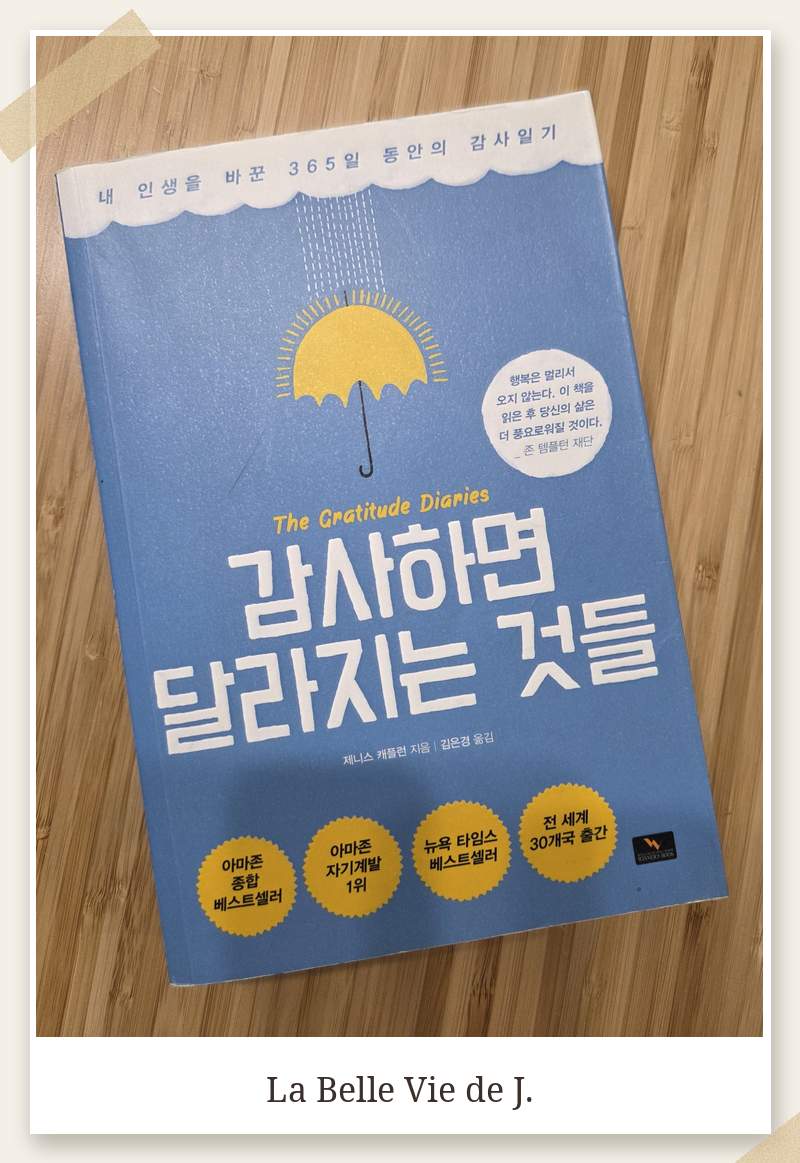
The Gratitude Diaries is Janice Kaplan’s record of a year-long decision: to live looking for gratitude, and to write it down every single day. Nothing dramatic happens in it: a husband, a family, the small moments of ordinary days, searched each evening for something worth thanks. Woven between the entries are the voices of the researchers who study gratitude.
The practice above — the kind first word, the bright good-morning — is a practice of speech. But a spoken word disappears the moment it leaves us. Kaplan’s journal is a way of catching it: at night, in a single line, write down one kind word you offered today, and one warm word that came back to you. That, I think, is exactly where the practice in this post and her journal become the same habit.
The copy on my shelf is the Korean edition, and it’s a book I genuinely return to. When my heart feels heavy and my thoughts about life get tangled, I take it down again and reread a few pages. Some books you finish; this one is a book for rereading over a lifetime.
📖 A Technique for the Moments Words Turn Sharp — Tongue Fu!
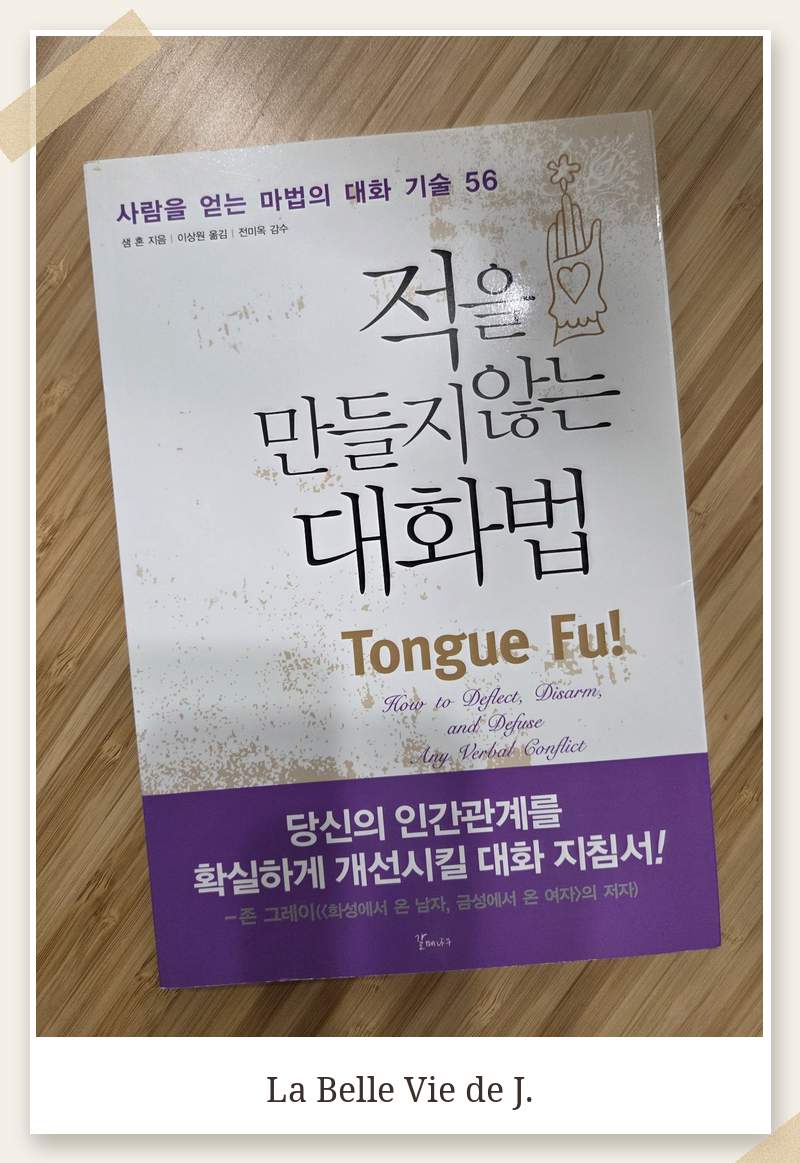
A kind tone isn’t always a matter of a kind heart — in a heated moment, most of us need a technique, not just an intention. On my shelf sits Sam Horn’s Tongue Fu! — quite literally “the martial art of the tongue.” (My copy is the Korean edition.) One signature move: take a sentence built as blame and rebuild it as a proposal — and where a “but” would cut the other person off, let an “and” carry the thought forward instead.
📖 And the Strength to Keep Going — Grit
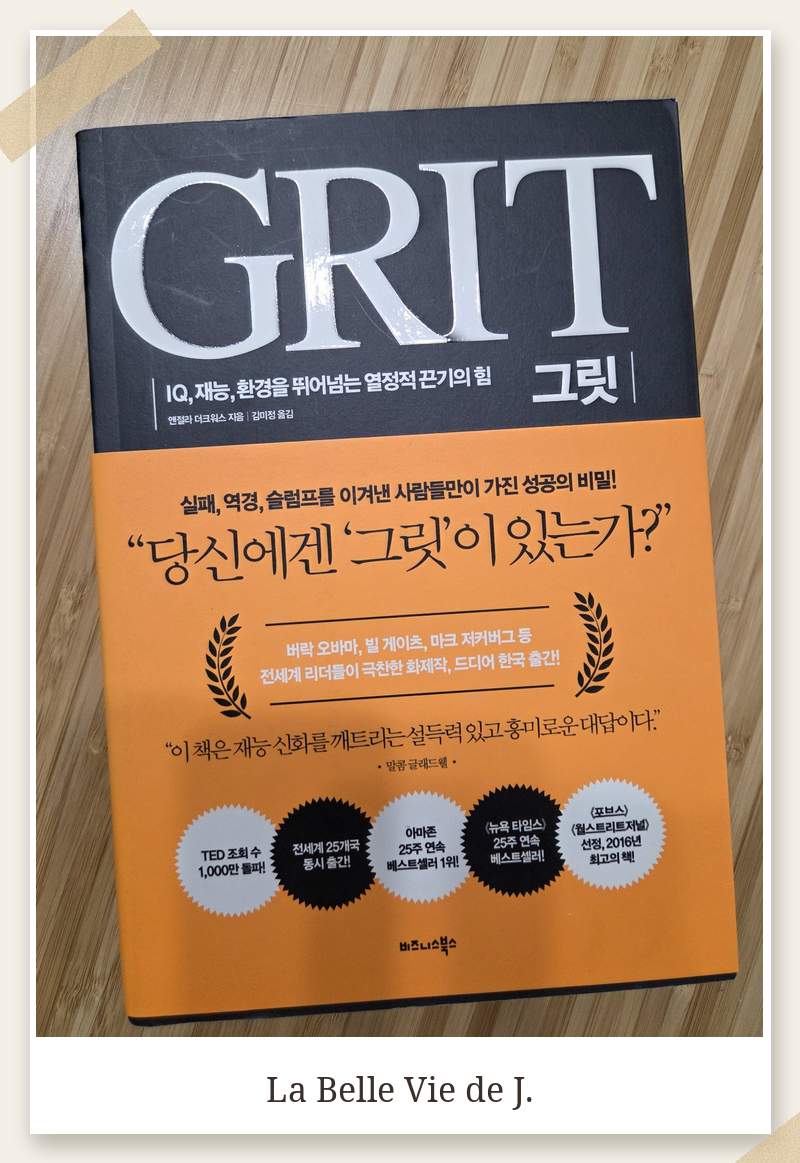
Neither a gratitude journal nor a kind good-morning survives on a day or two of good resolutions. What they need is the strength to start again on the shaky days. Psychologist Angela Duckworth’s Grit is about exactly that strength — not a gift some are born with, but a blend of passion and perseverance that grows with practice. Kind words work the same way. It is the second of the two books I reach for when life feels hard — at home, it sits right beside the first.
✨ The Power I Know Best: Life Follows Your Words
And finally, the power of speech I know best — not from books, but from my own life: things happen the way you say them.
I don’t mean magic. I mean that the words I kept repeating about my own future — out loud, to myself and to others — are, one by one, the directions my life actually took. My life has flowed the way I spoke it. I believe yours can, too.
So, to you reading this: speak like the future you dream of. Your life will flow that way.
A last word about those two books: The Gratitude Diaries and Grit are the very ones I pull off the shelf and reread on the days when my heart feels heavy and unsteady.
What is one kind sentence you want to say first tomorrow morning? Tell me in the comments — I’d love to read it.
| Moment | The words (10 seconds is enough) |
|---|---|
| First person you meet | A bright “Good morning” |
| To your family | “Did you sleep well?” — in a sweet tone |
| To your family, anytime | “I love you” — said like you mean it |
| One person, for no reason | One unconditional kind word |
| Before phones, news or complaints | One warm sentence to start the day |
📚 You May Also Like
- 5 Home Decluttering Tips to Boost Wealth Luck in October | Space Energy Cleaning
- [Fortune 4-Panel] 4 Morning Routines of People Who Attract Good Luck (Series ④)
- [Fortune 4-Panel] 4 Secret Habits of People Blessed With Great Relationships (Series ②)
Thanks for stopping by — have a lovely day! 💛
— J.
Can you really tell what kind of person someone is from their voice?
To a surprising degree, yes. Beyond the words themselves, prosody — pitch, pace, volume and tone — carries emotion and attitude, and listeners pick it up instantly. Combined with a person’s habitual words and way of speaking, it forms a pattern as personal as a fingerprint.
What is emotional contagion?
It’s the well-documented tendency to “catch” the emotions of people around us, unconsciously — through facial expressions, posture and vocal tone. Research published in PNAS showed that emotional expressions measurably influence the emotions of everyone exposed to them, which is why an irritated tone tends to irritate the listener, too.
Why do children end up sounding like their parents?
Because that’s how language is learned: by imitation of the whole package. Children copy not just vocabulary but prosody — the melody, tone and rhythm of their parents’ speech. It’s why so many parents eventually hear their own voice coming out of their child’s mouth.
How can I start changing the energy of my words today?
Start with the first sentence of the morning: a bright greeting, a warm “Did you sleep well?”, an “I love you” said in a sweet tone. One unconditional kind word a day is enough to begin — the energy around you changes as the habit grows. And add one small thing: at night, jot down — one line in a gratitude journal — a kind word you said that day. It is the practice Janice Kaplan, author of The Gratitude Diaries, kept every day for a full year: a way of holding on to kind words that would otherwise vanish.
Get the Free Canada Savings Checklist
Join the newsletter — get the free PDF checklist and weekly Canada savings tips in your inbox.
Read Next


Some links in this post are referral or affiliate links. If you sign up or buy through them, I may receive a bonus or commission at no extra cost to you. It helps keep this blog running — thank you!