Korean Money Habits: Wallet & Home Rituals Said to Attract Wealth
Last updated: November 1, 2026
Bonjour! It’s J. — In Korea, money is said to have habits of its own: it settles where it is treated well, and it slips away from places that ignore it. For generations, Korean homes have kept a quiet set of wallet and house rules built on that idea — part feng shui, part grandmother wisdom, part plain good housekeeping. Korean guides on the subject collect dozens of them. Are they superstition? Honestly, yes — treat them as folk beliefs, not promises. But look closely and most of them are simply respectful ways to handle money and home, and they adapt beautifully to North American houses. Here are the ones Korean families actually keep.
🌿 Quick Take
- Receipts out of the wallet, every night — a wallet is money’s house, not a filing cabinet
- Money rests in the dark — a deep drawer, never the entry table, bathroom or floor
- The entrance decides first impressions — shoes away, worn-out pairs gone, light bright, a small jar of salt
- Kitchen like a storehouse — clear counters, unbroken dishes, a rice jar that never runs empty
- Light, air and an empty bin — the daily trio that keeps a home’s energy moving
👛 1. The Wallet: Money’s First Home
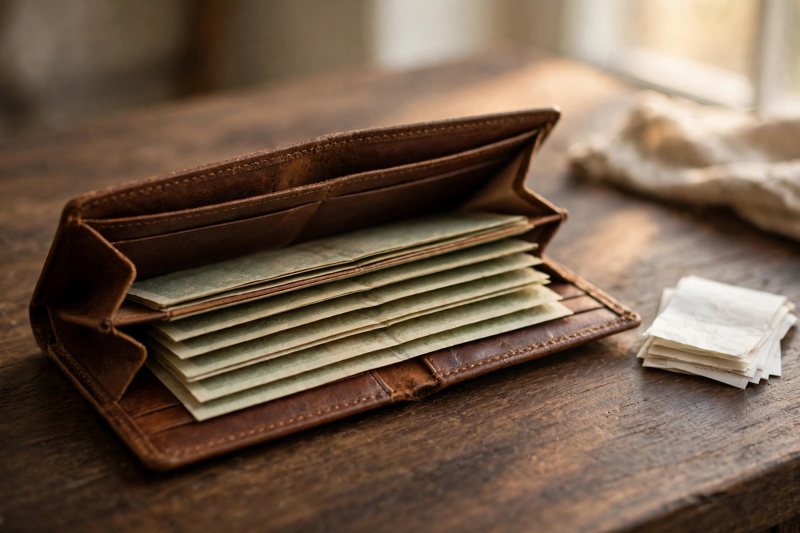
The first rule is the one Korean money advice repeats everywhere: never keep receipts in your wallet. A receipt is money that has already left — spent, finished, gone. Crowding your wallet with them is said to leave no room, and no welcome, for money coming in. The nightly ritual takes ten seconds: receipts out. In North America, receipts matter for returns and taxes, so keep them — just not in the wallet. Snap them into an expense app, or drop them in one envelope at home. Out of the wallet, not out of your records.
Next, the bills themselves. Line them up flat, smooth, all facing the same way, in order — never crumpled into a ball or stuffed in sideways. The belief is simple: money returns to the place where it was treated with respect. Canadian polymer bills barely crease, which makes the ritual easier, not pointless — the point was never the paper. It is the ten seconds of attention.
And keep the wallet lean. Two or three cards you actually use; unused cards, old memberships and other people’s business cards come out — in the folk reading, they are blocked passages and borrowed energy. Coins get their own small pouch rather than weighing the wallet down. The modern North American version is easy: move the loyalty cards into your phone’s wallet app and let the physical wallet carry only what deserves a room in money’s house.
💡 The 60-second wallet reset
Receipts out → bills flat and facing one way → cards down to the essentials → wallet into its drawer. One minute, once a day, ideally when you come home. That is the whole first section in a single habit.
If the wallet is money’s ‘first home,’ the idea running through this whole collection is that a house, too, has places where money comes, goes, and settles. At the end of section 3, the entrance, I’ll introduce a recent Korean how-to book that talks about exactly those places in the language of placement.
🌑 2. Money Likes the Dark: Where Cash Rests at Home
Here is the belief that surprises North American readers most: money is said to grow in dark, deep, quiet places. At home, the wallet and any cash belong inside a drawer, a safe, or a deep closet shelf in the bedroom — somewhere settled and out of sight. Not tossed on the entry table, not left open on the counter, never on the floor. A wallet dropped by the front door is read as money already halfway out of the house.
Two rooms are avoided on purpose. The bathroom, ruled by water, is said to wash money away; the kitchen, ruled by fire, to burn it. So the wallet gets one fixed home — a single drawer — and some families go one step further and keep two or three crisp new bills tucked in the wallet’s back slot as “seed money”: never spent, there to call more in, the way seed grain is kept for planting.
The wallet itself has folklore too. A long wallet, where bills lie flat without folding, is preferred over a stuffed bifold. Replace it roughly every two to three years — sooner if it is torn — and many people time the change to the New Year, which suits North American fresh-start energy perfectly. Colors are shared with a wink, not a rule: black and deep brown for keeping, gold and yellow for growing, deep green for steady expansion. Red is honestly debated — some say its fire energy spends money faster, others love it — so wear the color that makes you careful with what’s inside.
🚪 3. The Entrance: Where Fortune Walks In
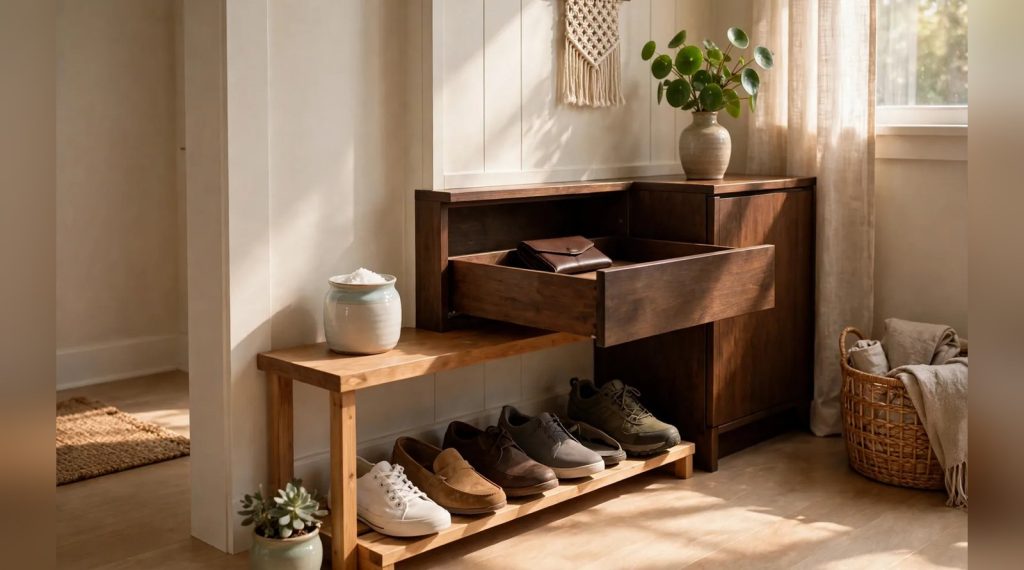
In Korean home wisdom, fortune enters through the front door — so the entrance is treated like a face you present to the world. Only the shoes being worn today sit out; the rest go into the cabinet, and the floor stays clear. In Korea most homes have a dedicated shoe cabinet; the North American version is a slim shoe rack or a tray by the door, with the same rule: the entry floor is a walkway, not a parking lot.
Worn-out shoes are let go without sentimentality. Shoes carry movement and direction, and a pair with a dead sole is said to drag yesterday’s energy into tomorrow. In Canada the habit has a natural cue: the season swap. When the winter boots come out or go away, any pair that is finished goes out too.
Then, light and salt. The entry should be the brightest-lit spot it can be — a dim foyer is said to stall whatever good arrives. Windowless North American foyers take a brighter bulb or a small sensor light. And on the shoe cabinet or a shelf by the door, many Korean homes keep a small ceramic jar of plain salt. Salt is the old purifier — it is believed to stop heavy energy at the threshold and keep what enters clean. Fill the jar, replace the salt when it turns damp, don’t cook with it afterwards, and keep it up high where pets and toddlers can’t reach. One last entrance rule: if there is a mirror, hang it on the side wall. A mirror facing the door head-on is said to bounce fortune straight back out.
📚 A Modern How-To to Set Beside Old Habits — Jaldoeneun Jiban-ui 10cm Bimil
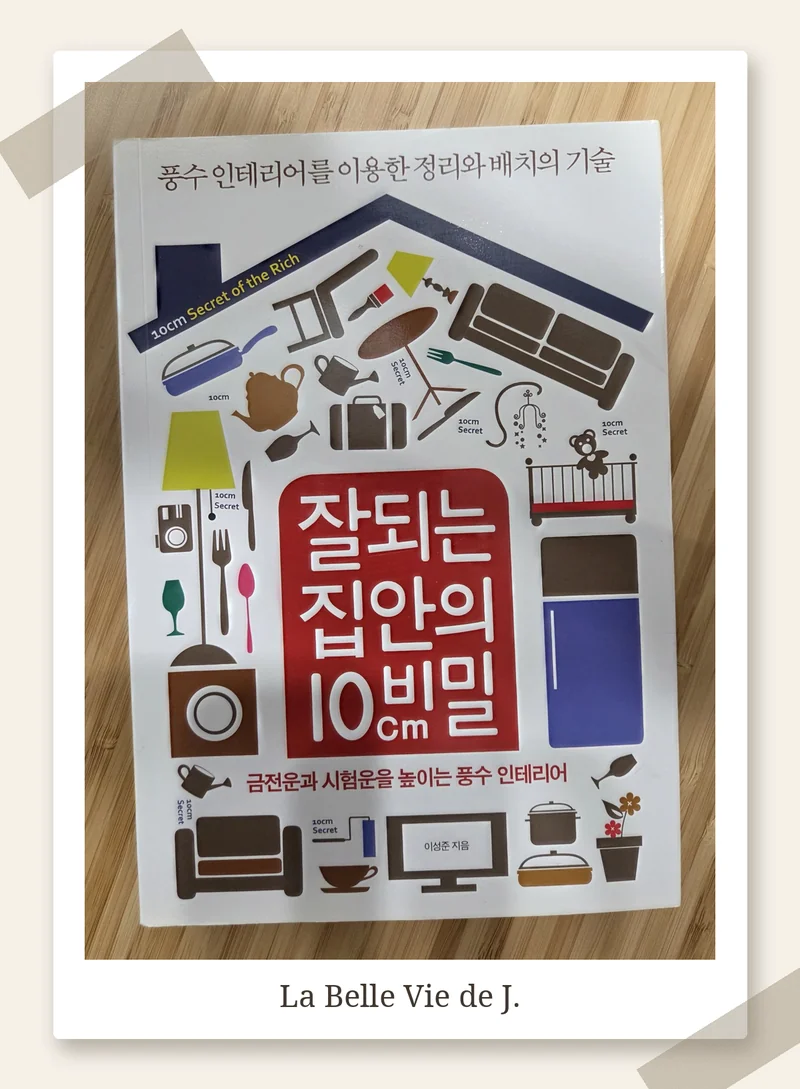
Most of the rules in this post were handed down in Korean homes long ago. But that instinct didn’t stay in the old days. Among the books I own and have read is Jaldoeneun Jiban-ui 10cm Bimil (잘되는 집안의 10cm 비밀, roughly ‘The 10cm Secret of Homes That Do Well’) by Lee Seong-jun — the copy on my shelf is the Korean edition. Its subtitle translates as ‘the art of tidying and placement through feng shui interiors,’ and that is exactly what it is: a practical guide to feng shui for the home.
There is a reason this book appears at the end of the entrance section. In this post, the entrance is the door fortune walks through — the place where clearing space and setting things in order shows most clearly. Feng shui interiors treat the entryway the same way: as the spot where a home’s whole flow begins. The book’s thinking isn’t far from that. How you assign a place to things changes the flow of a home. Entrance rules once passed down as grandmothers’ wisdom are read again, in a modern practical guide, in the words of place and placement.
But don’t get the order backwards. The customs — the tidied wallet, the jar of salt — were here long before; this book is a recent organizing method that arrived much later. So it is not the source of this collection. What it shows is that an old habit doesn’t have to end with the single word ‘superstition’: it can live on in the practical language of putting places in order. When tradition doesn’t tell you all of the why, a practical guide adds some of the how.
And that same order travels well. Even in North American homes, built nothing like Korean ones, you can still start by putting the entryway in order first. Try reading the rules in this post once more through a practitioner’s eyes.
🍽️ 4. The Kitchen: The Family Storehouse
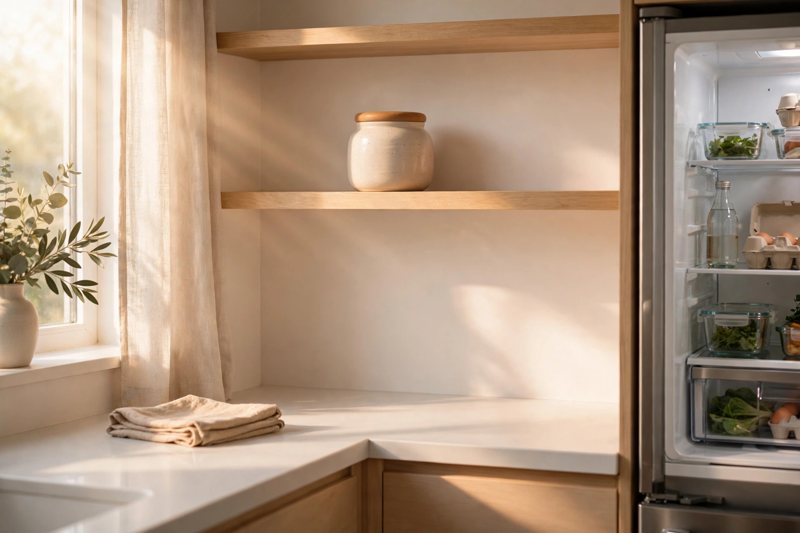
The kitchen is the family’s storehouse, and its first law is cleanliness: counters mostly clear, the stove wiped once a day, and the sink dried before bed — no dishes soaking overnight (the dishwasher, run in the evening, is the faithful North American translation). A storehouse that is scrubbed is a storehouse that can hold more.
Dishes get a rule of their own: chipped and cracked pieces go out. A bowl is the vessel wealth is served in; a cracked one is read as a leak — and honestly, chipped rims harbour bacteria and nick fingers, so folklore and food safety agree for once. Knives, too, are kept put away, blades covered and dry, rather than displayed edge-out.
Two storehouse habits complete the picture. The fridge — the modern rice chest — is kept about 70% full, expired food leaves the day it expires, and the door is not papered over with flyers. And the rice jar itself: a ceramic jar of rice (or, in a North American pantry, your staple grains) kept in a cool, dark corner and never allowed to run empty — half full at the lowest. An empty jar, the saying goes, is an empty storehouse; a full one quietly promises the house will always eat.
🛏️ 5. Bedroom & Bathroom: Rest Well, Close the Flow
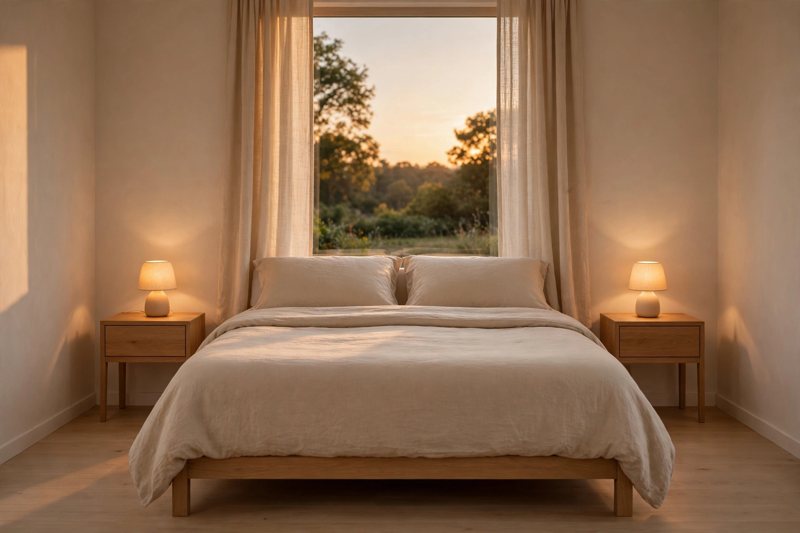
The bedroom is where the household recharges, so the Korean rule is a clear perimeter: nothing piled on or around the bed. Nightstands hold a lamp, not a landscape of chargers, cups and paperwork; the space under the bed stays empty too (tidy seasonal bedding in a proper bin is the accepted exception), so rest — and, in the folk picture, fortune — can circulate while you sleep. A mirror that stares straight at the bed is moved or covered, for the same reason as the entry mirror.
The bathroom rule is the one North Americans adopt fastest, because hygiene already argues for it: in this tradition water is money, so the toilet lid goes down before flushing and the bathroom door stays closed — you don’t leave the tap of the house’s wealth standing open. Beyond that: bright light, a clean mirror, the fan run after showers, and a dry floor. A bright, dry bathroom is said to hold money; a damp, dark one quietly leaks it.
💡 6. Light, Air, and Letting Go
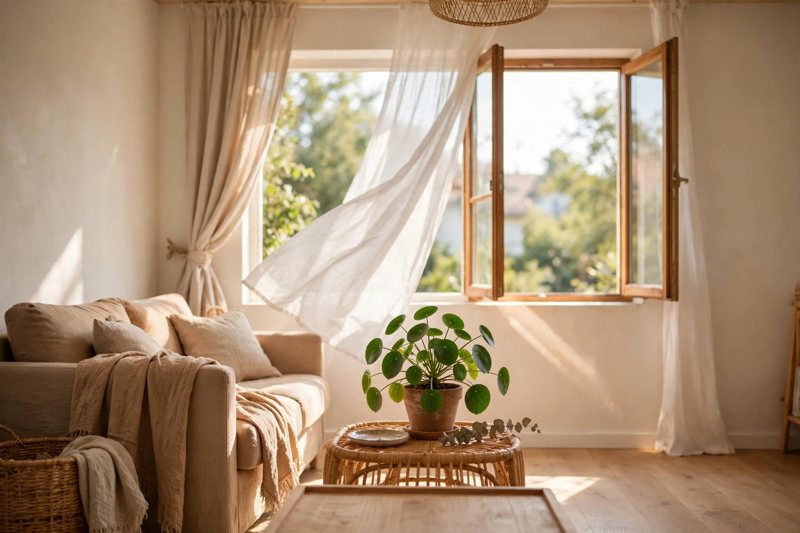
Three daily habits tie the whole house together. Light: living spaces are kept bright — curtains opened every morning even (especially) in the short Canadian winter, when every hour of daylight counts. Air: windows opened once a day so air reaches every corner — five to ten minutes of strong cross-breeze is the winter version. Release: bins are small, lidded, and emptied daily — with weekly pickup, that means the indoor bin walks out to the garage bin each evening — and never parked by the front door, where good arrivals would meet yesterday’s garbage first. It is the same philosophy as my October decluttering routine: what leaves on time makes room for what you actually want.
The letting-go list is specific. Dead plants and tired dried arrangements go out — living, round-leafed green stays. Broken things, stopped clocks and appliances that no longer work are repaired promptly or released; a stopped clock is read as stopped time, and the garage pile counts, too. And the smallest leak of all gets fixed first: a dripping faucet is money dripping away — in the folk reading, your wealth leaving drop by drop; on the water bill, exactly the same story told in dollars.
🍀 7. Beyond Money: Everyday Korean Luck Habits
The same households keep a second, smaller set of rules that aim at luck in general — the companion pieces to the daily money habits in our Fortune series. Make the bed and air the room on waking — the day’s first order is set by you. Take morning light and keep sleep regular; luck is said to visit people who rise with the day. Say thank you when you pay — money is believed to return to people who thank it as it leaves, and in tip-country North America the habit is already half built. Watch your words: “thank you” often, complaints rarely — the Korean saying goes that words become seeds. Look neat, even at home — a tidy appearance is read as a tidy fate. Give: the old proverb jeokseonjiga pilyuyeogyeong promises that a house which stacks up good deeds will be met by good fortune — the year-end food-bank box is the easiest first deed. And underneath them all, the one-minute resets: wipe the sink, clear the counter, one small thing put back — luck, in this tradition, is mostly housekeeping done daily.
Take this collection the way Korean families do: not as a contract with the universe, but as a gentle operating system for a home. Pick one habit this week — the wallet reset is the easiest — and let the rest arrive one at a time. A house where money is respected, light is welcomed and nothing broken is allowed to linger feels luckier whether or not the folklore is true. And most days, that feeling is the part that was real all along.
If you’d like to re-read today’s habits through that practical lens, keep the book from section 3, Jaldoeneun Jiban-ui 10cm Bimil, close by. For a deeper look at placement alongside this book, see 4 Space Energy Tips to Boost Your Home.
💛 — J.
📚 You May Also Like
Get the Free Canada Savings Checklist
Join the newsletter — get the free PDF checklist and weekly Canada savings tips in your inbox.
Read Next
Some links in this post are referral or affiliate links. If you sign up or buy through them, I may receive a bonus or commission at no extra cost to you. It helps keep this blog running — thank you!