[Fortune 4-Panel] 4 Money Habits of People Luck Always Finds (Series ⑦)
Last updated: November 6, 2026
Bonjour! It’s J. — We tend to think luck finds people at random — but watch how people who are “always lucky” with money actually handle it, and a pattern appears. Their wallets are tidy. Their spending is written down. Their first purchase of the day is often a kind one. And their savings leave before anything else does. None of it requires a bigger income — only four small rituals, done daily. Today, I’m sharing 4 money habits of people luck always finds.
🌿 Quick Take
- Tidy Your Wallet Every Day — receipts out, cards down to 2 or 3, bills in order, one goal note inside
- Log Every Spend in One Minute — three columns only: date, item, amount — 80% logged is enough
- Make Your First Spend a Grateful One — the day’s first money goes out with thanks: a coffee for someone, a generous tip
- Move Your Savings First — a fixed percentage leaves on payday, before any spending happens
Behind these four rituals sits one shared attitude. Before any technique for earning more, you set the heart that handles money first. Not the size of the amounts — the order and the attitude come first. That is where this post begins. And there is a book that shows that attitude through the whole of one person’s story, which I’ll introduce at ritual ③ — not a glossy success story, but a record of small choices made daily, quietly stacking up.
👛 ① Tidy Your Wallet Every Day
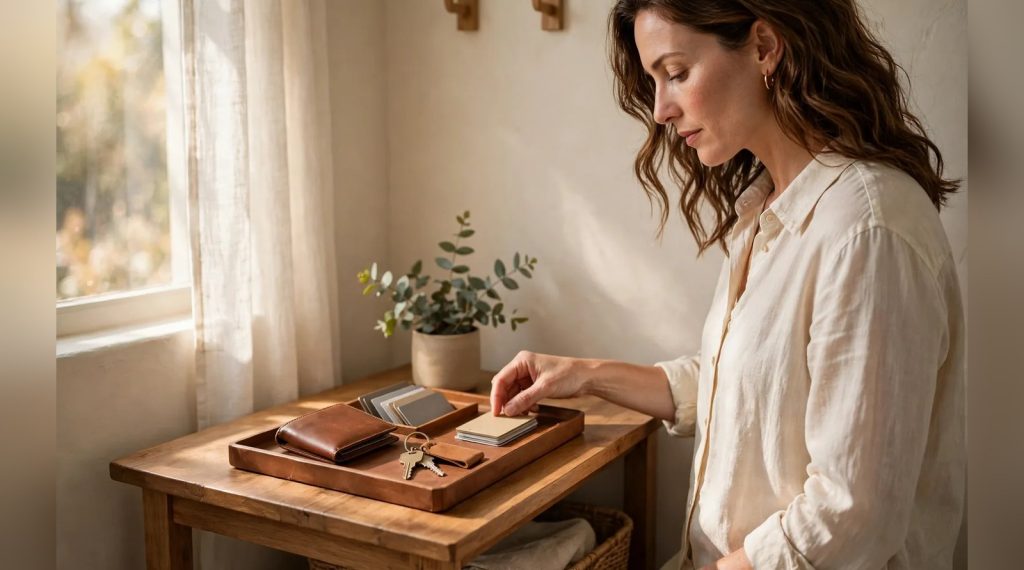
The first ritual happens when you walk in the door, and it takes one minute. Empty the day out of your wallet: receipts go into a small envelope at home (keep them one month, then toss), cards come down to the 2 or 3 you actually use, bills are smoothed and lined up facing the same way, largest at the back, coins in their own pocket. Tuck one small note inside with this month’s goal on it — “Save 20% of this month’s pay” — and give the wallet itself a fixed home: a tray by the door, the same spot every night.
- Never leave the wallet completely empty — a few bills keep it “in use”
- One or two credit cards plus one debit card is plenty for most days
- Every 27 days or so, do the full version: everything out, wiped clean, rebuilt
✨ The principle behind it: Space Energy tradition treats the wallet as money’s home — money returns to a home that is clean and ready for it. The practical mechanism runs underneath: you cannot manage what you cannot see. A wallet stuffed with dead receipts and mystery cards hides your actual balance from you; a tidy one makes a one-second balance check possible, several times a day. People who see their money clearly spend it more deliberately — and deliberate spenders are the ones we call lucky.
✏︎ ② Log Every Spend in One Minute

The second ritual is a notebook — a pocket one, kept with a pen — and a rule so small it can’t fail: three columns only: date, item, amount. Coffee $5. Lunch $12. Bus $3. No categories, no apps, no judging yourself in the margins. Anchor it to something fixed — right after dinner, or a 10 p.m. alarm — and accept the standard the practitioners set: if 80% of your spending gets written down, the habit is working. The point is not accounting. The point is that nothing you spend stays invisible.
- Small spends matter most — they’re the ones that never feel like “spending”
- One line per spend, written the same day, takes about a minute total
- Review the week on Sunday: circle the one purchase you’d happily repeat
✨ The principle behind it: Small, painless payments slip under the brain’s alarm — researchers sometimes call it transactional invisibility. The most famous illustration is financial author David Bach’s “latte factor”: a $5 coffee, five days a week, is $25 a week, about $100 a month, roughly $1,200 a year — a sum most people swear they don’t have, spent in sips they barely noticed. A one-minute log reverses the invisibility. And it has centuries of company: Japan’s kakeibo household ledgers, kept since 1904, sort spending into just four buckets — needs, wants, culture, and the unexpected — and ask four questions before a non-essential purchase, starting with “Can I live without this?”
🎁 ③ Make Your First Spend a Grateful One

The third ritual sets the tone of the whole day’s money: let the first spend of the day be a grateful one. The coffee after yours, paid for the stranger behind you. The tip that’s a little rounder than required. The market flowers bought while actually thanking the grower. While the coffee brews, some practitioners list three to five things they’re grateful for — the ritual takes the length of one drink being made. Keep it small and planned: a little “kindness” line in your budget means generosity never has to argue with your savings.
- Amount doesn’t matter — the research below compared $5 with $20, and both worked
- Say the thanks out loud, not just in your head
- Set the kindness budget in advance, so it’s joyful rather than impulsive
✨ The principle behind it: In experiments by psychologist Elizabeth Dunn and colleagues, people who spent money on others — even as little as $5 — reported greater happiness than people who spent the same amount on themselves, and the $5 gift produced as much lift as a $20 one. Gratitude researchers add a second effect: expressed thanks tends to make people more generous themselves, so a grateful first spend quietly multiplies through everyone it touches. It’s the spending version of the gratitude money habit: money that leaves with thanks seems to set the exchange rate for everything that follows.
📚 The Heart Toward Money — The Woman Who Sells Lunchboxes in Paris
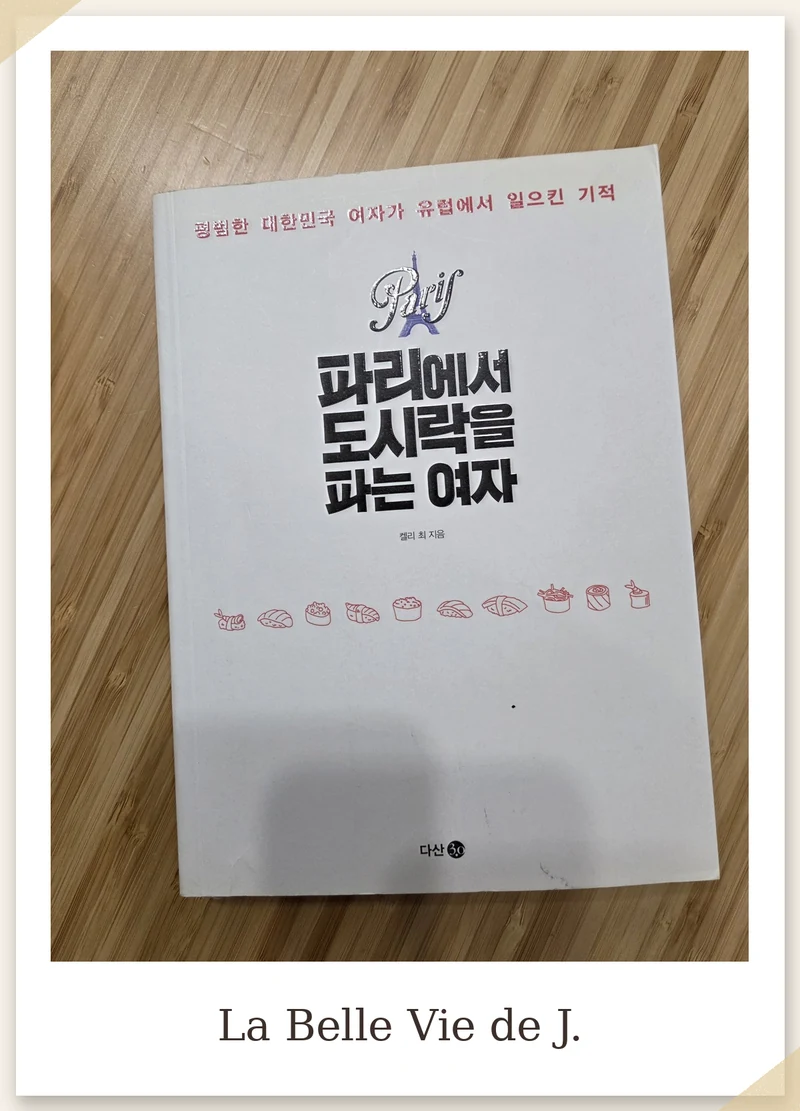
There is a book that shows this whole feeling — the sense of a grateful first spend — through one person’s story. It is Kelly Choi’s The Woman Who Sells Lunchboxes in Paris (파리에서 도시락을 파는 여자, Dasan Books), a book I own and read in its Korean edition. Its subtitle calls it “the miracle an ordinary Korean woman worked in Europe” — the record of a Korean woman who built KellyDeli, her lunchbox business, in an unfamiliar Europe.
But read this book only as a success story, chasing the word “miracle” in its subtitle, and it drifts away from the grain of this post. What stays with you is not the scenes of big success; it is the time that came before them. Through seasons of failure and debt, what she kept doing was deciding again, every single day, the order in which she treated the money that came in — and where her gratitude would go. Even the cash flow of a large business is, in the end, one person’s money habits grown big.
That is why this book sits here, at ritual ③. People money gathers around carry a different heart toward money first. A heart that treats the first spend as thanks, and an attitude that settles the order of incoming money in advance — both are small rituals you can practise from today, whatever the amounts involved.
It is also why this book reads as a story about managing yourself. The way you treat money turns out to be one body with the way you treat your day. Deciding what comes first, what can wait, and what to set aside — a person whose money runs in order usually keeps their day in the same grain. That is exactly why the four rituals in this post ask about order at every station money passes through: the wallet, the log, the first spend, and the savings.
🏢 ④ Move Your Savings First

The fourth ritual is the one that does the heavy lifting, and it happens before any spending at all: on payday, a fixed percentage of your income moves to a separate savings account — first, automatically. If money is tight, start honestly small: 1 to 5% still counts. Ten percent is a solid start, 15% a strong middle, 20% the classic goal. Savers who use account systems keep the order strict: savings leave on payday itself, fixed bills next, everyday spending last, from what remains. The remainder is yours to enjoy, guilt-free — the saving is already done.
- Automate it — a transfer you must remember is a transfer you’ll skip
- Build the emergency cushion first: 3 to 6 months of living costs, easy to reach
- Every raise, raise the savings too: +1% each time, or half of each raise
✨ The principle behind it: This reverses the usual (broken) formula. Most budgets save “whatever is left” — and behavioral research on mental accounting (Nobel laureate Richard Thaler’s work) shows why leftovers are usually zero: money without a label gets spent. Money moved first into a labeled, separate account is treated by the mind as a different kind of money — spoken for, out of bounds. The well-known 50/30/20 rule (50% needs, 30% wants, 20% savings and debt) is built on exactly this: the 20% is decided in advance, not discovered at month’s end. Luck, it turns out, prefers people whose good decisions happen automatically.
This sense of order is one that people who have run a business know in their bones. In Kelly Choi’s story, introduced back at ritual ③, the handling of money always came back to the same question of order — what gets placed first.
You don’t need to adopt all four rituals this week.
Wishing you a beautiful day.
I covered the thankfulness side of this in my piece on The Gratitude Money Habit: How Thankfulness Changes spending — this post is its practical, daily companion.
📅 Start This Week: One Small Step
Attach the rituals in order of effort. Day 1: the wallet reset — receipts out, cards down to three, goal note in. Days 2–3: the one-minute log after dinner; don’t backfill, just start. Day 4: one grateful first spend, however small. On payday: set the automatic transfer — even 1% — before you spend anything from the new balance. Four rituals, four anchors, one week. By next payday, the system runs itself and you’re only steering.
🚫 3 Habits That Leak Money Luck
First, saving what’s left: the reverse order guarantees the answer is usually nothing — spending expands to fill an unlabeled balance. Second, the invisible small spend: unlogged coffees, delivery fees and app taps that never register as “real” money; the latte-factor arithmetic says these are precisely where a four-figure sum hides each year. Third, the wallet as storage unit: months of receipts and a dozen cards don’t just look messy — they make your true balance unseeable at a glance, and unseen money gets spent twice in the mind. Plug the leaks before chasing bigger income.
🧮 The Numbers to Remember
$5 × 5 days = ~$100 a month — the latte factor, the size of a “small” habit. 1% → 10% → 20% — the savings ladder: start where you can, climb at every raise. 3 to 6 months — the emergency cushion that turns bad luck into an inconvenience. $26.50 a week — the average pace of the 52-week savings challenge, which quietly stacks up to $1,378 in a year. And 80% — how much of your spending needs to reach the log for the habit to work. Money luck, reduced to arithmetic, turns out to be mostly attention, paid daily.
🗣︎ Steal These Sentences
For the wallet, at the door: “Money’s home is tidy tonight.” For the log, when you’d rather skip it: “One minute, three columns.” For the first spend: “Let the first money out be thanks.” And for payday, the sentence this whole series is built on: “Savings first — then everything else is free to enjoy.”
Start with whichever ritual feels easiest today.
So try reading The Woman Who Sells Lunchboxes in Paris not as “a successful person’s story,” but as a book for setting your heart toward money. I picked up the same book in a morning key in 4 Morning Routines of People Who Attract Good Luck. And in your own day of money, which ritual have you set in its place first?
Happy living 💛
— J.
💌 You May Also Like
— J.
Get the Free Canada Savings Checklist
Join the newsletter — get the free PDF checklist and weekly Canada savings tips in your inbox.
Read Next


Some links in this post are referral or affiliate links. If you sign up or buy through them, I may receive a bonus or commission at no extra cost to you. It helps keep this blog running — thank you!