
[Fortune 4-Panel] 4 Nighttime Habits of People Who Wake Up Lucky (Series ⑤)
Last updated: November 6, 2026
Bonjour! It’s J. — They say the day’s fortune is decided in the morning — but people who wake up lucky know the morning is actually decided the night before. Lucky sleepers don’t collapse into bed with a racing mind and a messy kitchen waiting for them. They close the day on purpose, in about twenty minutes, with four small rituals. None of them is grand. All of them are specific. Today, I’m sharing 4 nighttime habits of people who wake up lucky — the evening half of the morning routines in Series ④.
Before we start, keep one question in mind: “Why am I still tired, no matter how much I rest?” You know it: a whole weekend on the couch, and Monday morning still lands like a ton of bricks. Akira Kugaya’s The Best Rest (최고의 휴식, the Korean edition of his book on resting the brain) starts from exactly that question — looking for the cause not in the body, but in the brain. The four rituals below all connect to one thing: letting the brain rest before sleep. Read them with that one lens in hand.
🌿 Quick Take
- Write Tomorrow’s 3 To-Dos — five minutes with a paper notebook, only 3 items, the most important one circled
- Close the Day With a 10-Minute Reset — sink empty, counters clear, shoes away, keys on the tray: “ready, not perfect”
- One Grateful Thought, Then Lights Out — one specific good moment, recalled last, right before sleep
- Let Your Phone Sleep Outside — a charging spot outside the bedroom and a small analog alarm clock instead
📝 ① Write Tomorrow’s 3 To-Dos
The first ritual takes five minutes and a paper notebook — not your phone. Write down only the 3 things that matter most tomorrow, then circle the single “1 Must” and add the time you’ll start it. The trick is in the wording: turn a vague worry into a next action with a time attached. “I’m worried about tomorrow’s presentation” keeps your brain open all night; “Check the first 3 slides by 10 a.m.” lets it close the file.
- Keep the list to 3 — if everything is a priority, nothing is
- Write the start time next to each item, not just the task
- Use paper by the bed, so the list never lights up your face
✨ The principle behind it: This one is measured, not mystical. In a 2018 study at Baylor University (Scullin et al., Journal of Experimental Psychology: General), 57 adults spent 5 minutes before bed writing either a to-do list or a list of finished tasks — the to-do writers fell asleep significantly faster, and the more specific their lists, the faster they fell asleep. Psychologists call it cognitive offloading: once a task sits on paper, your brain files it as “stored” instead of rehearsing it all night.
🧹 ② Close the Day With a 10-Minute Reset

Restaurants end the night with a “closing shift” — ten minutes that return the space to its starting state. Lucky homes do the same. Set a timer for 10 minutes and close two rooms. Kitchen closed: dishwasher running, counters cleared, sink empty. Entryway closed: shoes away, bags packed, keys on their tray. When the timer rings, you stop — this is a reset, not a deep clean. The goal is ready, not perfect.
- Start with the sink — an empty sink changes the whole morning
- Put out tomorrow’s mug and coffee things while you’re there
- Deep cleaning goes on tomorrow’s list, never into the 10 minutes
✨ The principle behind it: In a UCLA study (Saxbe & Repetti, 2010), spouses who described their homes with words like “cluttered” and “unfinished” showed cortisol patterns that stayed flat into the evening — their stress never switched off — while those who called their homes “restorative” wound down normally. Space Energy tradition says the same thing in older language: the entryway is the entrance for energy, and a home that is “closed” properly at night lets its people rest. You wake up to yesterday’s mess, or you don’t — the 10 minutes decide which.
📚 Resting the Brain — The Best Rest
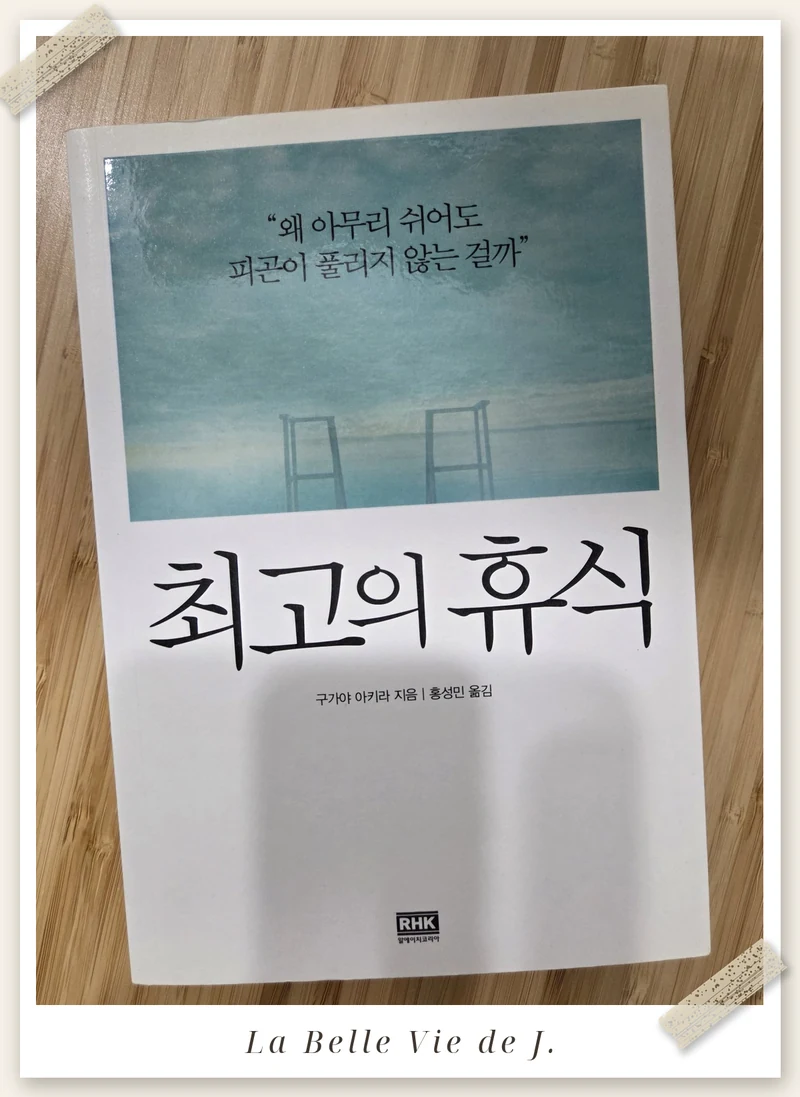
A proper introduction, then. In The Best Rest (RHK; Korean translation by Seongmin Hong), Japanese psychiatrist Akira Kugaya argues that the tiredness that never lifts lives not in the body but in the brain. The body may be on the sofa while the head replays the unfinished task, the unanswered message, tomorrow’s schedule — and while it runs, the brain gets no rest at all. That, in his diagnosis, is what is behind mornings when a long sleep still does not feel like enough. Bodily fatigue fades with rest; brain fatigue stays, as long as nonstop thinking comes along into the rest.
So the book’s proposal is a mindfulness-based way of resting the brain. Not some grand new meditation technique — closer to a practice: bring your attention back to the present and turn down the noise running on autopilot in your head. For anyone who has taken a day off and still not felt rested, it shows that rest, too, has a method.
Now look at tonight’s rituals through that lens. Writing tomorrow’s to-dos on paper is the brain setting down the work it was holding. The 10-minute reset moves “unfinished business” out of your sight. One grateful thought chooses the last thing your mind replays before sleep. And the phone outside the bedroom blocks the very channel through which that noise switches back on. One principle runs through all four: before you fall asleep, set down the noise in your head. Not just a body put to bed — a night that rests the brain, too.
🙏 ③ One Grateful Thought, Then Lights Out

The last ritual happens in bed, in the final minute before the light goes off. Recall one specific good moment from today — not “I’m grateful for my family,” but the actual scene: “My coworker listened to the end of my story today. That helped more than she knows.” One is enough. On truly hard days, practitioners say that noticing you ate, that you’re breathing, that tomorrow is a new day is enough. Then: breathe out slowly, and lights out.
- Name the moment and why it was good — the feeling is the point
- Do it last, right before sleep, not hours earlier at dinner
- Can’t think of three? Start with one — one is the whole habit
✨ The principle behind it: In a study of 401 adults (Wood et al., 2009, Journal of Psychosomatic Research), people higher in gratitude slept better and longer — and the mechanism was their pre-sleep thoughts: they fell asleep thinking fewer negative, worried thoughts and more positive ones. Your brain runs a kind of threat scan in the quiet before sleep, rehearsing whatever is unfinished. Gratitude takes up that same mental bandwidth with something kinder. The last thought of the day quietly becomes the first feeling of the night.
📵 ④ Let Your Phone Sleep Outside
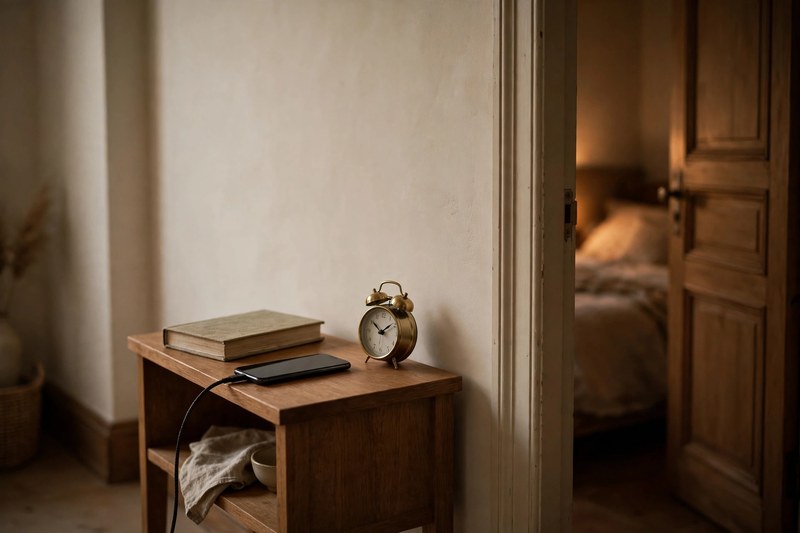
The fourth ritual protects the other three. Thirty minutes before bed, your phone goes to a charging spot outside the bedroom — a hallway console, the kitchen counter, anywhere that isn’t within arm’s reach of your pillow. The obvious objection is the alarm, and it has a ten-dollar answer: a small analog alarm clock. What stays in the bedroom instead is a paper book, a notebook, and a lamp. That’s the whole swap.
- Make one fixed charging station — the whole household can share it
- Set a “digital curfew”: screens off 30 to 60 minutes before lights out
- Try it for just one week first — a short test beats a forever vow
✨ The principle behind it: It isn’t only the blue light suppressing melatonin — it’s the scroll itself keeping your brain on alert, and the phone’s mere presence inviting one more check. In a randomized pilot study (He et al., 2020, PLOS ONE), just four weeks of no phone use in the 30 minutes before bed measurably improved sleep quality and helped people fall asleep faster; a large adolescent cohort study in JAMA Pediatrics likewise found that keeping the phone outside the bedroom was linked to better sleep. Distance beats willpower: a phone in another room can’t be “just checked.”
Through the lens of The Best Rest, a phone on the nightstand is close to an overtime order handed to your brain. The body has climbed into bed; the brain alone is still at work.
You don’t need to adopt all four rituals tonight.
Wishing you a beautiful day.
I covered the other side of this in my piece on [Fortune 4-Panel] 4 Morning Routines of People Who attract good luck — this post is its evening twin.
📅 A 7-Night Starter Plan
Stack the rituals one at a time, the way habit research says new behaviors actually stick — attached to a cue that already exists. Nights 1–2: phone to the hallway charger at your curfew time, nothing else changes. Nights 3–4: add the notebook — tomorrow’s 3 to-dos, five minutes, lights out. Nights 5–6: add the 10-minute closing shift before you sit down for the evening. Night 7: add the grateful thought in bed. By the end of the week you own the full twenty minutes, and each piece had two days to stop feeling new.
🚫 3 Habits That Leak Tomorrow’s Luck
First, the swirling list: going to bed with tomorrow’s tasks unwritten and unranked. The Baylor researchers found that worry about incomplete future tasks is a prime driver of trouble falling asleep — the list exists whether you write it or not; writing just moves it out of your head. Second, scrolling until the lights go out: the last content your brain processes is whatever the feed chose, rarely calm and never yours. Third, leaving the day un-closed: dishes in the sink and shoes in the doorway are the first things tomorrow’s eyes meet — and the cortisol research says an “unfinished” home keeps the body braced. Plug the leaks and the four rituals get twice as powerful.
🗣︎ Steal These Sentences
For the notebook, borrow the conversion: instead of “Tomorrow will be busy,” write “Tomorrow, first: send the draft by 9.” For the reset, say the checklist out loud as you finish: “Kitchen closed. Entryway closed. House closed.” For the grateful minute: “Today, thank you for the ten quiet minutes with my coffee.” And for the phone, give it a bedtime of its own: “My phone sleeps in the hallway tonight.” Rituals are just sentences and small actions, repeated until they become your evenings.
Start with whichever ritual feels easiest tonight.
If you rest all weekend and the tiredness still doesn’t lift, keep The Best Rest nearby and give it a read. On especially unrefreshed mornings, which feels more tired — your body, or your brain?
Happy living 💛
— J.
💌 You May Also Like
— J.
Get the Free Canada Savings Checklist
Join the newsletter — get the free PDF checklist and weekly Canada savings tips in your inbox.
Read Next


Some links in this post are referral or affiliate links. If you sign up or buy through them, I may receive a bonus or commission at no extra cost to you. It helps keep this blog running — thank you!