
[Fortune 4-Panel] 4 Gratitude Habits of People With Truly Blessed Lives (Series ⑥)
Last updated: November 6, 2026
Bonjour! It’s J. — Some people seem to live blessed lives — helped at the right moments, welcomed in every room, quietly lucky in ways that compound. When you look closely, it usually isn’t a charm they were born with. It’s a habit they repeat: they say thank you early, specifically, and out loud — and they do it in small doses, every day, not in grand gestures once a year. As November, the season of thanks, comes around, here are 4 gratitude habits of people with truly blessed lives.
Before the four habits, let me set one book beside them. It is a gratitude book I own and read with real affection, and its story runs right alongside these habits — so at habit ④, I will open it briefly.
🌿 Quick Take
- Say One Thank-You as Your First Thought — 30 seconds, before your phone, naming one specific kindness from yesterday
- Send the Thank-You Message Right Away — within 24 hours, in 3 short lines, while the feeling is still warm
- Share One Gratitude at the Table — one round, one sentence each, before the meal begins
- Keep a Gratitude Note Where You Can See It — 3 lines in a notebook by the bed, re-read on Sundays
🌅 ① Say One Thank-You as Your First Thought
Before your feet touch the floor — and definitely before your phone does — spend 30 seconds on one sentence: “Thank you for ______ — because ______.” The first blank takes something specific from yesterday; the second says why it mattered. “Thank you for the coworker who covered my call yesterday — because I could finally breathe.” Vague gratitude (“I’m blessed”) slides off the mind. A named person and a real scene stay with you all day.
- Name a person, not a thing — a face makes the feeling real
- Keep it to one sentence and savor it for 10 to 20 seconds
- Yesterday’s smallest kindness counts — a door held, a seat given up
✨ The principle behind it: The placement is the point. Northwestern psychologist Judith Moskowitz advises practicing gratitude at exactly one of two moments — “first thing in the morning or right before you fall asleep” — the times when the mind is setting its frame for what comes next. And Berkeley’s Greater Good “Three Good Things” practice adds the detail that makes it stick: name not just the good thing, but why it happened. That small “because” trains your attention to spot the next kindness faster. Less a mood than a lens — installed first, used all day.
💬 ② Send the Thank-You Message Right Away

Somebody did something kind for you — the message goes out today, within 24 hours, no exceptions for “too small to mention.” It takes three lines and ten minutes at most: what they did, what it meant to you, one warm closing line. “The soup you left on my desk while I was working late — I still remember it. Thank you for noticing.” Send it without expecting a reply; the sending is the habit. Waiting for a bigger occasion means the thanks quietly expires.
- Within 24 hours — gratitude has a freshness date
- Three lines: the act, the meaning, the warm close
- Mentions the specific detail only you would remember
✨ The principle behind it: Research on expressed gratitude (Kumar & Epley, 2018, Psychological Science) finds that senders consistently underestimate how surprised and happy their thank-you makes the receiver, and overestimate how awkward it will feel — while receivers judge the message by its warmth, not its wording. And expressed thanks does measurable social work: in a pre-registered experiment with 916 adults (Walsh et al., 2022), people who sent one-to-one thank-you texts to four different people across about a week gained more in social connection and felt support than any other group tested. One more detail worth stealing: in Kumar & Epley’s studies, most thank-you letters took under five minutes to write. The thanks you’re postponing is smaller — and lands bigger — than you think.
There is also the record of a woman who put expressed gratitude at the center of her life for a whole year. She wrote thank-you letters to people she owed thanks to, said thank you first to her family and her colleagues, and watched her relationships change. I will open that book at habit ④ below.
🍴︎ ③ Share One Gratitude at the Table

Once a day, at the meal you share with others, run one small round: each person names one good thing from today, in one sentence, 30 seconds each. Phones go face-down while it happens. Keep the bar low with an easy prompt — “the best bite of today,” “one person who was kind today” — so nobody feels put on stage. At a holiday table, the same round is what turns a big dinner into the part everyone actually remembers.
- One sentence each — the round ends before it feels like homework
- The host goes first, and goes small and specific
- Children join with the easy prompts — and copy what they hear
✨ The principle behind it: Gratitude said out loud becomes culture. Developmental research on gratitude in children shows that kids who regularly watch adults express thanks — and are included in it — begin imitating it quickly and spontaneously; like manners, gratitude is caught more than taught. The same is true for adults at the table: a daily round normalizes noticing good things, so the household’s default conversation shifts from complaints to sightings of good fortune. Houses where thanks is spoken daily simply feel luckier to live in.
📝 ④ Keep a Gratitude Note Where You Can See It

The fourth habit gives gratitude a physical home. A small notebook lives by your bed; every night, three lines — what happened, who was in it, how it felt. Beside it, a corkboard or the fridge door holds sticky notes with the best lines where you’ll see them daily: by the kettle, on the bathroom mirror. On Sunday, spend five minutes re-reading the week’s pages. Once a month, retire the old stickies and let new ones take their place.
- The notebook stays open by the bed — starting should take under 20 seconds
- Three lines a night beat a page once a month
- Sunday re-read: five minutes that turn entries into a mood
✨ The principle behind it: This is the oldest studied form of the practice. In the classic experiments by Emmons & McCullough (2003), participants who listed things they were grateful for — up to five items, once a week for ten weeks — reported more optimism and greater life satisfaction, fewer physical symptoms, and they exercised more than comparison groups. The deeper principle is placement: behavior designers note that a habit placed within arm’s reach, in the path of an existing routine, gets done; a habit stored in a drawer doesn’t. What you see daily becomes what you think daily.
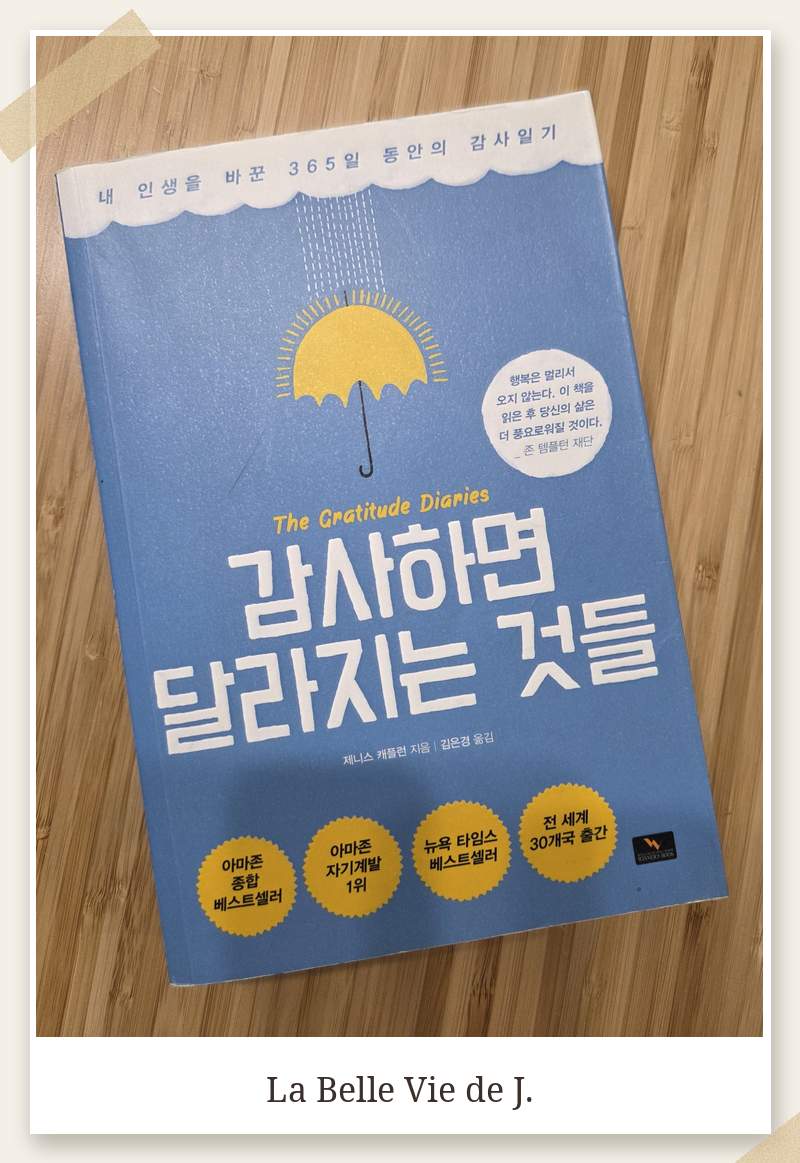
📖 A Year of Saying Thank You Out Loud — The Gratitude Diaries
The Gratitude Diaries (Janice Kaplan, Dutton, 2015) is the record of a year its author spent living gratefully. What caught my eye: she never left gratitude inside her head. When something good happened, she wrote a thank-you letter. With her husband, family, and colleagues, she stopped holding her thanks back and rebuilt her days around saying it. Between scenes, the book weaves in the research — she sat down with gratitude scientists, too. Read it, and gratitude stops looking like a mood; it looks like something you do.
Habits two and three of this post — the thank-you message sent right away, the gratitude shared at the table — are about gratitude delivered. Kaplan’s year is what that delivering becomes when it repeats daily: gratitude never expressed never actually reaches anyone. And it shares a root with habit four: sticky note or journal, the move is the same — gratitude pinned down where your eyes can find it. A line on a note can be the first draft of words you’ll send someone; notes kept long enough become a journal. I followed that journal side — gratitude kept as a daily record — in the companion piece, The Energy of Words: How Your Tone Shapes Your Life.
So if the note habit is already yours, the next small step is to pick one of those notes and actually send it today. From written down to sent out — exactly the direction this book keeps pointing.
The copy on my shelf is the Korean edition, and that is the one I read. On days when my heart feels heavy and life needs some thinking through, I sometimes take it down and re-read it. Every time I open it, I think the same: this is a book worth keeping close, one to return to for years.
You don’t need to adopt all four habits this week.
Wishing you a beautiful day.
For a closer look, see my guide on [Fortune 4-Panel] 4 Secret Habits of People Blessed with great relationships — gratitude is the thread running through both.
🌱 Start Today: One Small Step
Pick the habit that asks the least of you today, and let momentum do the rest. If mornings are chaos, start with the notebook — three lines tonight, nothing else. If someone helped you this week and you haven’t said so, start with the message: ten minutes, three lines, sent before you sleep. If your household shares dinner, tomorrow’s round can be a single sentence from you, offered casually with the first serving. Gratitude has an unusually low entry price: the research doses that showed effects were minutes per week, not hours.
🚫 3 Habits That Leak Gratitude
First, thank-you’s saved for later: the feeling is genuine, but an unsent thanks helps no one — and the research says its warmth fades with delay. Second, vague thanks: “thanks for everything” is kind, but it gives the other person nothing specific to hold; naming the act is what makes it land and last. Third, the comparison scroll: a few minutes of measuring your life against highlight reels right before bed quietly erases the day’s real blessings from view. Gratitude and comparison compete for the same attention — whichever you feed last before sleep wins the night.
📅 A One-Month Practice Plan
Week 1: the notebook only — three lines a night, Sunday re-read. Week 2: add two thank-you messages, sent within a day of the kindness. Week 3: add the table round on the two days your household eats together. Week 4: keep all four, and at month’s end re-read everything and mark your four favorite entries — they become the sticky notes on the board. Notice what the month leaves behind: not a mood, but a paper trail of good fortune you can point to on the next hard day.
🗣︎ Steal These Sentences
For the message you keep postponing: “I smiled today because of you.” For a small kindness: “Thanks to you, today felt lighter.” For the table round with kids, lower the bar to: “My favorite bite today was ______.” And for the notebook on a hard day: “Today was heavy, but ______ was good.” Blessed lives are built one honest sentence at a time.
Start with whichever sentence feels easiest today.
Happy living 💛
— J.
💌 You May Also Like
— J.
Get the Free Canada Savings Checklist
Join the newsletter — get the free PDF checklist and weekly Canada savings tips in your inbox.
Read Next


Some links in this post are referral or affiliate links. If you sign up or buy through them, I may receive a bonus or commission at no extra cost to you. It helps keep this blog running — thank you!