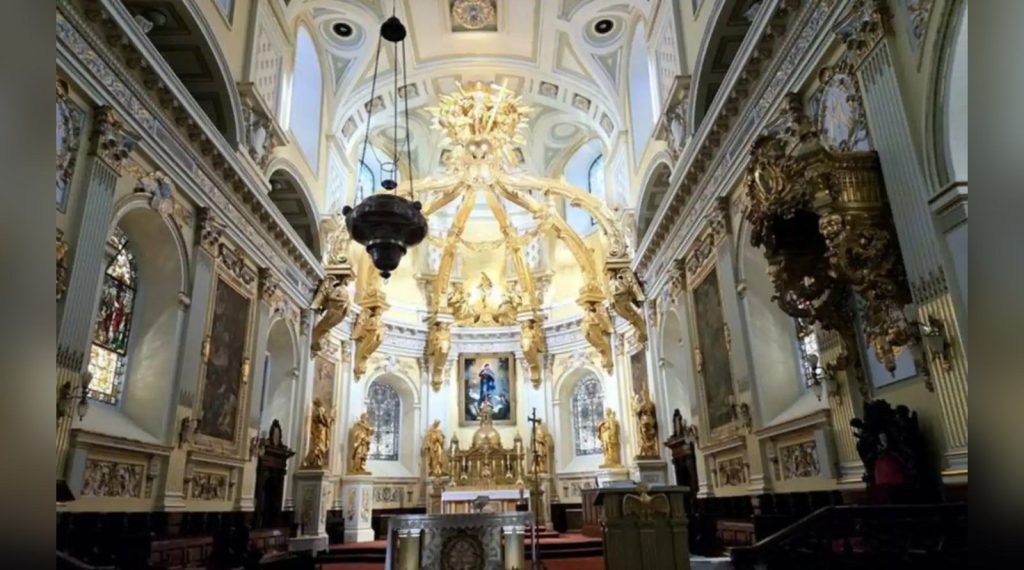
Notre-Dame de Québec Basilica: The Holy Door, the Golden Canopy and Canada’s Oldest Parish
Last updated: November 5, 2026
Most visitors photograph the façade and move on. Walk in instead: Canada’s oldest parish keeps its treasures inside — a gilded canopy, the first bishop’s tomb, and the only Holy Door outside Europe — and admission is free.
In October 2026, during our Charlevoix road trip — the same trip that took us to Sainte-Anne-de-Beaupré — we spent an afternoon inside Notre-Dame de Québec, the oldest parish in Canada. Most visitors photograph the façade and move on. The real treasures are inside, and walking in costs nothing.
🌿 Quick Take
- There are only seven Holy Doors in the whole world — and the only one outside Europe is hiding in plain sight in Old Québec.
- Notre-Dame de Québec is Canada’s oldest parish, founded in 1664 — and walking in costs nothing.
- Inside: a soaring gilded canopy over the sanctuary, and the funeral chapel of Saint François de Laval, the first bishop of Québec.
- Heads-up: the square in front of the cathedral is under construction right now (October 2026).
🚪 The Holy Door: The Only One Outside Europe
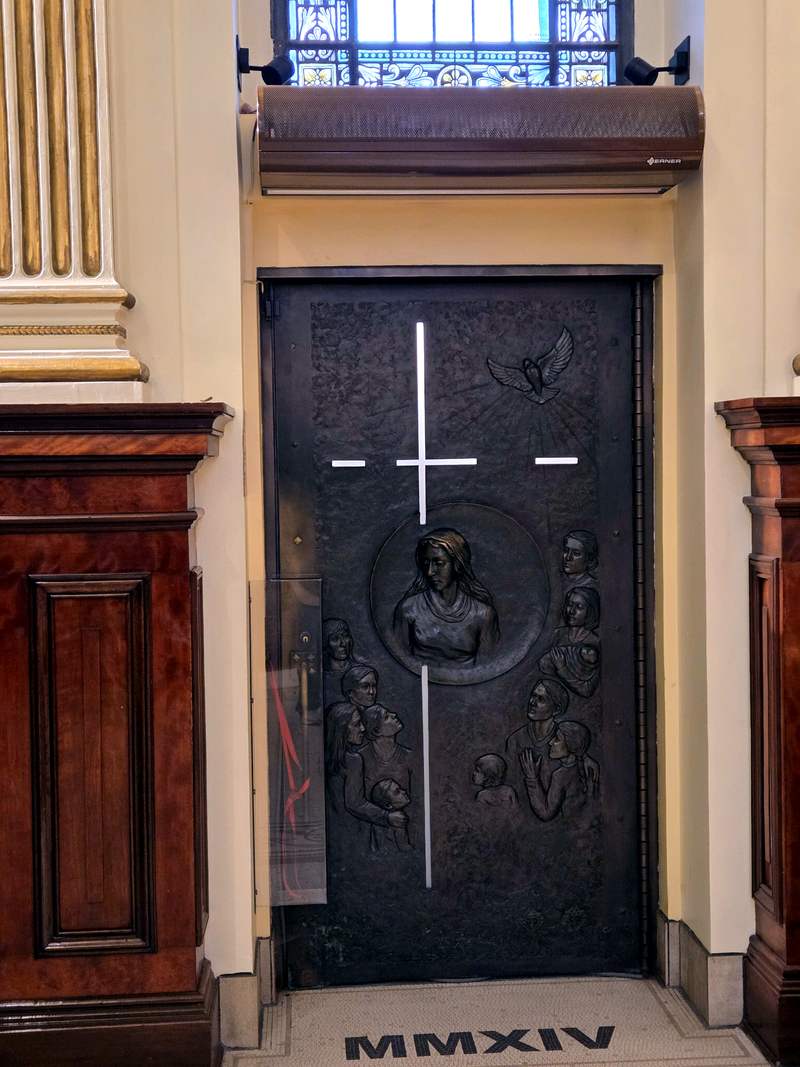
Start with the door. Pierced through the wall of the Sacred Heart Chapel on the north side of the church, Notre-Dame’s Holy Door was inaugurated on December 8, 2013, ahead of the parish’s 350th anniversary in 2014. It is the seventh Holy Door in the world — the other six are four in Rome, one in Ars, France, and one in Santiago de Compostela, Spain — and the first, and still only, one outside Europe. A Holy Door is an extraordinary privilege granted by the Holy See, and Québec received it as the first Catholic parish in North America north of the old Spanish colonies.
Sculpted by Jules Lasalle, the bronze door rewards a close look: on its inside face, the Virgin Mary stands surrounded by believers of every age, a luminous cross is cut clean through the metal, and the floor tiles read MMXIV — 2014. It is less a door than a piece of theology you can touch.
✨ A Canopy of Gold Over the Sanctuary
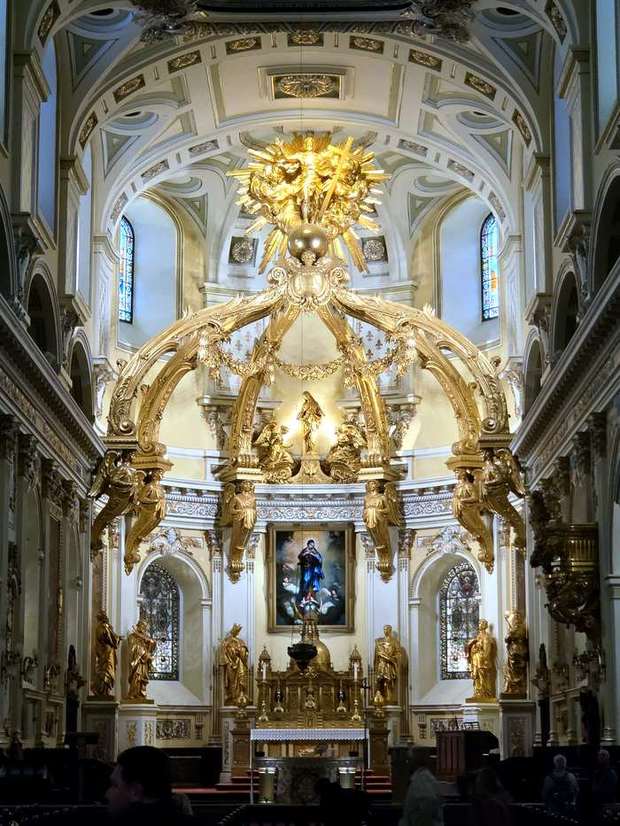
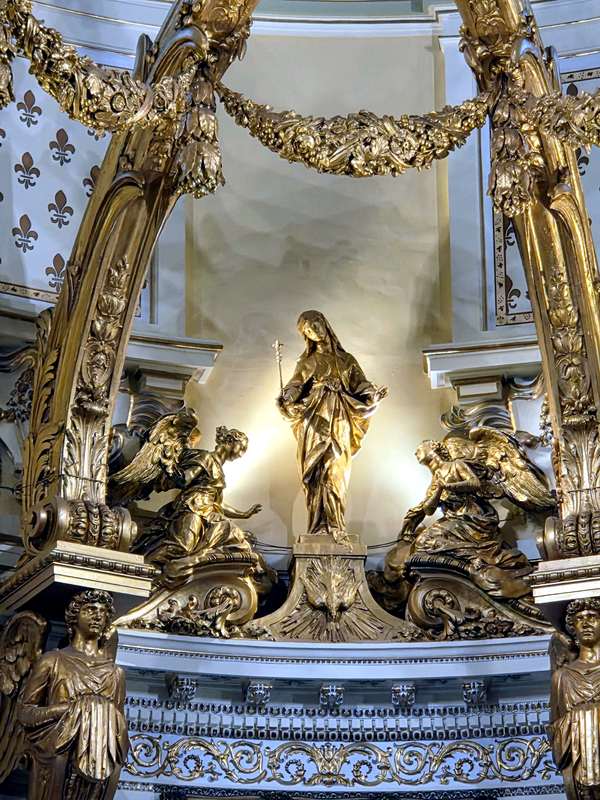
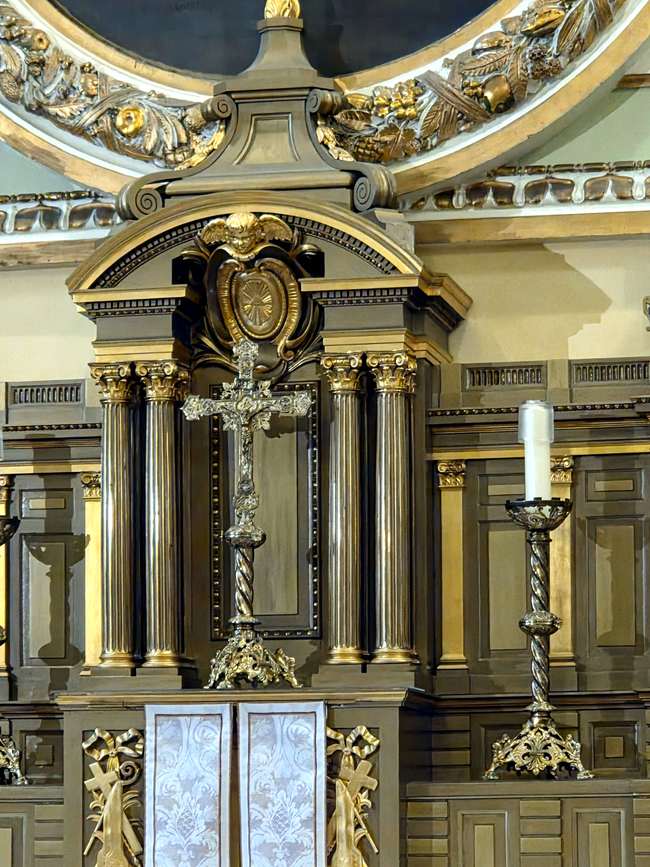
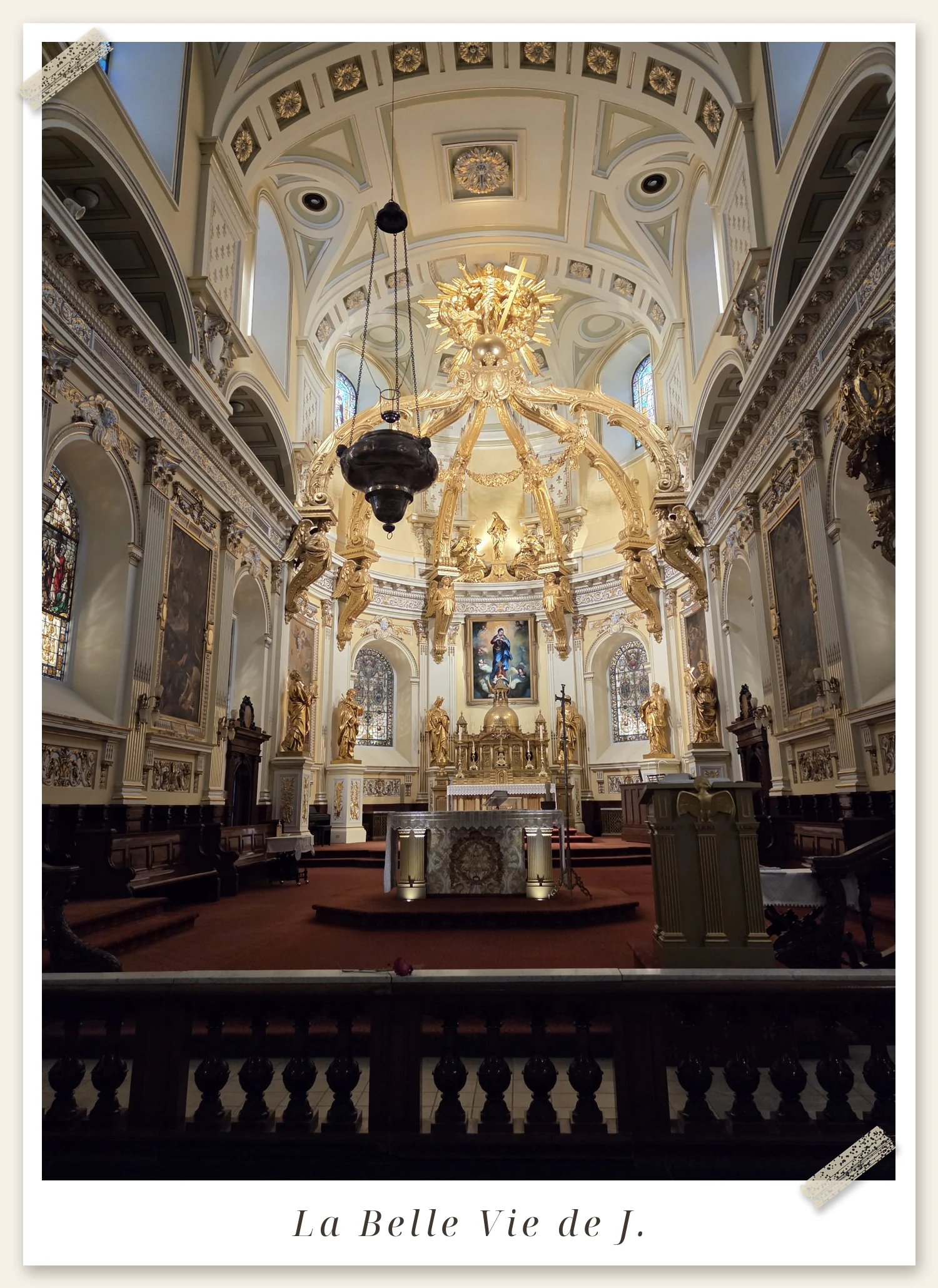
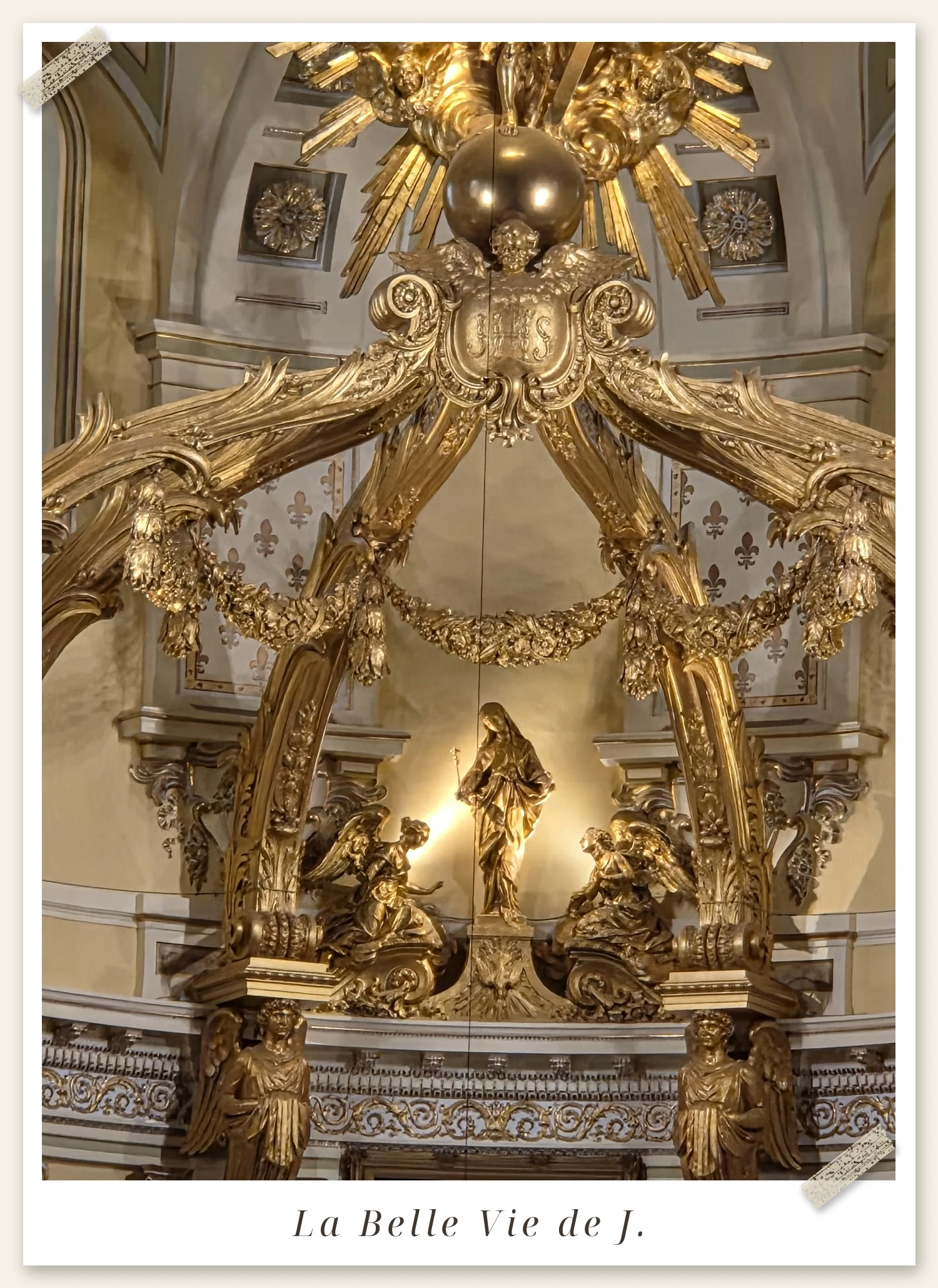
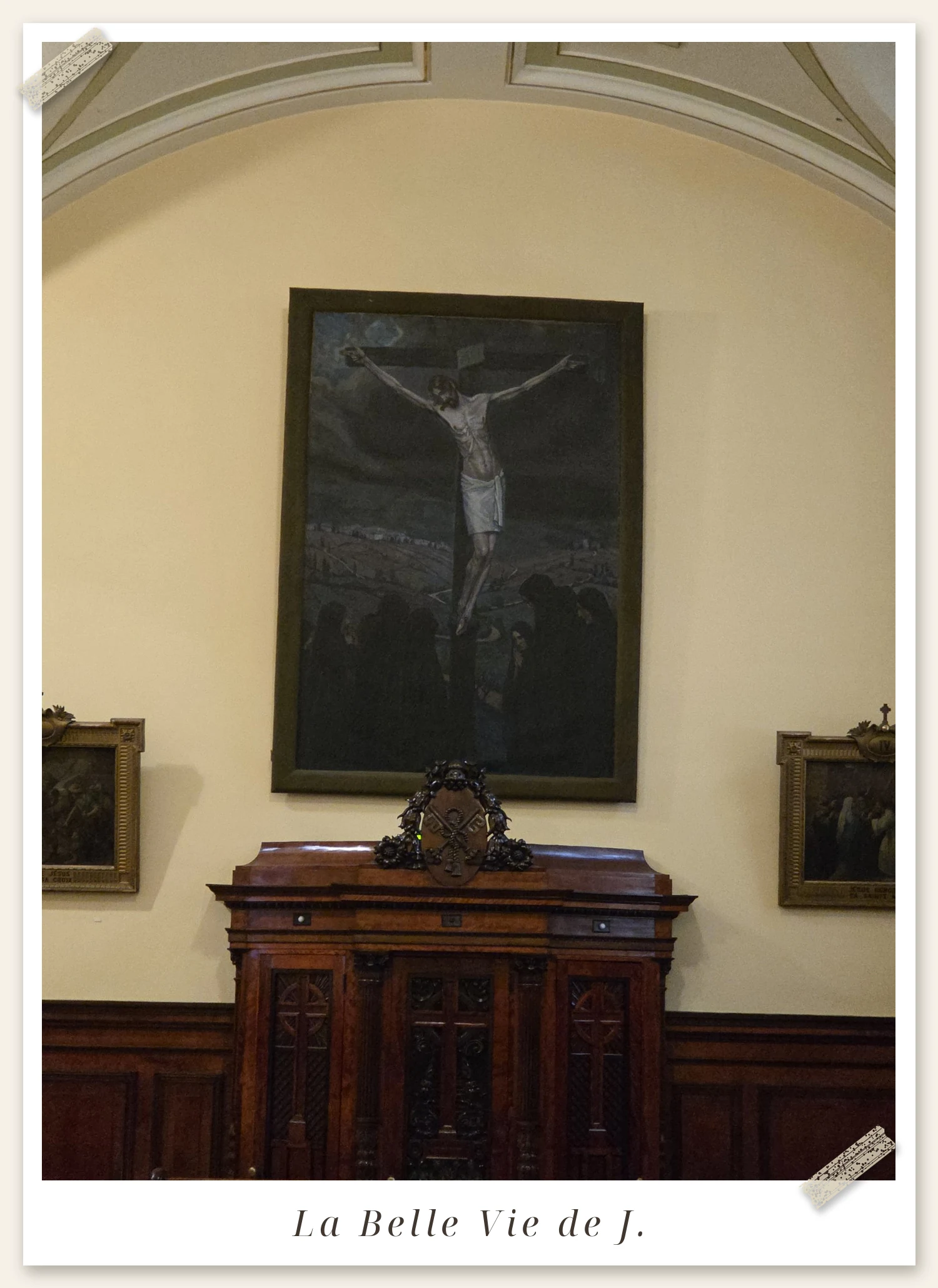
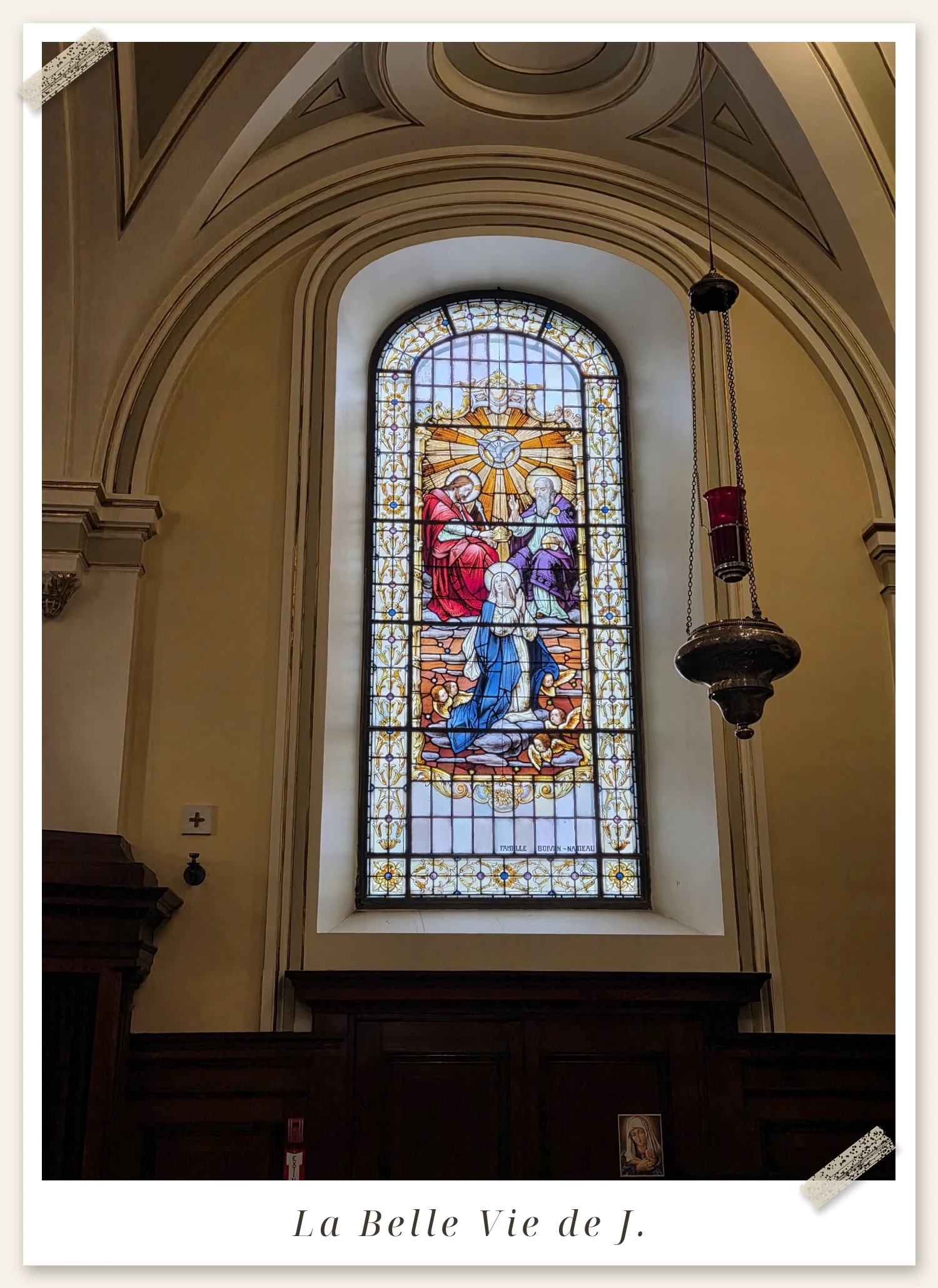
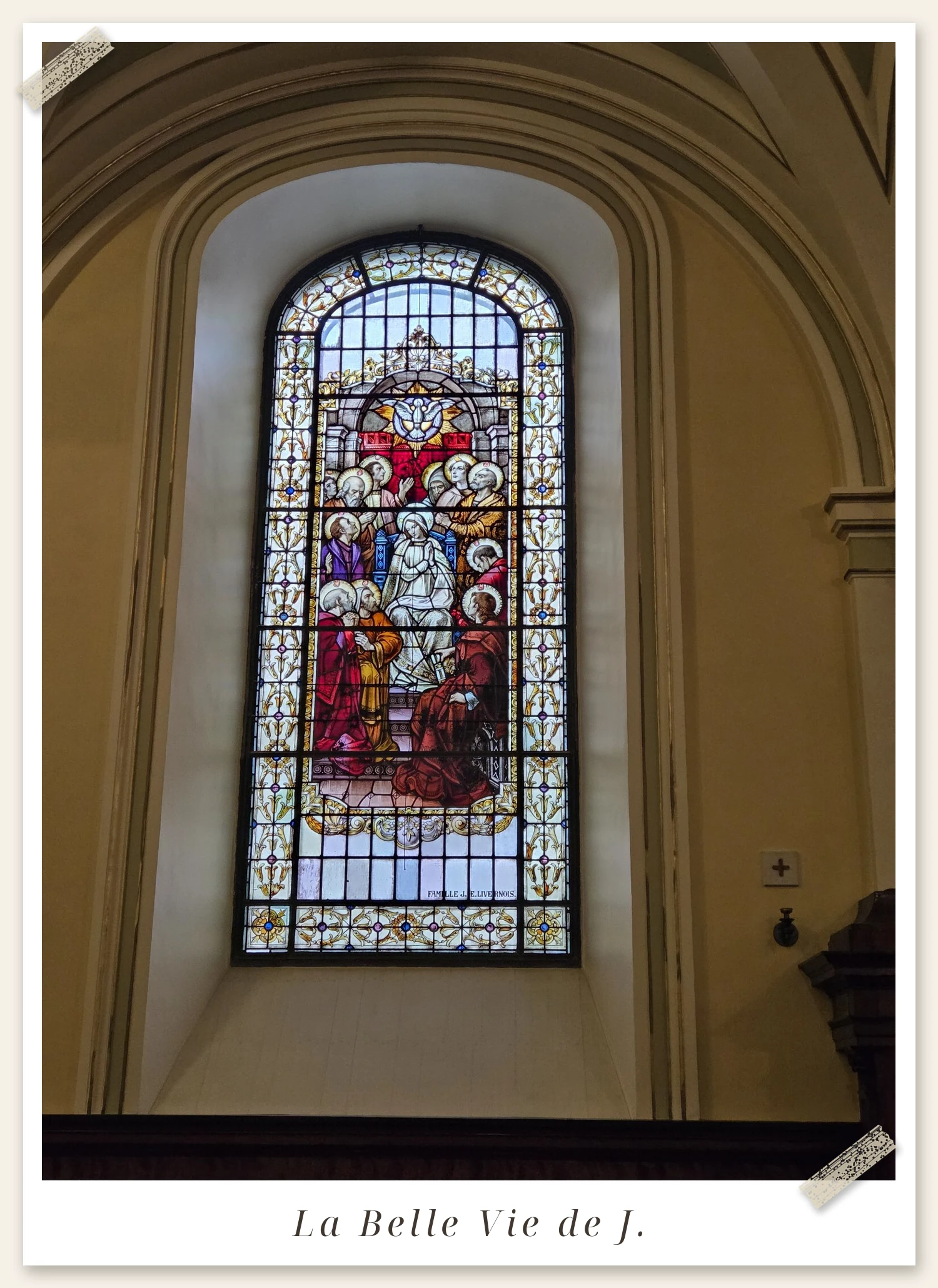
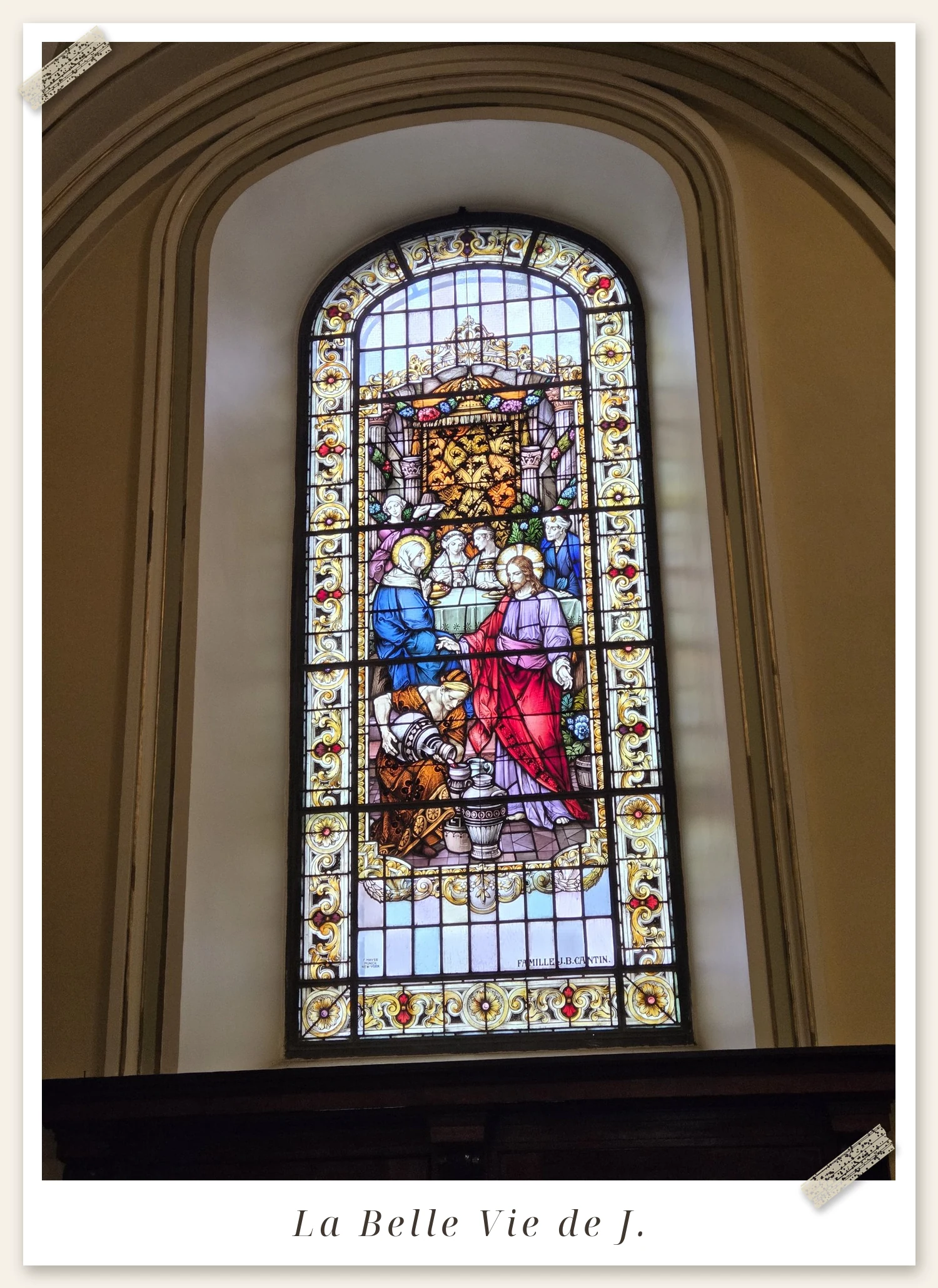
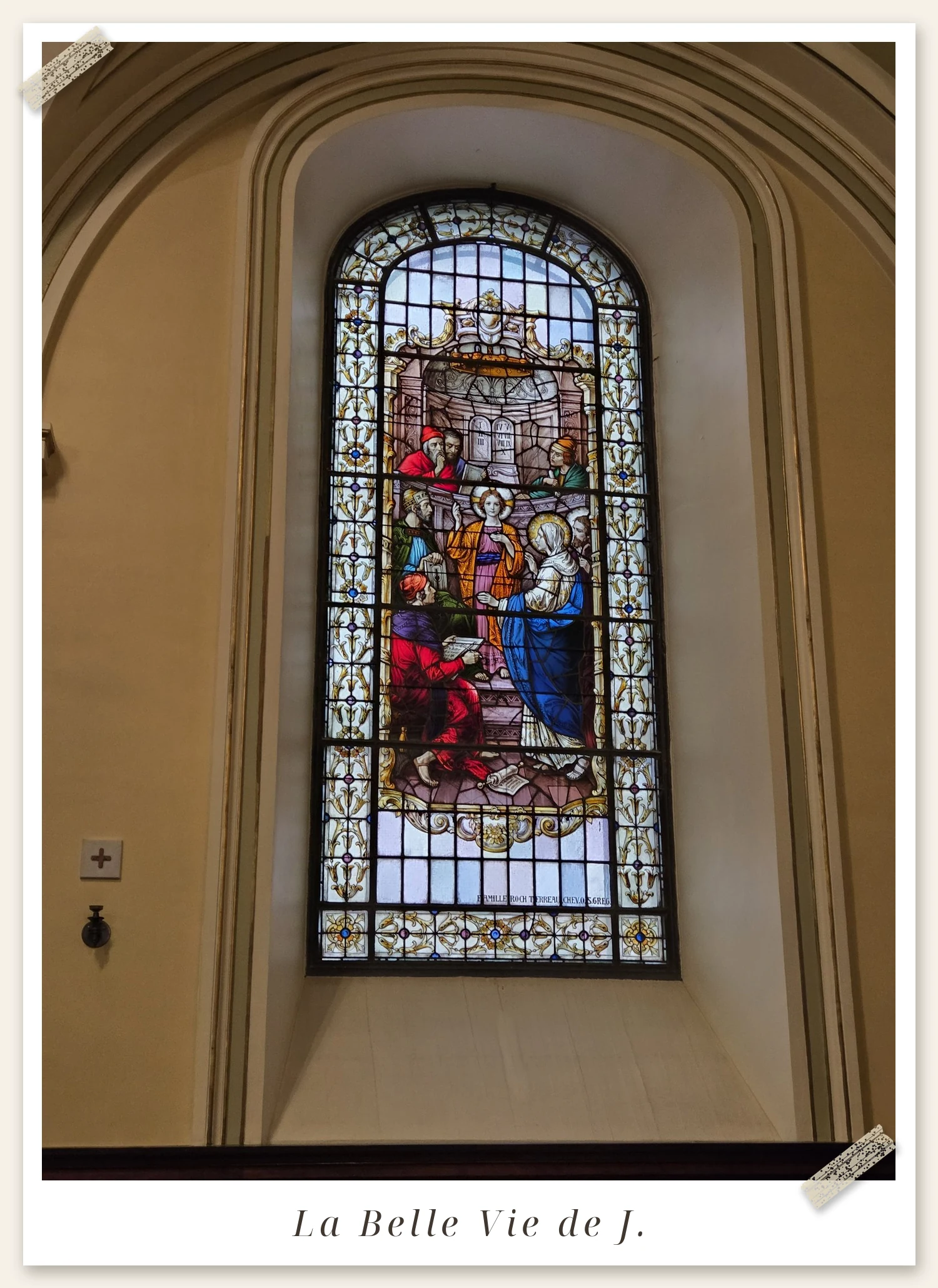
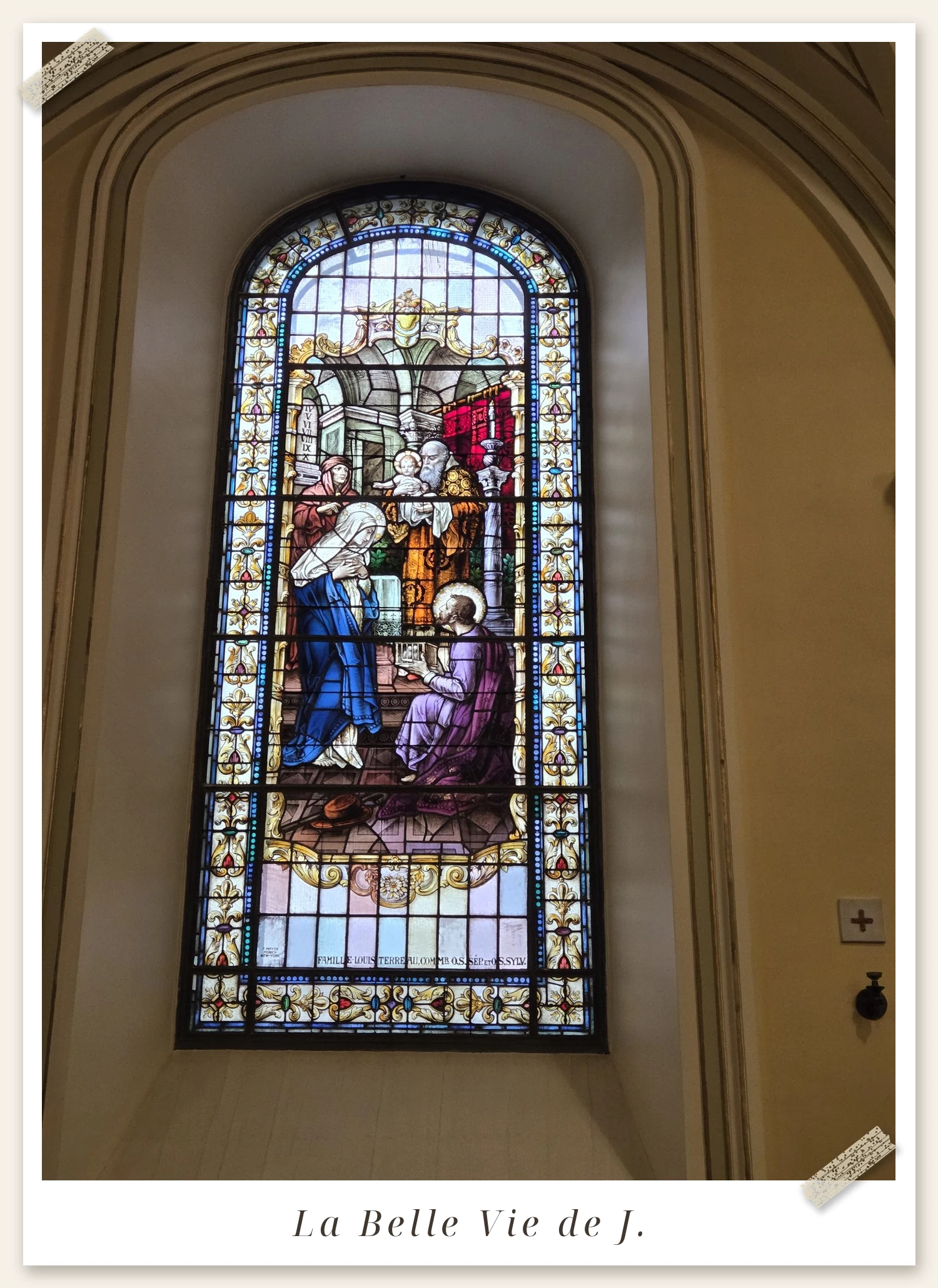
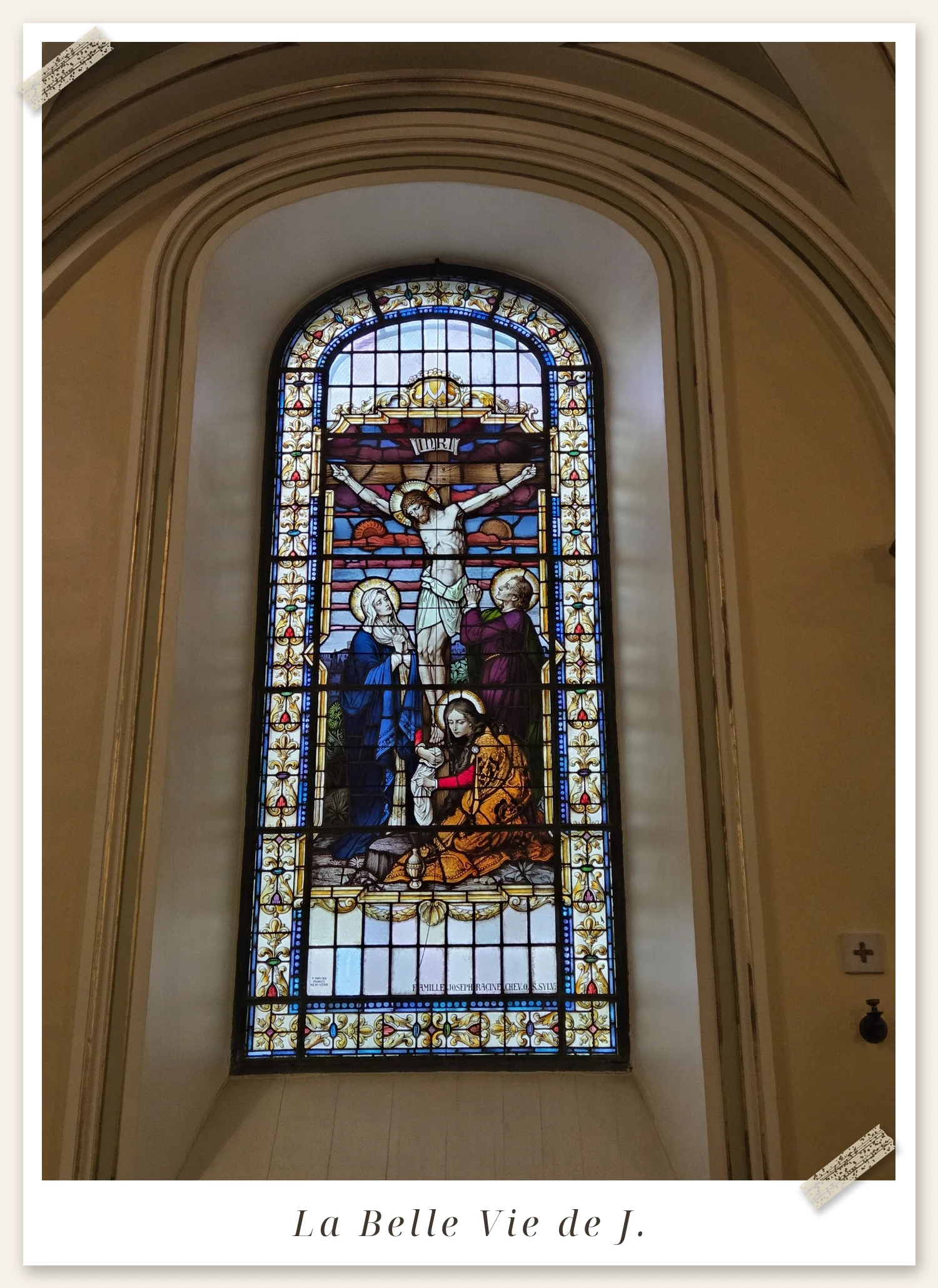
Then look up. The sanctuary is crowned by a soaring gilded baldachin — a golden canopy held up by twisted columns and angels, with the Virgin at its heart. The interior decoration is the work of the Baillairgé family of Québec artists, designed and carved between 1786 and 1822: gold leaf, carved wood, stained glass, and a sanctuary lamp gifted by Louis XIV.
What makes it more moving is knowing how close it came to vanishing. The church burned during the Siege of Québec in 1759, was rebuilt, then burned again in a 1922 fire — and was restored as faithfully as possible to what the Baillairgés had made. The gold you see is a reconstruction, but an honest, loving one.
🕊︎ Saint François de Laval: The First Bishop Sleeps Here
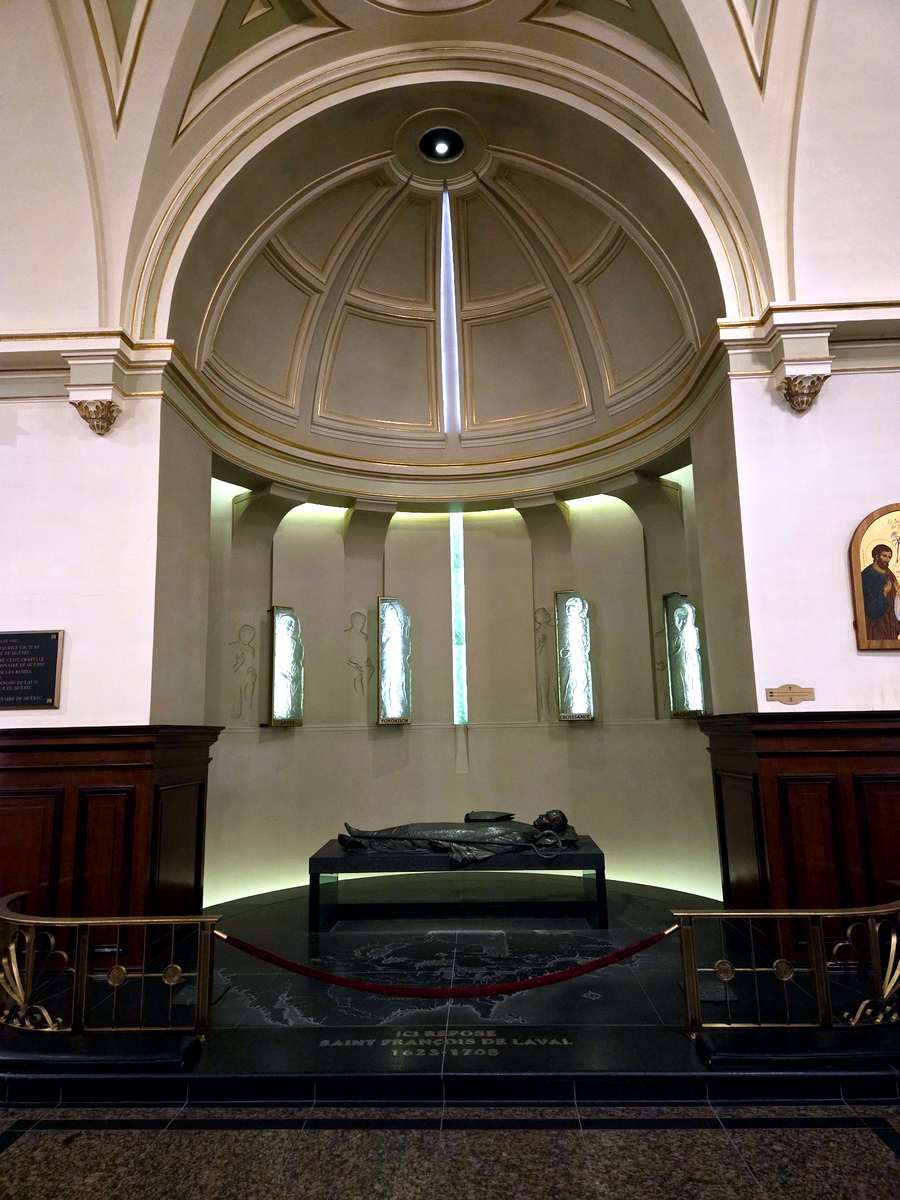
Down the north aisle sits the funeral chapel of Saint François de Laval, the first bishop of Québec, canonized by Pope Francis in 2014. His bronze effigy lies in state above the tomb, hands folded, beneath the words “Ici repose Saint François de Laval, 1623–1708.”
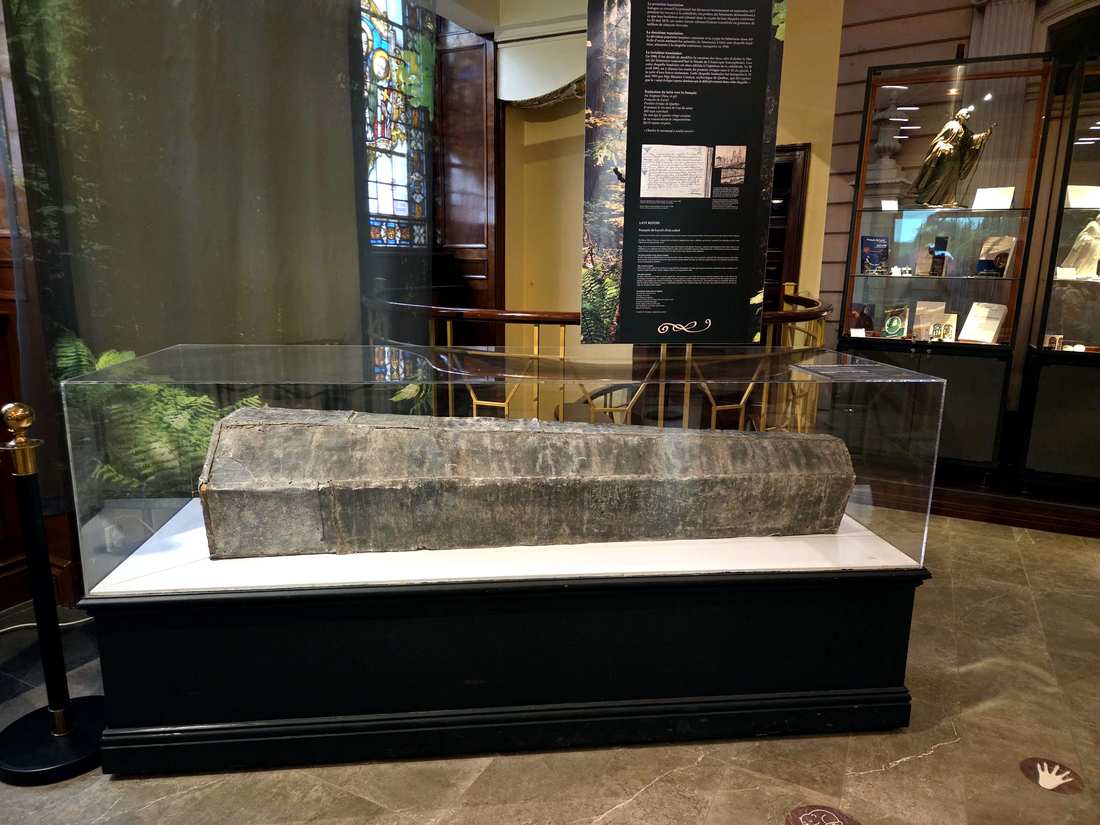
Beside the chapel, under glass, is something plainer and, to me, more affecting: Laval’s first casket, a simple wooden coffin. After all the sanctuary’s gold, the humility of that box stays with you.
🕯︎ Side Chapels: Saints, Relics and Small Change
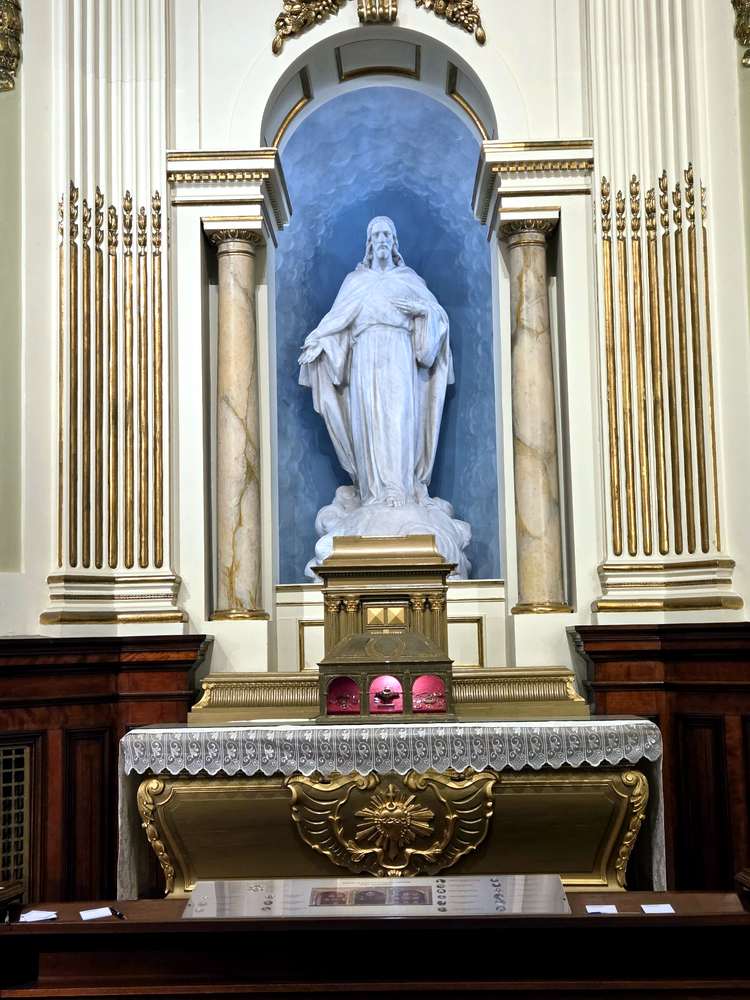
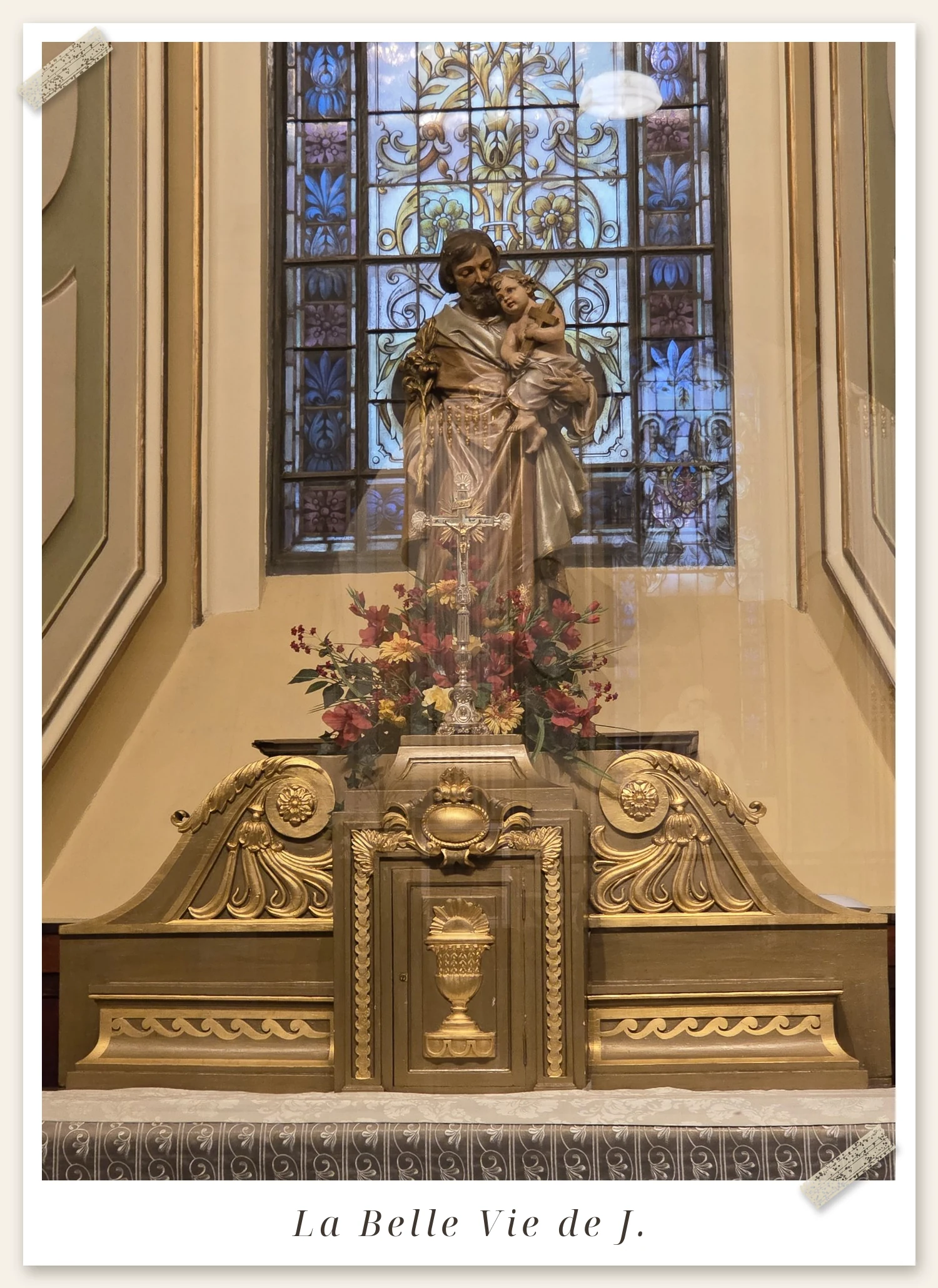
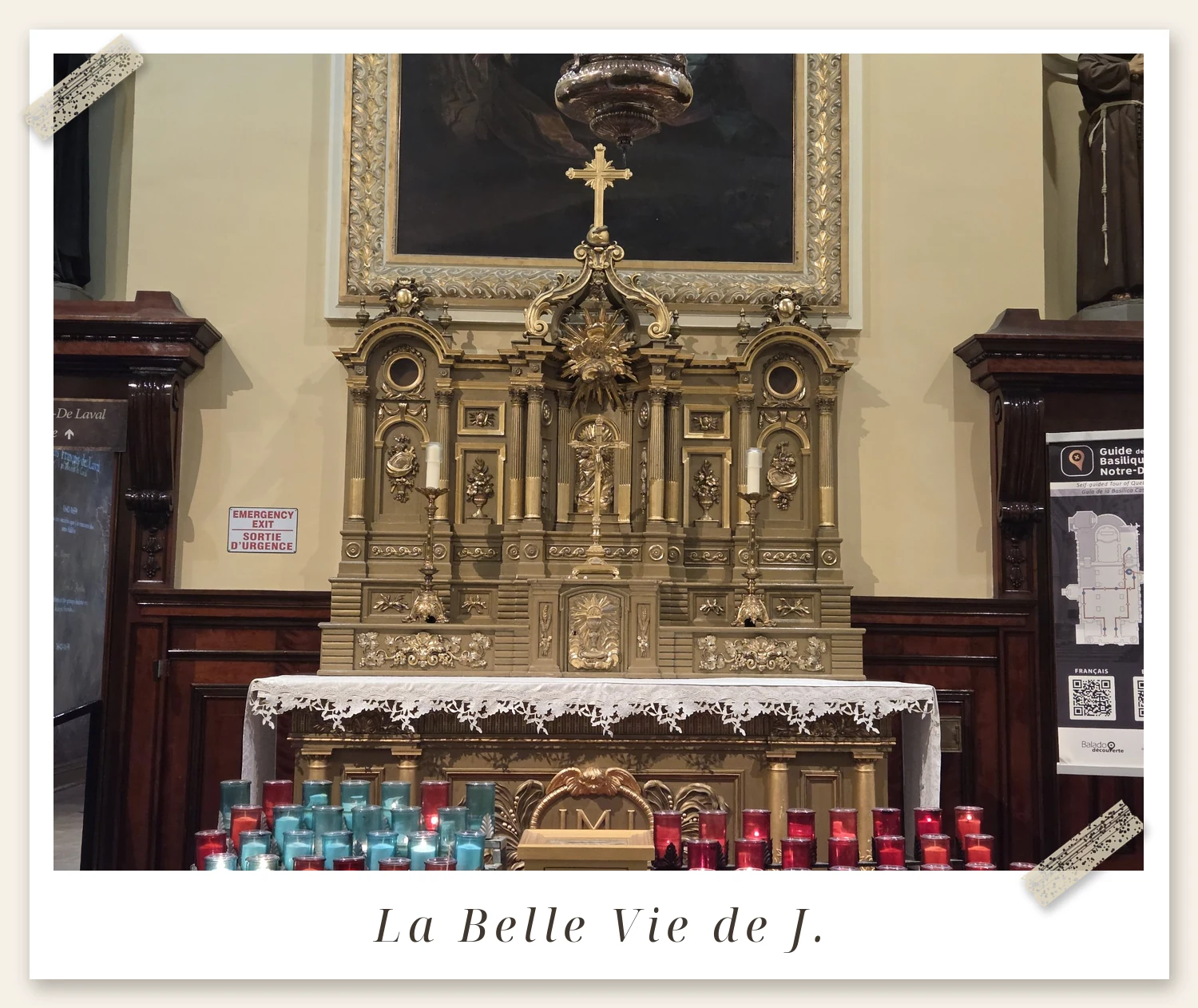
The Holy Door leads into the Sacred Heart Chapel, where a white Christ stands over the great reliquary of the Canadian saints and blessed — rows of small relics in red velvet cases. Around the church, the side chapels each keep their own quiet world: a Saint Anne chapel (a gentle echo of her great basilica up the coast), and Saint Thérèse of Lisieux beneath her promise, lettered in French: “Je ferai tomber une pluie de roses” — I will let fall a shower of roses.
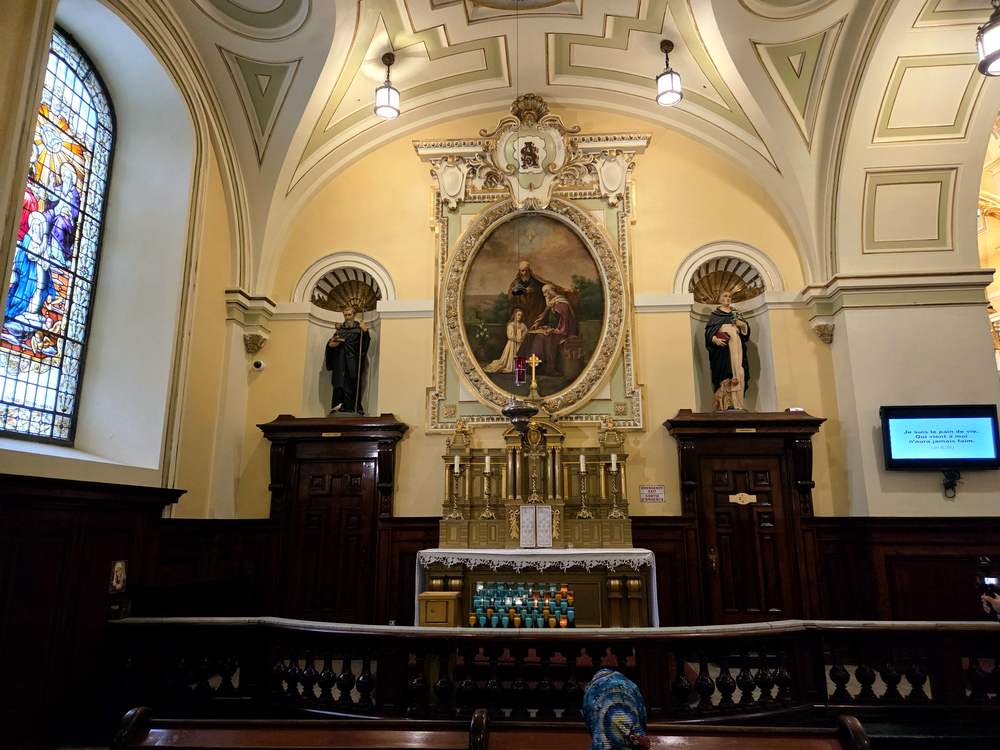
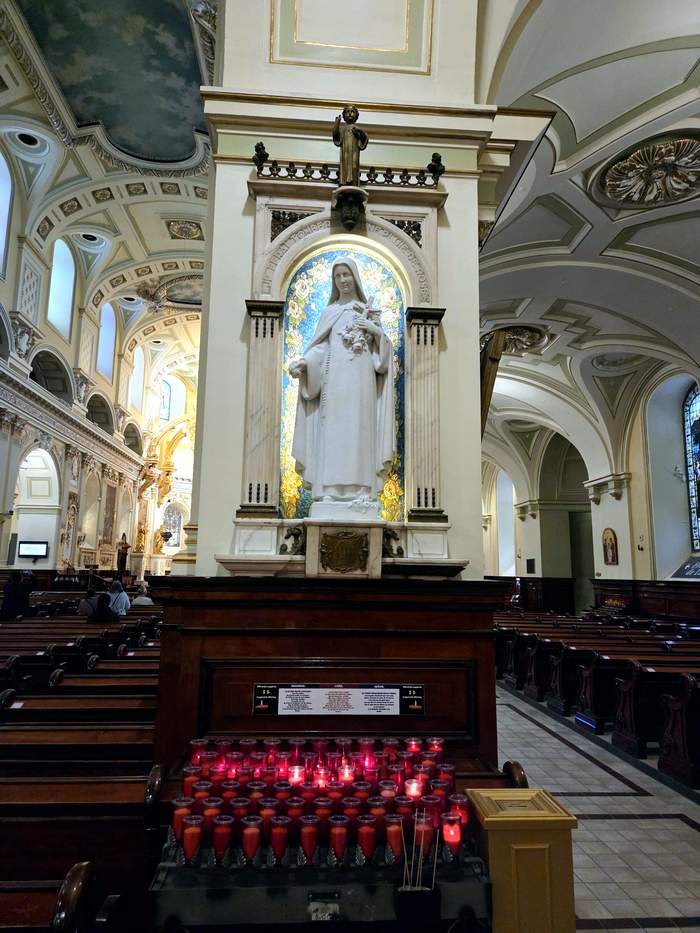
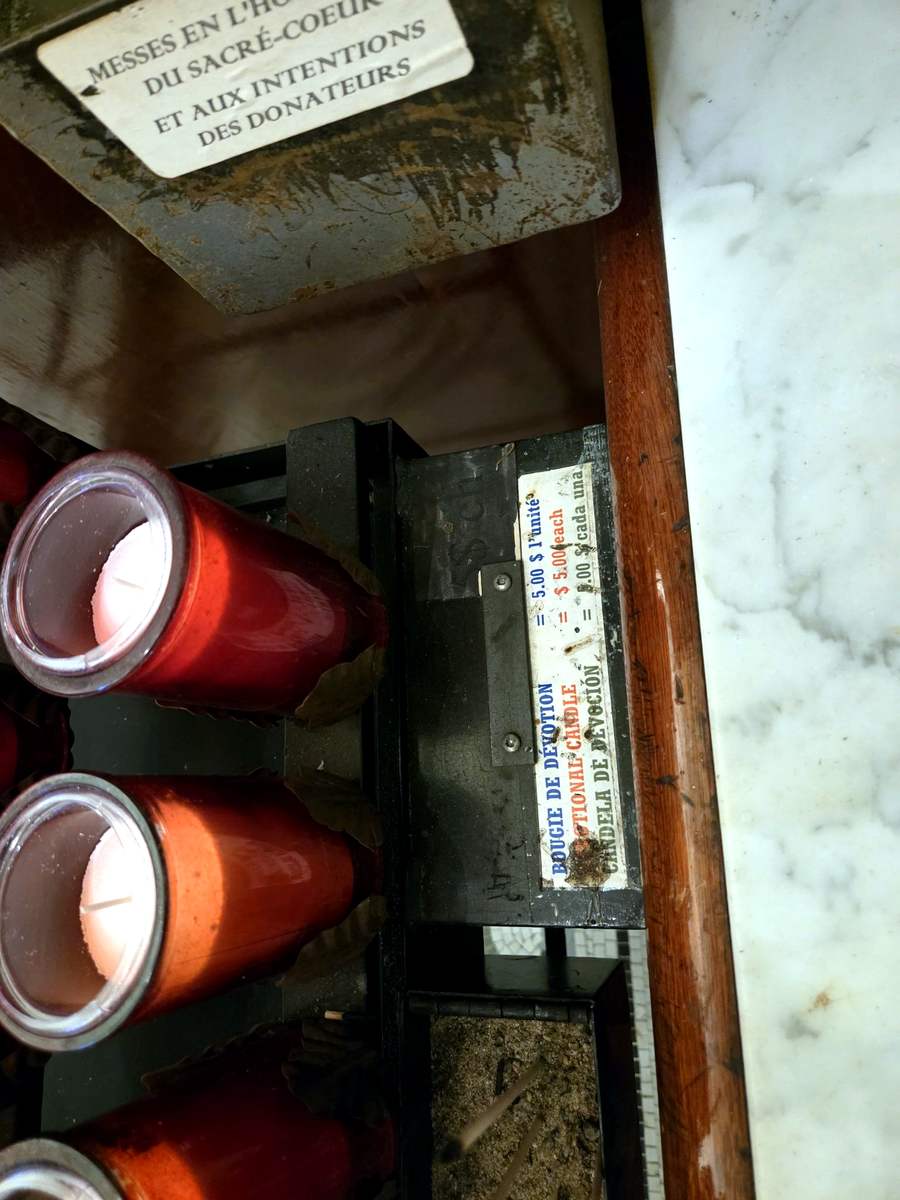
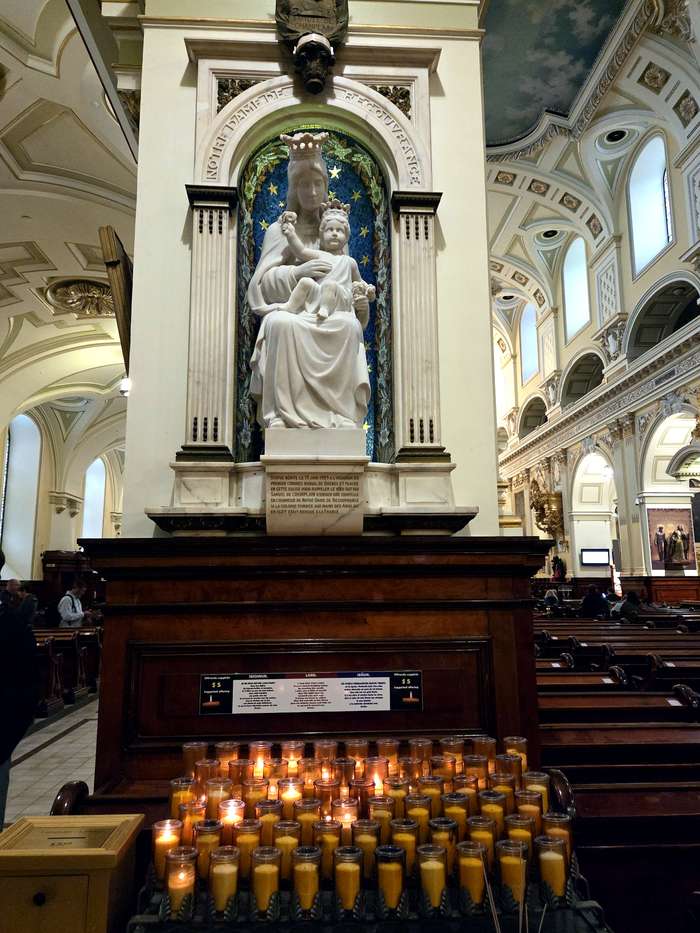
Practical poetry: the votive candles here are $5 each, as the little sign on the candle stand says — the same $5 we saw at Sainte-Anne-de-Beaupré.
📜 Three and a Half Centuries on One Street Corner
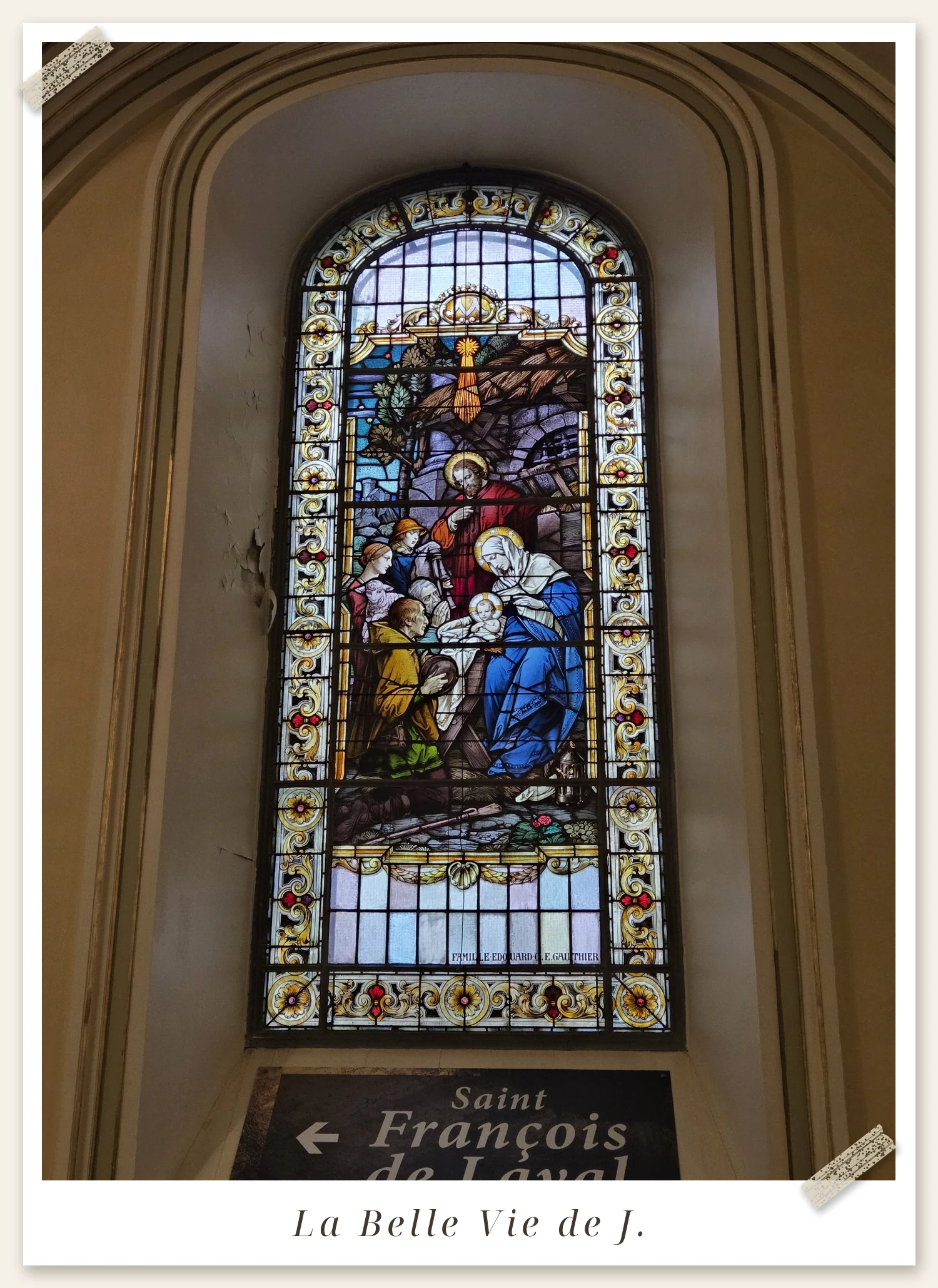
This site is where Québec began. Samuel de Champlain built a small chapel here in 1633, Notre-Dame de la Recouvrance; the first church rose in 1647, the parish was founded in 1664 — the first parish north of the Spanish colonies — and in 1674 it became a cathedral. Inside, the Recouvrance statue keeps that first chapel’s name — blessed on June 15, 1929, as its plaque records, with Champlain’s bust above it.
What I especially liked: the history is not left to a few wall panels. Next door, the Centre d’animation François-de-Laval is a dedicated space where the story of the cathedral and of Laval himself is laid out properly, in exhibits made for the purpose. If you enjoy knowing what you are looking at — and I do — give it twenty minutes before or after the church itself.
✅ Inside, in the Order I’d Walk It
- Admission is free — walk straight in (as of October 2026).
- Start at the Holy Door, pierced through the Sacred Heart Chapel on the north side of the church.
- Look up in the sanctuary: the gilded canopy, and the sanctuary lamp gifted by Louis XIV.
- Down the north aisle, find Laval’s funeral chapel — and his plain first wooden casket under glass beside it.
- Votive candles are $5 each, as the little sign on the candle stand says.
- Give the Centre d’animation François-de-Laval, right next door, its twenty minutes.
🗺︎ Good to Know Before You Go
Admission is free (as of October 2026) — remarkable, given what is inside. Two practical warnings from our own visit: the square in front of the cathedral is under construction right now (October 2026), so you reach the entrance by walking around the side; don’t mistake the works for a closure. And the cathedral has no parking of its own — you’ll use paid parking nearby in Old Québec, like everyone else. It stands at 16, rue de Buade, steps from the Château Frontenac; check the official website for hours before you go. 📍 View Notre-Dame de Québec on Google Maps
Course tip: Notre-Dame pairs perfectly with the drive east — Montmorency Falls, then Sainte-Anne-de-Beaupré, then the Charlevoix coast, where our trip continued to the Baie-Saint-Paul lookout, the hilltop cemetery in La Malbaie and the little wooden chapel in Tadoussac. One road, four centuries of Québec.
Old Québec has no shortage of postcard views, but this quiet golden room — part museum, part living parish, wholly free — is the stop that stayed with me longest. Whatever your faith, give it half an hour. It gives back more.
🚶 Old Québec on Foot: Everything Connects
The basilica is not an isolated stop: it stands at the heart of the quarter where the city began, and everything is walkable. A few minutes downhill, Place-Royale marks the spot where Samuel de Champlain built his Habitation in 1608 — the starting point of Québec City. On that same square stands Notre-Dame-des-Victoires, built in 1688 and considered the oldest stone church in Canada. Right beside it, Rue du Petit-Champlain lines its little shops at the foot of the cliff, and the funicular has climbed since 1879 toward the Dufferin Terrace and the Château Frontenac, which you can already see from the basilica forecourt. In other words, one short walking loop takes you through four centuries, without ever getting back in the car.
🕰️ How Much Time Should You Allow?
My benchmarks from our visit. The church alone, taking time to look — the canopy, the Laval chapel, the side chapels — takes a good half hour; add about twenty minutes for the Centre d’animation François-de-Laval, right next door, and count an hour to an hour and a half for the whole thing, unhurried. If a Mass is under way, the visit simply becomes more discreet: stay toward the back and keep your voice down. And as everywhere in Old Québec, morning is the quietest time of day.
Have a wonderful day 💛
— J.
🧮 Three and a Half Centuries, in Round Numbers
The dates scattered through this visit add up to a story of their own. Champlain’s little chapel rose in 1633; the parish was founded 31 years later, in 1664, and in 2014 that parish turned 350 — the anniversary the Holy Door, opened on December 8, 2013, was built to precede. The church burned in 1759 and again in 1922, two fires 163 years apart, and between them the Baillairgé family spent 36 years, from 1786 to 1822, carving the golden interior the second fire would take.
Laval’s own numbers are just as stark: born in 1623, died in 1708 — 85 years of life — and canonized in 2014, a full 306 years after his death. Even the famous count of doors is arithmetic: four in Rome, one in Ars, one in Santiago de Compostela, and this one makes seven. And the visit itself? Thirty minutes for the church plus twenty for the Centre next door is fifty minutes of looking that somehow fills an hour and a half. Some rooms are bigger than their measurements.
If you prefer reading in Korean, I’ve also published the full Korean edition of this review: 전 세계에 단 7개뿐인 성문이 퀘벡에 있어요 | 노트르담 대성당 성문과 황금 천개.
If you prefer reading in French, I’ve also published the full French edition of this review: La Porte sainte de Québec : la seule hors d’Europe, cachée dans le Vieux-Québec.
You May Also Like
- Sainte-Anne-de-Beaupré Basilica: The Québec Landmark Everyone Should See Once
- Belvédère Baie-Saint-Paul: The Free Route 138 Viewpoint You Shouldn’t Drive Past
- Fairmont Le Manoir Richelieu Review: The Hotel We Return to Every Year When the Cold Sets In
*Photos: all taken by J. at Notre-Dame de Québec, Quebec City.*
Get the Free Canada Savings Checklist
Join the newsletter — get the free PDF checklist and weekly Canada savings tips in your inbox.
Read Next

Some links in this post are referral or affiliate links. If you sign up or buy through them, I may receive a bonus or commission at no extra cost to you. It helps keep this blog running — thank you!